 Add to Chrome
 Add to Firefox
 Add to Edge
COLLAR: Cascaded Object-Level Latent Refinement for High-Fidelity Conditional Generation
May 31, 2026
Achieving high-fidelity object-level control in Diffusion Transformers remains a significant challenge despite the introduction of structural priors like depth and Canny maps. Current object-level conditional generation methods frequently suffer from visual artifacts and struggle to maintain precise control over objects within small localized regions. To address these limitations, we propose Cascaded Object-Level Latent Refinement (COLLAR), a training-free framework that progressively optimizes object-level features via the Field-of-View (FoV) expansion. First, we propose the Cross-Scale Semantic Alignment (CSSA) module to address spatial-semantic gaps by injecting object-level features into extended-FoV branches via attention mechanisms. To further optimize these features, the Cyclic Feature Injection (CFI) module introduces a reciprocal background feedback mechanism. It leverages a frequency-based adaptive strategy to selectively update the global backbone with context-aligned local information. Finally, the extended-FoV branch serves as a hub for feature optimization, ensuring that object-level features are integrated into the global generation process without compromising final image quality. Extensive experiments on the COCO-MIG and COCO-POS benchmarks demonstrate that our approach consistently outperforms state-of-the-art methods across semantic alignment, image quality, and spatial fidelity.

Multi-Scale Diffusion: Enhancing Spatial Layout in High-Resolution Panoramic Image Generation
Oct 24, 2024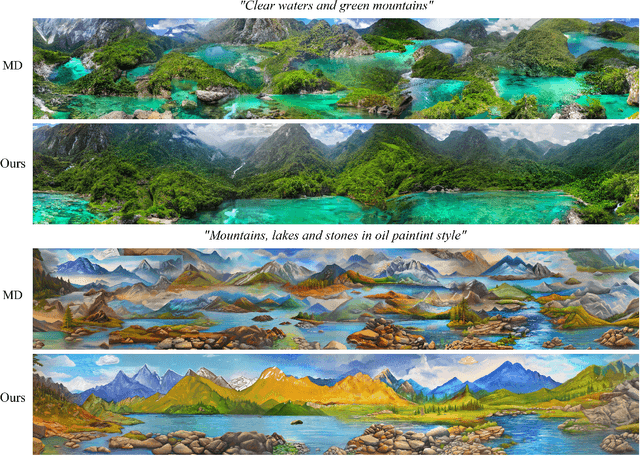
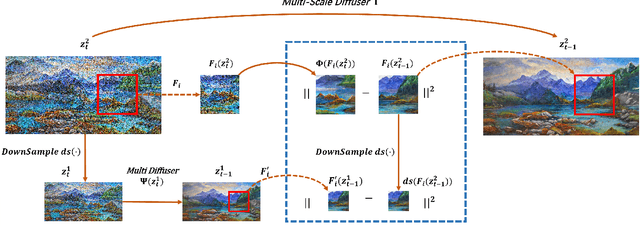
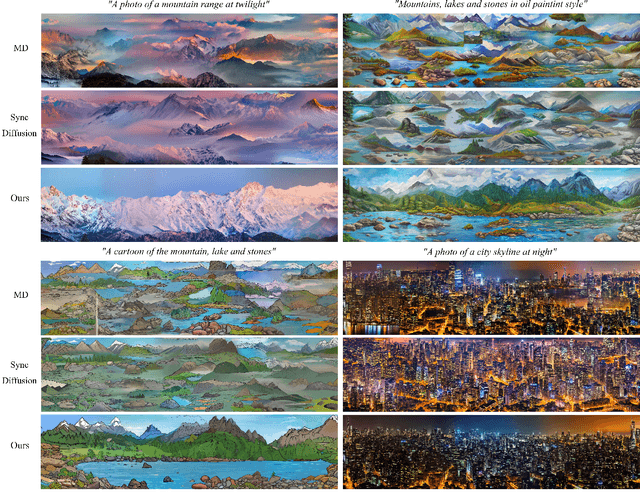
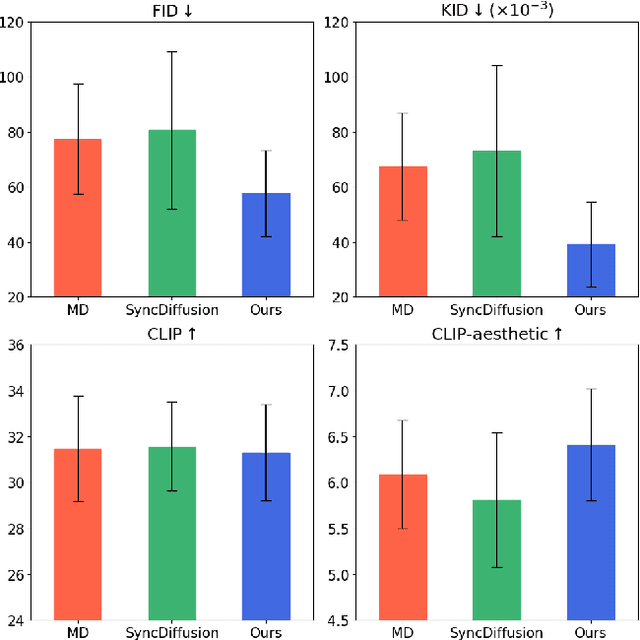
Diffusion models have recently gained recognition for generating diverse and high-quality content, especially in the domain of image synthesis. These models excel not only in creating fixed-size images but also in producing panoramic images. However, existing methods often struggle with spatial layout consistency when producing high-resolution panoramas, due to the lack of guidance of the global image layout. In this paper, we introduce the Multi-Scale Diffusion (MSD) framework, a plug-and-play module that extends the existing panoramic image generation framework to multiple resolution levels. By utilizing gradient descent techniques, our method effectively incorporates structural information from low-resolution images into high-resolution outputs. A comprehensive evaluation of the proposed method was conducted, comparing it with the prior works in qualitative and quantitative dimensions. The evaluation results demonstrate that our method significantly outperforms others in generating coherent high-resolution panoramas.