 Add to Chrome
 Add to Firefox
 Add to Edge
Revitalizing AR Process Simulation of Non-Gaussian Radar Clutter via Series-Based Analytic Continuation
Mar 05, 2026
Due to the conceptual simplicity, the linear filtering framework, notably the autoregressive (AR) process, has a long history in simulating clutter sequences with specified probability density functions (PDFs) and autocorrelation functions (ACFs). However, linear filtering inevitably distorts the input distribution, which may lead to inaccurate PDF reproduction or restrict applicability to very simple ACFs. To address these challenges, this study proposes a series-based analytic continuation strategy that revitalizes AR process clutter simulation by accurately precomputing the input pre-distortion required to compensate for AR filtering. First, the moments and cumulants of the AR input are derived based on the input-output relationship of the AR process, facilitating the moment and cumulant expansions of the Laplace transform (LT) and the logarithmic LT around zero, respectively. Second, both series expansions are analytically continued via the Padé approximation (PA) to recover the LT over the full complex plane. Notably, the PA-based continuation of the moment expansion, a conventional choice, can be highly inaccurate when the LT exhibits strong oscillations. By contrast, given the logarithmic LT generally has a simpler structure, the continuation of the cumulant expansion provides a more stable and accurate alternative. Third, the LT recovered from the cumulant expansion facilitates fast simulation of the AR input non-Gaussian white sequence via a random variable transformation method, thereby enabling an efficient AR process. Finally, simulations demonstrate that the proposed strategy enables accurate and fast simulation of non-Gaussian correlated clutter sequences.

Compound Gaussian Radar Clutter Model With Positive Tempered Alpha-Stable Texture
Dec 06, 2024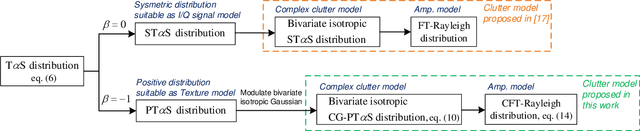
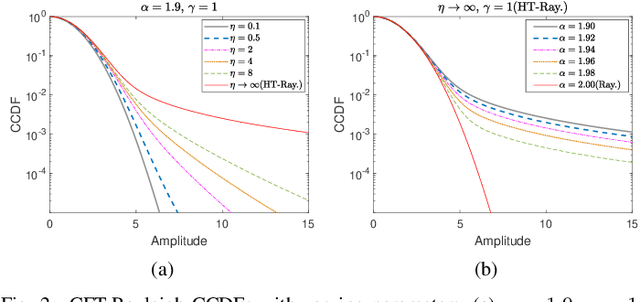
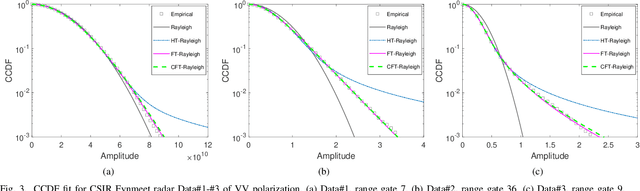
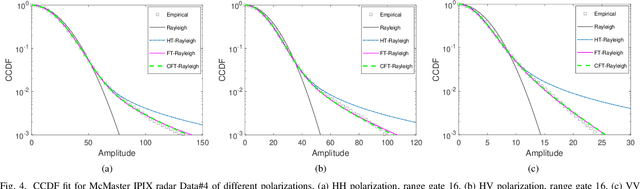
The compound Gaussian (CG) family of distributions has achieved great success in modeling sea clutter. This work develops a flexible-tailed CG model to improve generality in clutter modeling, by introducing the positive tempered $\alpha$-stable (PT$\alpha$S) distribution to model clutter texture. The PT$\alpha$S distribution exhibits widely tunable tails by tempering the heavy tails of the positive $\alpha$-stable (P$\alpha$S) distribution, thus providing greater flexibility in texture modeling. Specifically, we first develop a bivariate isotropic CG-PT$\alpha$S complex clutter model that is defined by an explicit characteristic function, based on which the corresponding amplitude model is derived. Then, we prove that the amplitude model can be expressed as a scale mixture of Rayleighs, just as the successful compound K and Pareto models. Furthermore, a characteristic function-based method is developed to estimate the parameters of the amplitude model. Finally, real-world sea clutter data analysis indicates the amplitude model's flexibility in modeling clutter data with various tail behaviors.