 Add to Chrome
 Add to Firefox
 Add to Edge
IGMiRAG: Intuition-Guided Retrieval-Augmented Generation with Adaptive Mining of In-Depth Memory
Feb 07, 2026
Retrieval-augmented generation (RAG) equips large language models (LLMs) with reliable knowledge memory. To strengthen cross-text associations, recent research integrates graphs and hypergraphs into RAG to capture pairwise and multi-entity relations as structured links. However, their misaligned memory organization necessitates costly, disjointed retrieval. To address these limitations, we propose IGMiRAG, a framework inspired by human intuition-guided reasoning. It constructs a hierarchical heterogeneous hypergraph to align multi-granular knowledge, incorporating deductive pathways to simulate realistic memory structures. During querying, IGMiRAG distills intuitive strategies via a question parser to control mining depth and memory window, and activates instantaneous memories as anchors using dual-focus retrieval. Mirroring human intuition, the framework guides retrieval resource allocation dynamically. Furthermore, we design a bidirectional diffusion algorithm that navigates deductive paths to mine in-depth memories, emulating human reasoning processes. Extensive evaluations indicate IGMiRAG outperforms the state-of-the-art baseline by 4.8% EM and 5.0% F1 overall, with token costs adapting to task complexity (average 6.3k+, minimum 3.0k+). This work presents a cost-effective RAG paradigm that improves both efficiency and effectiveness.

Cog-RAG: Cognitive-Inspired Dual-Hypergraph with Theme Alignment Retrieval-Augmented Generation
Nov 17, 2025Retrieval-Augmented Generation (RAG) enhances the response quality and domain-specific performance of large language models (LLMs) by incorporating external knowledge to combat hallucinations. In recent research, graph structures have been integrated into RAG to enhance the capture of semantic relations between entities. However, it primarily focuses on low-order pairwise entity relations, limiting the high-order associations among multiple entities. Hypergraph-enhanced approaches address this limitation by modeling multi-entity interactions via hyperedges, but they are typically constrained to inter-chunk entity-level representations, overlooking the global thematic organization and alignment across chunks. Drawing inspiration from the top-down cognitive process of human reasoning, we propose a theme-aligned dual-hypergraph RAG framework (Cog-RAG) that uses a theme hypergraph to capture inter-chunk thematic structure and an entity hypergraph to model high-order semantic relations. Furthermore, we design a cognitive-inspired two-stage retrieval strategy that first activates query-relevant thematic content from the theme hypergraph, and then guides fine-grained recall and diffusion in the entity hypergraph, achieving semantic alignment and consistent generation from global themes to local details. Our extensive experiments demonstrate that Cog-RAG significantly outperforms existing state-of-the-art baseline approaches.
* Accepted by AAAI 2026 main conference
Beyond Graphs: Can Large Language Models Comprehend Hypergraphs?
Oct 14, 2024


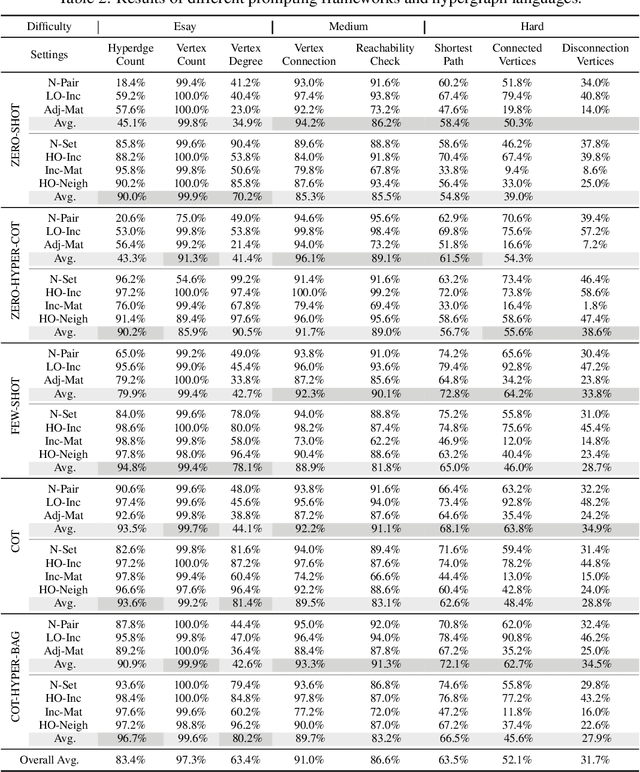
Existing benchmarks like NLGraph and GraphQA evaluate LLMs on graphs by focusing mainly on pairwise relationships, overlooking the high-order correlations found in real-world data. Hypergraphs, which can model complex beyond-pairwise relationships, offer a more robust framework but are still underexplored in the context of LLMs. To address this gap, we introduce LLM4Hypergraph, the first comprehensive benchmark comprising 21,500 problems across eight low-order, five high-order, and two isomorphism tasks, utilizing both synthetic and real-world hypergraphs from citation networks and protein structures. We evaluate six prominent LLMs, including GPT-4o, demonstrating our benchmark's effectiveness in identifying model strengths and weaknesses. Our specialized prompting framework incorporates seven hypergraph languages and introduces two novel techniques, Hyper-BAG and Hyper-COT, which enhance high-order reasoning and achieve an average 4% (up to 9%) performance improvement on structure classification tasks. This work establishes a foundational testbed for integrating hypergraph computational capabilities into LLMs, advancing their comprehension.