 Add to Chrome
 Add to Firefox
 Add to Edge
Scalable Dynamic Tactile Sensing Enabled by Passive and Flexible Acoustic Waveguides
Jun 11, 2026
Artificial dynamic tactile sensing requires sensitivity, robustness, and compliance, yet existing technologies face trade-offs when scaling to large-area arrays, compounded by wiring complexity and cost. Here, we report a passive distributed paradigm using deep sub-wavelength acoustic waveguides that decouples performance from structural flexibility. Elastic-membrane-capped Helmholtz resonators interconnected by spring-reinforced microtubes form an enclosed network with invariant acoustic transmission under macroscopic bending. By sparsely embedding microphones, the system achieves real-time localization (4 mm highest spatial resolution; >99% accuracy in a 4 microphones 64-node sensing array) and waveform reconstruction of low-frequency signals (<100 Hz). Fast Continuous Wavelet Transform and a lightweight neural network enable inference within 5.5 ms. We demonstrate conformable prototypes-fingertip arrays, a tactile glove, and large-area skins-detecting stimuli from single-hair contact to 5-mg particle impacts, arterial pulse waves, feather touches, and finger contact. This establishes a scalable, flexible, low-cost paradigm for next-generation human-machine interfaces.

Asymptotically Optimal Lazy Lifelong Sampling-based Algorithm for Efficient Motion Planning in Dynamic Environments
Sep 10, 2024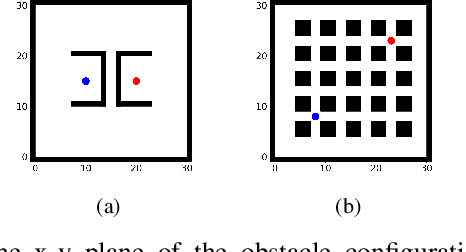

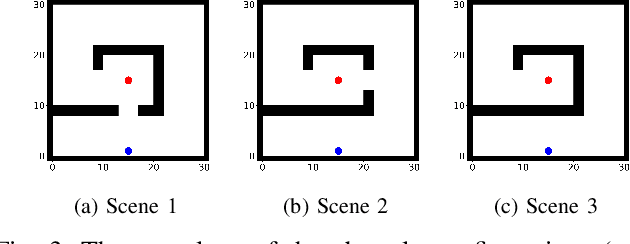
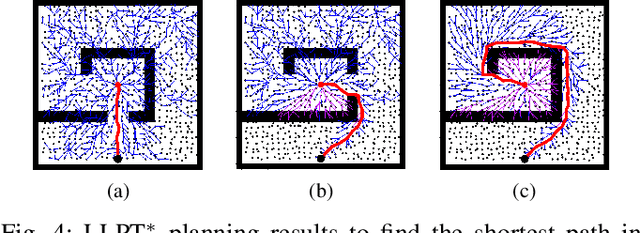
The paper introduces an asymptotically optimal lifelong sampling-based path planning algorithm that combines the merits of lifelong planning algorithms and lazy search algorithms for rapid replanning in dynamic environments where edge evaluation is expensive. By evaluating only sub-path candidates for the optimal solution, the algorithm saves considerable evaluation time and thereby reduces the overall planning cost. It employs a novel informed rewiring cascade to efficiently repair the search tree when the underlying search graph changes. Simulation results demonstrate that the algorithm outperforms various state-of-the-art sampling-based planners in addressing both static and dynamic motion planning problems.