 Add to Chrome
 Add to Firefox
 Add to Edge
Spectral Geometry and Bosonic-Bloch Probes: Explorations in Quantum Learning
Jun 30, 2026
This paper studies how spectral geometry emerges in quantum learning models and how it can be diagnosed with physically grounded probes. In graph-regularized quantum networks, training reorganizes the output similarity graph, increases the effective spectral dimension Delta S = +0.23, and reshapes the Laplacian spectrum. Edge-resolved two-boson interference directly probes this restructuring: the bosonic enhancement Delta P_uv correlates with the Fiedler edge split |Delta v_2| (r = -0.50), linking learned spectral partitions to interference signatures. A phase diagram shows a nonmonotonic dependence of performance on coupling strength gamma and noise delta, with graph regularization improving fidelity only in a restricted regime; hardware experiments confirm the predicted interference behavior within shot-noise uncertainty. We also analyze a hybrid quantum autoencoder and introduce Bloch-space drift as a geometric diagnostic of its latent representation. With an unsupervised benign-data threshold, the model achieves high ranking performance (ROC-AUC about 0.99) and negligible false-negative rates. Absolute Bloch drift strongly discriminates anomalies (ROC-AUC at least about 0.9), while consecutive drift is near random (ROC-AUC about 0.5), showing that detection arises from persistent state-space displacement rather than local fluctuations. Through the geometry of reduced single-qubit states and associated quantum Fisher information, these results show that learning-induced spectral organization appears as measurable quantum-state structure, establishing a unified spectral-geometric framework for diagnosing quantum learning systems with bosonic and Bloch probes.

Compression-Driven Anomaly Detection in Brain MRI Using an Interpretable Quantum Autoencoder
Jun 25, 2026We study a quantum autoencoder (QAE) for compression-driven anomaly detection in brain MRI data. The approach leverages angle encoding to map image patches into quantum states, followed by a variational encoder-decoder architecture trained to discard information via auxiliary trash qubits. Anomaly scores reflect the degree to which inputs resist compression relative to normal data, with higher scores corresponding to deviations from the learned normal manifold. Evaluated on publicly available brain MRI DICOM datasets, the method achieves a slice-level ROC-AUC of approximately 0.95 and a patch-level ROC-AUC of approximately 0.813, outperforming classical autoencoder and PCA baselines. Analysis of the learned parameters reveals a pronounced encoder-decoder asymmetry, where effective anomaly detection arises from structured information compression within the encoder rather than increased parameter magnitude or decoder expressivity. This results in a controlled compression-reconstruction trade-off with a clear operating regime that supports principled threshold selection. Qualitative evaluation further shows that the QAE produces spatially localized anomaly heatmaps aligned with tumorous regions. The results, supported by promising baseline performances, demonstrate that quantum autoencoders provide an interpretable and controllable mechanism for anomaly detection based on incompressibility with respect to a learned latent representation. This work highlights the potential of quantum autoencoders as a principled tool for studying compression dynamics in quantum machine learning, with promising implications for decision support in medical imaging workflows.
Quantum Generative Diffusion Model for Real-World Time Series
Jun 25, 2026Generative models have achieved remarkable success in data synthesis, though recent advances driven by increasing model scale have introduced challenges in computational cost and efficiency. Quantum machine learning offers a promising alternative, representing complex data distributions using compact, highly expressive models. Here, we propose QDiffusion-TS, the first quantum generative diffusion model for time series synthesis, and validate it on the IQM quantum processor. The framework extends a classical diffusion architecture by replacing feed-forward components within the denoising transformer with quantum neural networks, yielding a hybrid quantum transformer that reduces the number of trainable parameters in each replaced component by nearly three orders of magnitude. Evaluated on financial time series from Apple and Amazon, the model generates synthetic data that more accurately reproduces the real distributions, reducing Wasserstein distance by approximately 44% relative to its classical counterpart across both datasets. In a downstream forecasting task, augmentation with the generated data improves predictive performance by up to 71% in RMSE over a baseline trained solely on real data. These results show that quantum enhanced architectures can consistently match and frequently surpass classical performance with substantially fewer parameters, establishing a practical framework towards more efficient and scalable data-driven generative modelling.
A Multi-modal Machine Learning Approach and Toolkit to Automate Recognition of Early Stages of Dementia among British Sign Language Users
Oct 01, 2020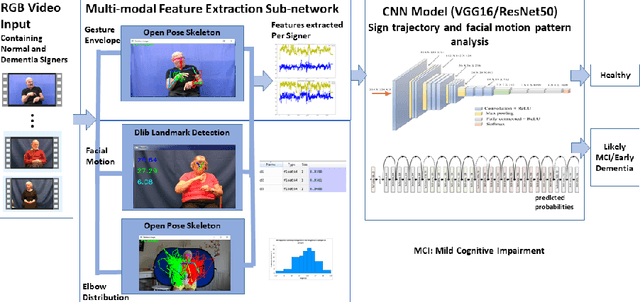
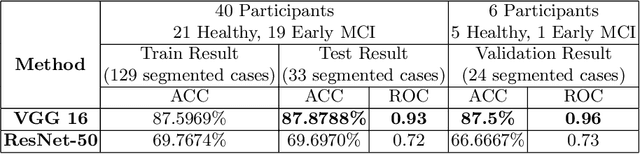
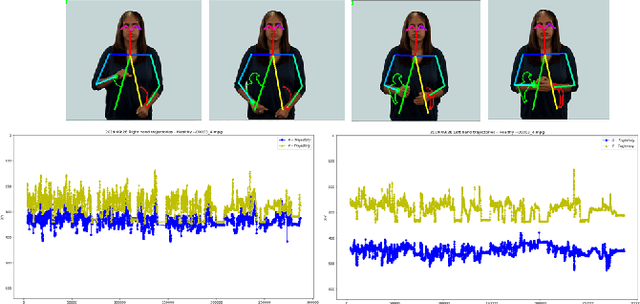
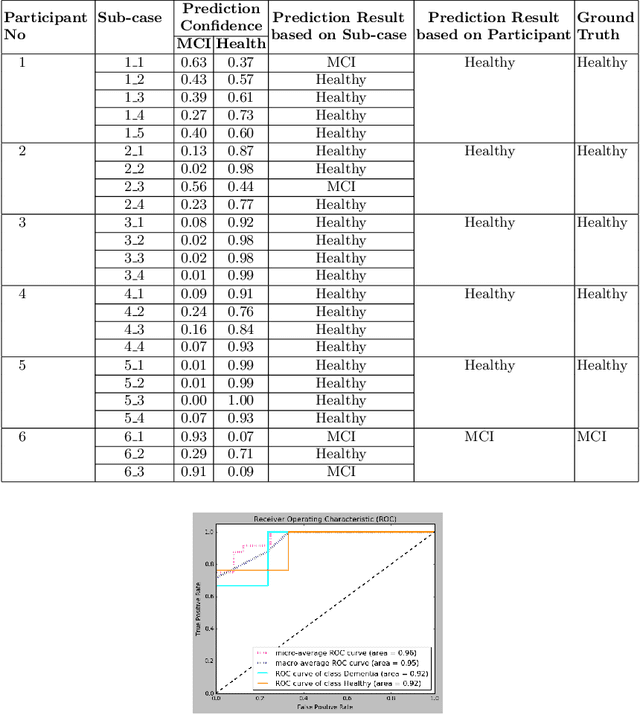
The ageing population trend is correlated with an increased prevalence of acquired cognitive impairments such as dementia. Although there is no cure for dementia, a timely diagnosis helps in obtaining necessary support and appropriate medication. Researchers are working urgently to develop effective technological tools that can help doctors undertake early identification of cognitive disorder. In particular, screening for dementia in ageing Deaf signers of British Sign Language (BSL) poses additional challenges as the diagnostic process is bound up with conditions such as quality and availability of interpreters, as well as appropriate questionnaires and cognitive tests. On the other hand, deep learning based approaches for image and video analysis and understanding are promising, particularly the adoption of Convolutional Neural Network (CNN), which require large amounts of training data. In this paper, however, we demonstrate novelty in the following way: a) a multi-modal machine learning based automatic recognition toolkit for early stages of dementia among BSL users in that features from several parts of the body contributing to the sign envelope, e.g., hand-arm movements and facial expressions, are combined, b) universality in that it is possible to apply our technique to users of any sign language, since it is language independent, c) given the trade-off between complexity and accuracy of machine learning (ML) prediction models as well as the limited amount of training and testing data being available, we show that our approach is not over-fitted and has the potential to scale up.