 Add to Chrome
 Add to Firefox
 Add to Edge
Spectral Geometry and Bosonic-Bloch Probes: Explorations in Quantum Learning
Jun 30, 2026
This paper studies how spectral geometry emerges in quantum learning models and how it can be diagnosed with physically grounded probes. In graph-regularized quantum networks, training reorganizes the output similarity graph, increases the effective spectral dimension Delta S = +0.23, and reshapes the Laplacian spectrum. Edge-resolved two-boson interference directly probes this restructuring: the bosonic enhancement Delta P_uv correlates with the Fiedler edge split |Delta v_2| (r = -0.50), linking learned spectral partitions to interference signatures. A phase diagram shows a nonmonotonic dependence of performance on coupling strength gamma and noise delta, with graph regularization improving fidelity only in a restricted regime; hardware experiments confirm the predicted interference behavior within shot-noise uncertainty. We also analyze a hybrid quantum autoencoder and introduce Bloch-space drift as a geometric diagnostic of its latent representation. With an unsupervised benign-data threshold, the model achieves high ranking performance (ROC-AUC about 0.99) and negligible false-negative rates. Absolute Bloch drift strongly discriminates anomalies (ROC-AUC at least about 0.9), while consecutive drift is near random (ROC-AUC about 0.5), showing that detection arises from persistent state-space displacement rather than local fluctuations. Through the geometry of reduced single-qubit states and associated quantum Fisher information, these results show that learning-induced spectral organization appears as measurable quantum-state structure, establishing a unified spectral-geometric framework for diagnosing quantum learning systems with bosonic and Bloch probes.

Compression-Driven Anomaly Detection in Brain MRI Using an Interpretable Quantum Autoencoder
Jun 25, 2026We study a quantum autoencoder (QAE) for compression-driven anomaly detection in brain MRI data. The approach leverages angle encoding to map image patches into quantum states, followed by a variational encoder-decoder architecture trained to discard information via auxiliary trash qubits. Anomaly scores reflect the degree to which inputs resist compression relative to normal data, with higher scores corresponding to deviations from the learned normal manifold. Evaluated on publicly available brain MRI DICOM datasets, the method achieves a slice-level ROC-AUC of approximately 0.95 and a patch-level ROC-AUC of approximately 0.813, outperforming classical autoencoder and PCA baselines. Analysis of the learned parameters reveals a pronounced encoder-decoder asymmetry, where effective anomaly detection arises from structured information compression within the encoder rather than increased parameter magnitude or decoder expressivity. This results in a controlled compression-reconstruction trade-off with a clear operating regime that supports principled threshold selection. Qualitative evaluation further shows that the QAE produces spatially localized anomaly heatmaps aligned with tumorous regions. The results, supported by promising baseline performances, demonstrate that quantum autoencoders provide an interpretable and controllable mechanism for anomaly detection based on incompressibility with respect to a learned latent representation. This work highlights the potential of quantum autoencoders as a principled tool for studying compression dynamics in quantum machine learning, with promising implications for decision support in medical imaging workflows.
Implementing Quantum Generative Adversarial Network (qGAN) and QCBM in Finance
Aug 15, 2023Quantum machine learning (QML) is a cross-disciplinary subject made up of two of the most exciting research areas: quantum computing and classical machine learning (ML), with ML and artificial intelligence (AI) being projected as the first fields that will be impacted by the rise of quantum machines. Quantum computers are being used today in drug discovery, material & molecular modelling and finance. In this work, we discuss some upcoming active new research areas in application of quantum machine learning (QML) in finance. We discuss certain QML models that has become areas of active interest in the financial world for various applications. We use real world financial dataset and compare models such as qGAN (quantum generative adversarial networks) and QCBM (quantum circuit Born machine) among others, using simulated environments. For the qGAN, we define quantum circuits for discriminators and generators and show promises of future quantum advantage via QML in finance.
Classification of NEQR Processed Classical Images using Quantum Neural Networks (QNN)
Mar 29, 2022
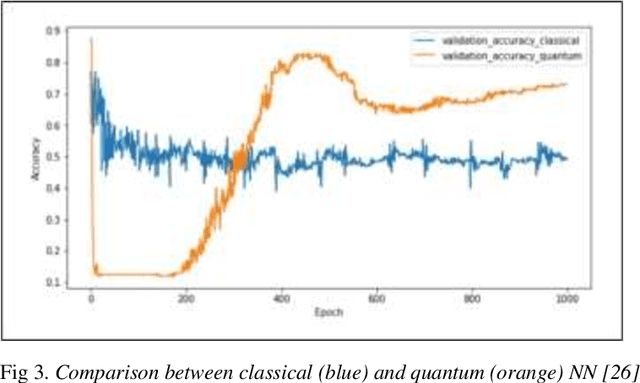
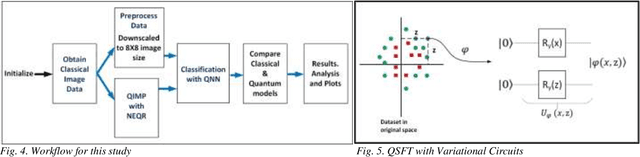
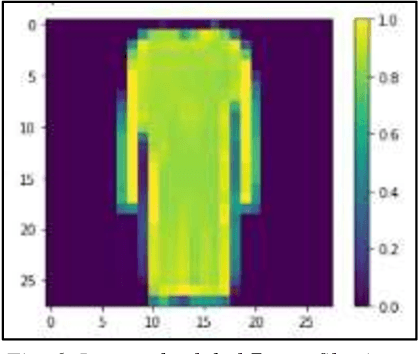
A quantum neural network (QNN) is interpreted today as any quantum circuit with trainable continuous parameters. This work builds on previous works by the authors and addresses QNN for image classification with Novel Enhanced Quantum Representation of (NEQR) processed classical data where Principal component analysis (PCA) and Projected Quantum Kernel features (PQK) were investigated previously by the authors as a path to quantum advantage for the same classical dataset. For each of these cases the Fashion-MNIST dataset was downscaled using PCA to convert into quantum data where the classical NN easily outperformed the QNN. However, we demonstrated quantum advantage by using PQK where quantum models achieved more than ~90% accuracy surpassing their classical counterpart on the same training dataset as in the first case. In this current work, we use the same dataset fed into a QNN and compare that with performance of a classical NN model. We built an NEQR model circuit to pre-process the same data and feed the images into the QNN. Our results showed marginal improvements (only about ~5.0%) where the QNN performance with NEQR exceeded the performance of QNN without NEQR. We conclude that given the computational cost and the massive circuit depth associated with running NEQR, the advantage offered by this specific Quantum Image Processing (QIMP) algorithm is questionable at least for classical image dataset. No actual quantum computing hardware platform exists today that can support the circuit depth needed to run NEQR even for the reduced image sizes of our toy classical dataset.