 Add to Chrome
 Add to Firefox
 Add to Edge
Spectral Geometry and Bosonic-Bloch Probes: Explorations in Quantum Learning
Jun 30, 2026
This paper studies how spectral geometry emerges in quantum learning models and how it can be diagnosed with physically grounded probes. In graph-regularized quantum networks, training reorganizes the output similarity graph, increases the effective spectral dimension Delta S = +0.23, and reshapes the Laplacian spectrum. Edge-resolved two-boson interference directly probes this restructuring: the bosonic enhancement Delta P_uv correlates with the Fiedler edge split |Delta v_2| (r = -0.50), linking learned spectral partitions to interference signatures. A phase diagram shows a nonmonotonic dependence of performance on coupling strength gamma and noise delta, with graph regularization improving fidelity only in a restricted regime; hardware experiments confirm the predicted interference behavior within shot-noise uncertainty. We also analyze a hybrid quantum autoencoder and introduce Bloch-space drift as a geometric diagnostic of its latent representation. With an unsupervised benign-data threshold, the model achieves high ranking performance (ROC-AUC about 0.99) and negligible false-negative rates. Absolute Bloch drift strongly discriminates anomalies (ROC-AUC at least about 0.9), while consecutive drift is near random (ROC-AUC about 0.5), showing that detection arises from persistent state-space displacement rather than local fluctuations. Through the geometry of reduced single-qubit states and associated quantum Fisher information, these results show that learning-induced spectral organization appears as measurable quantum-state structure, establishing a unified spectral-geometric framework for diagnosing quantum learning systems with bosonic and Bloch probes.

Quantum Generative Diffusion Model for Real-World Time Series
Jun 25, 2026Generative models have achieved remarkable success in data synthesis, though recent advances driven by increasing model scale have introduced challenges in computational cost and efficiency. Quantum machine learning offers a promising alternative, representing complex data distributions using compact, highly expressive models. Here, we propose QDiffusion-TS, the first quantum generative diffusion model for time series synthesis, and validate it on the IQM quantum processor. The framework extends a classical diffusion architecture by replacing feed-forward components within the denoising transformer with quantum neural networks, yielding a hybrid quantum transformer that reduces the number of trainable parameters in each replaced component by nearly three orders of magnitude. Evaluated on financial time series from Apple and Amazon, the model generates synthetic data that more accurately reproduces the real distributions, reducing Wasserstein distance by approximately 44% relative to its classical counterpart across both datasets. In a downstream forecasting task, augmentation with the generated data improves predictive performance by up to 71% in RMSE over a baseline trained solely on real data. These results show that quantum enhanced architectures can consistently match and frequently surpass classical performance with substantially fewer parameters, establishing a practical framework towards more efficient and scalable data-driven generative modelling.
Compression-Driven Anomaly Detection in Brain MRI Using an Interpretable Quantum Autoencoder
Jun 25, 2026We study a quantum autoencoder (QAE) for compression-driven anomaly detection in brain MRI data. The approach leverages angle encoding to map image patches into quantum states, followed by a variational encoder-decoder architecture trained to discard information via auxiliary trash qubits. Anomaly scores reflect the degree to which inputs resist compression relative to normal data, with higher scores corresponding to deviations from the learned normal manifold. Evaluated on publicly available brain MRI DICOM datasets, the method achieves a slice-level ROC-AUC of approximately 0.95 and a patch-level ROC-AUC of approximately 0.813, outperforming classical autoencoder and PCA baselines. Analysis of the learned parameters reveals a pronounced encoder-decoder asymmetry, where effective anomaly detection arises from structured information compression within the encoder rather than increased parameter magnitude or decoder expressivity. This results in a controlled compression-reconstruction trade-off with a clear operating regime that supports principled threshold selection. Qualitative evaluation further shows that the QAE produces spatially localized anomaly heatmaps aligned with tumorous regions. The results, supported by promising baseline performances, demonstrate that quantum autoencoders provide an interpretable and controllable mechanism for anomaly detection based on incompressibility with respect to a learned latent representation. This work highlights the potential of quantum autoencoders as a principled tool for studying compression dynamics in quantum machine learning, with promising implications for decision support in medical imaging workflows.
LLM-Conditioned Synthesis of Pathological Gaits via Structured Gait-Language Representations
Jun 04, 2026Pathological gait datasets remain scarce due to privacy, recruitment, cost, and movement variability. Our work presents a multimodal LLM-guided framework for pathology-aware 3D gait data synthesis from structured textual descriptions. The proposed method generates fixed-length synthetic skeleton-based gait sequences for pathological gait classification tasks. The framework combines motion tokenisation, pathology-aware language conditioning, LLM-based semantic augmentation, and language-to-gait generation. A key contribution is the proposed pathological tokeniser, which is designed to preserve pathology-specific motion characteristics during discrete representation learning. Experiments suggest that the proposed synthetic sequences improve downstream classification for recurrent classifiers when combined with real data. The best result is obtained using a GRU classifier trained with real and synthetic samples, achieving 92.77\% accuracy under a leave-one-subject-out protocol.
PGcGAN: Pathological Gait-Conditioned GAN for Human Gait Synthesis
Mar 15, 2026Pathological gait analysis is constrained by limited and variable clinical datasets, which restrict the modeling of diverse gait impairments. To address this challenge, we propose a Pathological Gait-conditioned Generative Adversarial Network (PGcGAN) that synthesises pathology-specific gait sequences directly from observed 3D pose keypoint trajectories data. The framework incorporates one-hot encoded pathology labels within both the generator and discriminator, enabling controlled synthesis across six gait categories. The generator adopts a conditional autoencoder architecture trained with adversarial and reconstruction objectives to preserve structural and temporal gait characteristics. Experiments on the Pathological Gait Dataset demonstrate strong alignment between real and synthetic sequences through PCA and t-SNE analyses, visual kinematic inspection, and downstream classification tasks. Augmenting real data with synthetic sequences improved pathological gait recognition across GRU, LSTM, and CNN models, indicating that pathology-conditioned gait synthesis can effectively support data augmentation in pathological gait analysis.
Dynamic Distinction Learning: Adaptive Pseudo Anomalies for Video Anomaly Detection
Apr 07, 2024We introduce Dynamic Distinction Learning (DDL) for Video Anomaly Detection, a novel video anomaly detection methodology that combines pseudo-anomalies, dynamic anomaly weighting, and a distinction loss function to improve detection accuracy. By training on pseudo-anomalies, our approach adapts to the variability of normal and anomalous behaviors without fixed anomaly thresholds. Our model showcases superior performance on the Ped2, Avenue and ShanghaiTech datasets, where individual models are tailored for each scene. These achievements highlight DDL's effectiveness in advancing anomaly detection, offering a scalable and adaptable solution for video surveillance challenges.
Asynchronous Bioplausible Neuron for Spiking Neural Networks for Event-Based Vision
Nov 20, 2023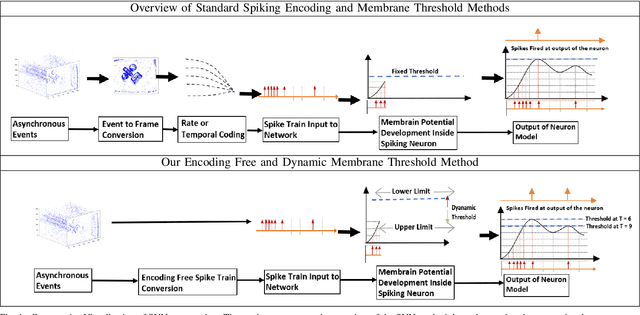
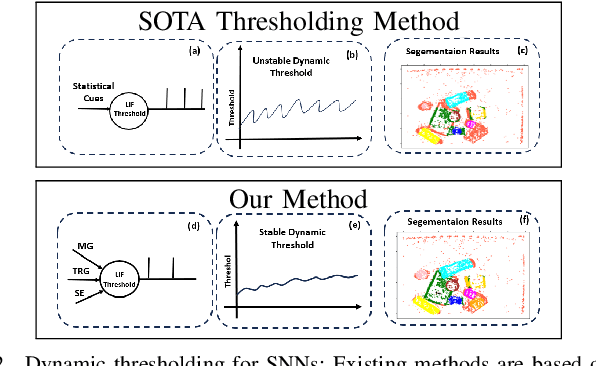
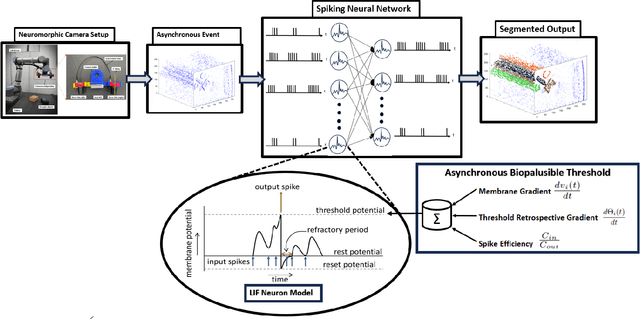
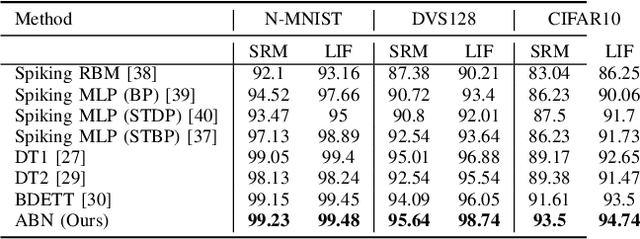
Spiking Neural Networks (SNNs) offer a biologically inspired approach to computer vision that can lead to more efficient processing of visual data with reduced energy consumption. However, maintaining homeostasis within these networks is challenging, as it requires continuous adjustment of neural responses to preserve equilibrium and optimal processing efficiency amidst diverse and often unpredictable input signals. In response to these challenges, we propose the Asynchronous Bioplausible Neuron (ABN), a dynamic spike firing mechanism to auto-adjust the variations in the input signal. Comprehensive evaluation across various datasets demonstrates ABN's enhanced performance in image classification and segmentation, maintenance of neural equilibrium, and energy efficiency.
Gait Data Augmentation using Physics-Based Biomechanical Simulation
Jul 21, 2023This paper focuses on addressing the problem of data scarcity for gait analysis. Standard augmentation methods may produce gait sequences that are not consistent with the biomechanical constraints of human walking. To address this issue, we propose a novel framework for gait data augmentation by using OpenSIM, a physics-based simulator, to synthesize biomechanically plausible walking sequences. The proposed approach is validated by augmenting the WBDS and CASIA-B datasets and then training gait-based classifiers for 3D gender gait classification and 2D gait person identification respectively. Experimental results indicate that our augmentation approach can improve the performance of model-based gait classifiers and deliver state-of-the-art results for gait-based person identification with an accuracy of up to 96.11% on the CASIA-B dataset.
Asynchronous Events-based Panoptic Segmentation using Graph Mixer Neural Network
May 05, 2023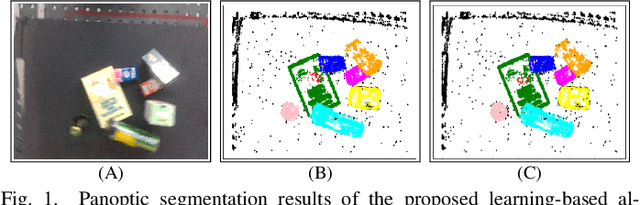
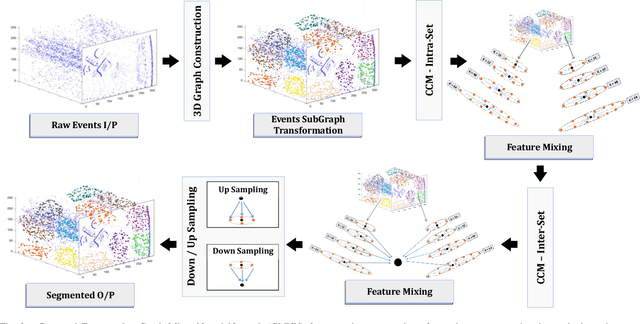
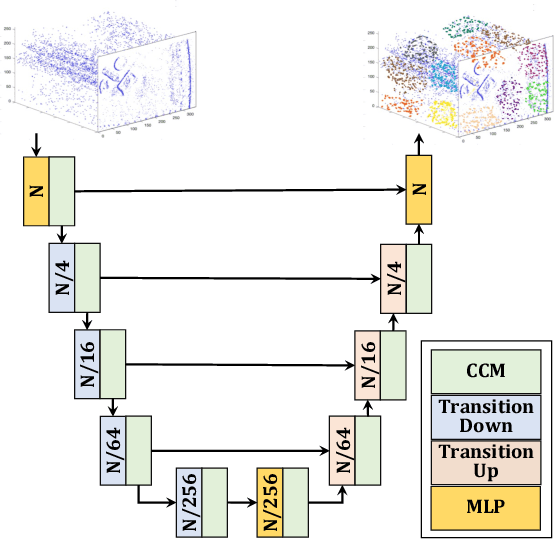
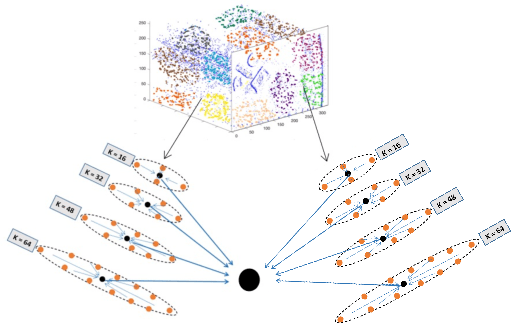
In the context of robotic grasping, object segmentation encounters several difficulties when faced with dynamic conditions such as real-time operation, occlusion, low lighting, motion blur, and object size variability. In response to these challenges, we propose the Graph Mixer Neural Network that includes a novel collaborative contextual mixing layer, applied to 3D event graphs formed on asynchronous events. The proposed layer is designed to spread spatiotemporal correlation within an event graph at four nearest neighbor levels parallelly. We evaluate the effectiveness of our proposed method on the Event-based Segmentation (ESD) Dataset, which includes five unique image degradation challenges, including occlusion, blur, brightness, trajectory, scale variance, and segmentation of known and unknown objects. The results show that our proposed approach outperforms state-of-the-art methods in terms of mean intersection over the union and pixel accuracy. Code available at: https://github.com/sanket0707/GNN-Mixer.git
Bimodal SegNet: Instance Segmentation Fusing Events and RGB Frames for Robotic Grasping
Mar 20, 2023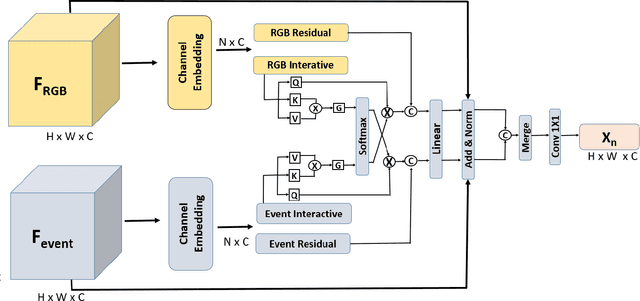
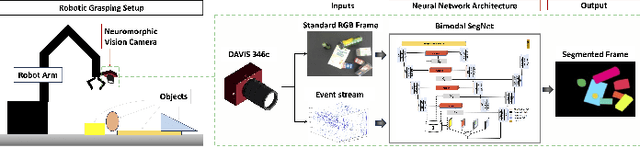
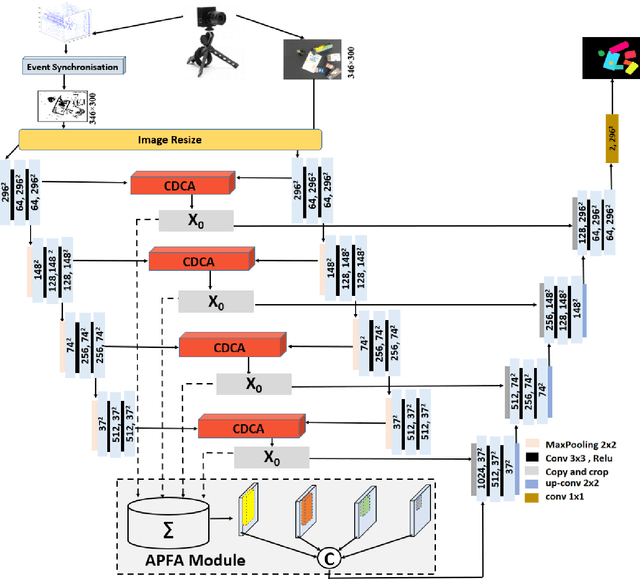

Object segmentation for robotic grasping under dynamic conditions often faces challenges such as occlusion, low light conditions, motion blur and object size variance. To address these challenges, we propose a Deep Learning network that fuses two types of visual signals, event-based data and RGB frame data. The proposed Bimodal SegNet network has two distinct encoders, one for each signal input and a spatial pyramidal pooling with atrous convolutions. Encoders capture rich contextual information by pooling the concatenated features at different resolutions while the decoder obtains sharp object boundaries. The evaluation of the proposed method undertakes five unique image degradation challenges including occlusion, blur, brightness, trajectory and scale variance on the Event-based Segmentation (ESD) Dataset. The evaluation results show a 6-10\% segmentation accuracy improvement over state-of-the-art methods in terms of mean intersection over the union and pixel accuracy. The model code is available at https://github.com/sanket0707/Bimodal-SegNet.git