 Add to Chrome
 Add to Firefox
 Add to Edge
TouchGuide: Inference-Time Steering of Visuomotor Policies via Touch Guidance
Jan 28, 2026
Fine-grained and contact-rich manipulation remain challenging for robots, largely due to the underutilization of tactile feedback. To address this, we introduce TouchGuide, a novel cross-policy visuo-tactile fusion paradigm that fuses modalities within a low-dimensional action space. Specifically, TouchGuide operates in two stages to guide a pre-trained diffusion or flow-matching visuomotor policy at inference time. First, the policy produces a coarse, visually-plausible action using only visual inputs during early sampling. Second, a task-specific Contact Physical Model (CPM) provides tactile guidance to steer and refine the action, ensuring it aligns with realistic physical contact conditions. Trained through contrastive learning on limited expert demonstrations, the CPM provides a tactile-informed feasibility score to steer the sampling process toward refined actions that satisfy physical contact constraints. Furthermore, to facilitate TouchGuide training with high-quality and cost-effective data, we introduce TacUMI, a data collection system. TacUMI achieves a favorable trade-off between precision and affordability; by leveraging rigid fingertips, it obtains direct tactile feedback, thereby enabling the collection of reliable tactile data. Extensive experiments on five challenging contact-rich tasks, such as shoe lacing and chip handover, show that TouchGuide consistently and significantly outperforms state-of-the-art visuo-tactile policies.

PointCAT: Cross-Attention Transformer for point cloud
Apr 06, 2023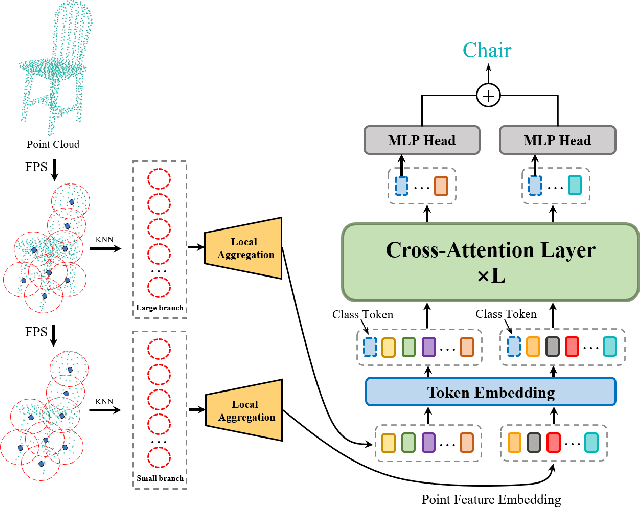
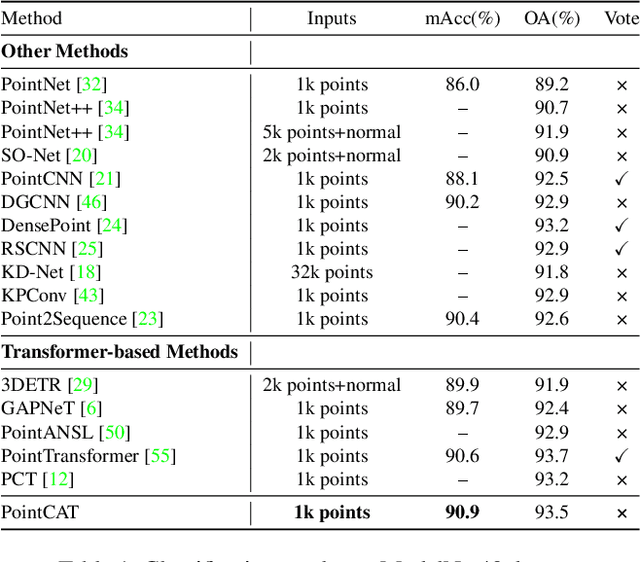
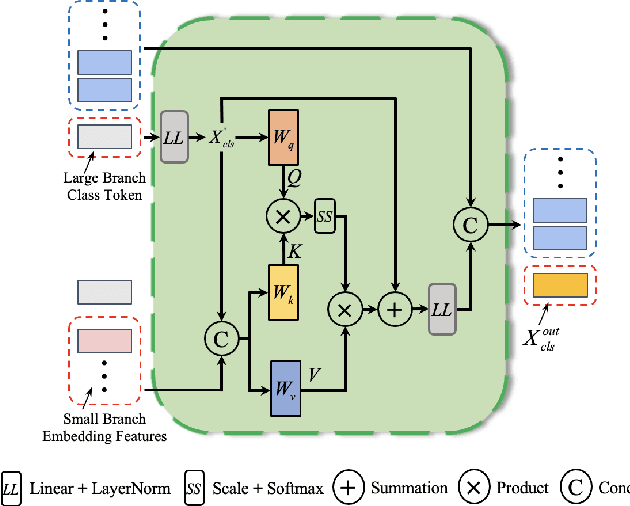
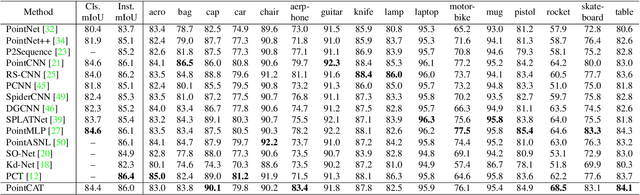
Transformer-based models have significantly advanced natural language processing and computer vision in recent years. However, due to the irregular and disordered structure of point cloud data, transformer-based models for 3D deep learning are still in their infancy compared to other methods. In this paper we present Point Cross-Attention Transformer (PointCAT), a novel end-to-end network architecture using cross-attentions mechanism for point cloud representing. Our approach combines multi-scale features via two seprate cross-attention transformer branches. To reduce the computational increase brought by multi-branch structure, we further introduce an efficient model for shape classification, which only process single class token of one branch as a query to calculate attention map with the other. Extensive experiments demonstrate that our method outperforms or achieves comparable performance to several approaches in shape classification, part segmentation and semantic segmentation tasks.