 Add to Chrome
 Add to Firefox
 Add to Edge
GRRE: Leveraging G-Channel Removed Reconstruction Error for Robust Detection of AI-Generated Images
Jan 06, 2026
The rapid progress of generative models, particularly diffusion models and GANs, has greatly increased the difficulty of distinguishing synthetic images from real ones. Although numerous detection methods have been proposed, their accuracy often degrades when applied to images generated by novel or unseen generative models, highlighting the challenge of achieving strong generalization. To address this challenge, we introduce a novel detection paradigm based on channel removal reconstruction. Specifically, we observe that when the green (G) channel is removed from real images and reconstructed, the resulting reconstruction errors differ significantly from those of AI-generated images. Building upon this insight, we propose G-channel Removed Reconstruction Error (GRRE), a simple yet effective method that exploits this discrepancy for robust AI-generated image detection. Extensive experiments demonstrate that GRRE consistently achieves high detection accuracy across multiple generative models, including those unseen during training. Compared with existing approaches, GRRE not only maintains strong robustness against various perturbations and post-processing operations but also exhibits superior cross-model generalization. These results highlight the potential of channel-removal-based reconstruction as a powerful forensic tool for safeguarding image authenticity in the era of generative AI.

CTP-Net: Character Texture Perception Network for Document Image Forgery Localization
Aug 15, 2023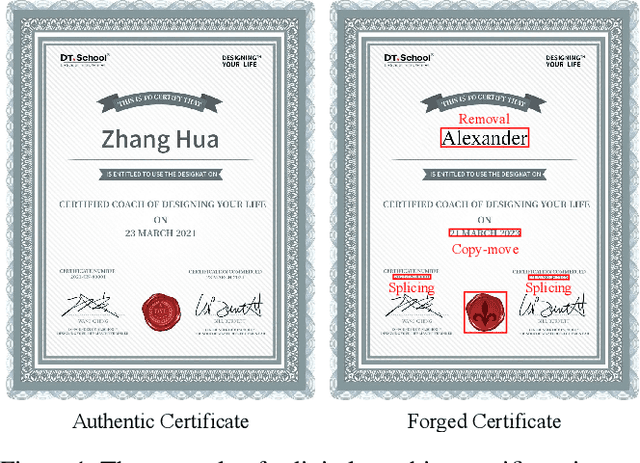
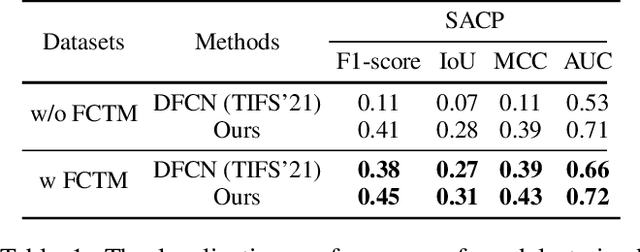
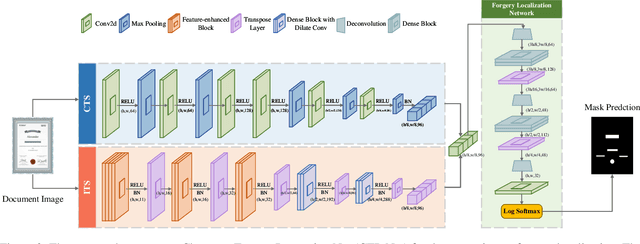
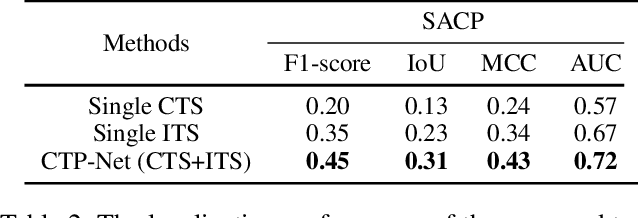
Due to the progression of information technology in recent years, document images have been widely disseminated on social networks. With the help of powerful image editing tools, document images are easily forged without leaving visible manipulation traces, which leads to severe issues if significant information is falsified for malicious use. Therefore, the research of document image forensics is worth further exploring. In this paper, we propose a Character Texture Perception Network (CTP-Net) to localize the forged regions in document images. Specifically, considering the characters with semantics in a document image are highly vulnerable, capturing the forgery traces is the key to localize the forged regions. We design a Character Texture Stream (CTS) based on optical character recognition to capture features of text areas that are essential components of a document image. Meanwhile, texture features of the whole document image are exploited by an Image Texture Stream (ITS). Combining the features extracted from the CTS and the ITS, the CTP-Net can reveal more subtle forgery traces from document images. Moreover, to overcome the challenge caused by the lack of fake document images, we design a data generation strategy that is utilized to construct a Fake Chinese Trademark dataset (FCTM). Experimental results on different datasets demonstrate that the proposed CTP-Net is able to localize multi-scale forged areas in document images, and outperform the state-of-the-art forgery localization methods, even though post-processing operations are applied.