 Add to Chrome
 Add to Firefox
 Add to Edge
PTL-Diffusion: Manifold-Aware Diffusion with Periodic Terminal Laws
Jun 08, 2026
Standard diffusion models typically use a single time-homogeneous Gaussian terminal distribution as the reference law for generation. While this choice is analytically convenient and empirically powerful, it provides little explicit structure for data concentrated near low-dimensional manifolds, where different regions of the data distribution may correspond to distinct local geometric or semantic factors. As a result, the reverse model must recover manifold-level structure almost entirely from an unstructured terminal reference distribution. We propose PTL-Diffusion, a proof-of-concept diffusion framework whose forward noising process converges to a nonconstant periodic family of Gaussian terminal laws rather than to a single invariant law. Unlike a phase-conditioned DDPM, where phase information only enters the denoising network while the forward process remains unchanged, PTL-Diffusion embeds phase structure directly into the forward noising dynamics. The proposed construction remains close to standard denoising diffusion models: for a periodically forced Ornstein--Uhlenbeck-type forward process, we derive closed-form forward marginals, the limiting periodic Gaussian terminal family, and explicit Gaussian reverse posteriors, enabling standard noise-prediction training. We also introduce an invariant-average regularization term coupling the phase-conditioned reverse dynamics through the averaged periodic reference law. Experiments on torus and cylinder point-cloud benchmarks and the Olivetti face dataset show that PTL-Diffusion improves manifold-level distributional matching over matched DDPM baselines, reducing phase-conditioned errors, feature-space covariance errors, and nearest-neighbour manifold distances. These results suggest structured terminal reference laws as a promising direction, while motivating more expressive phase constructions and larger-scale evaluations.

Bayesian Quadrature for Multiple Related Integrals
Jul 30, 2018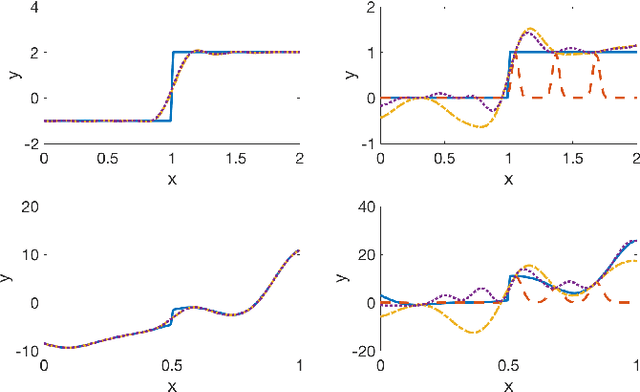
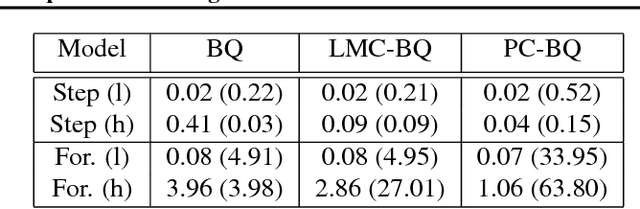
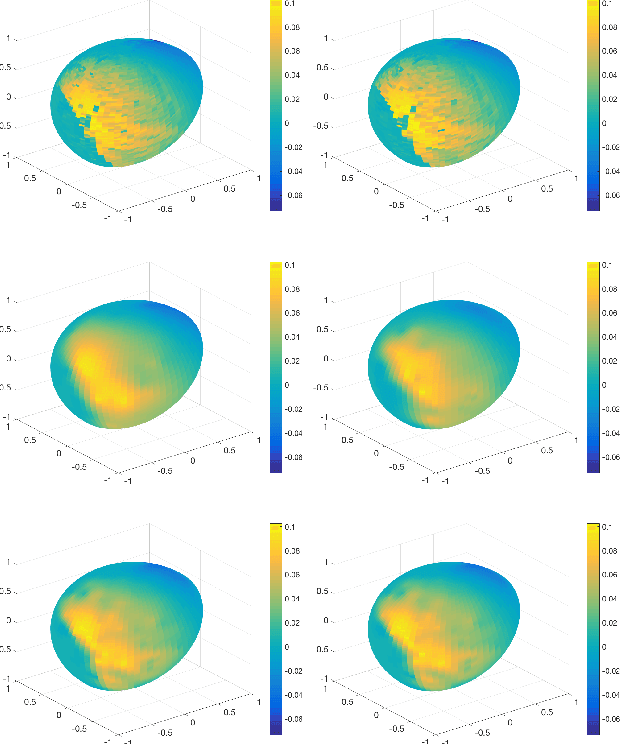
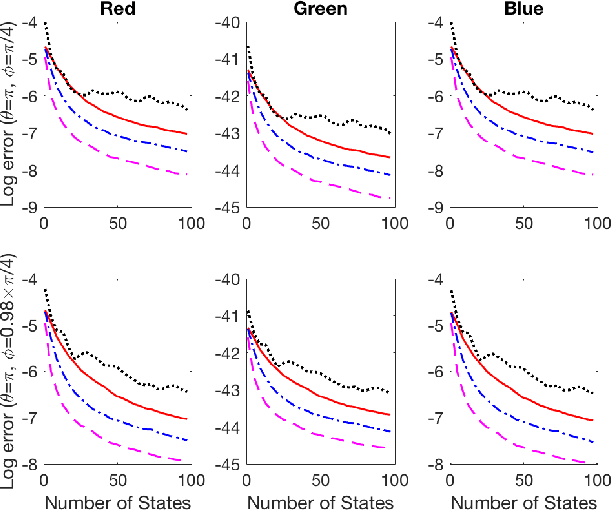
Bayesian probabilistic numerical methods are a set of tools providing posterior distributions on the output of numerical methods. The use of these methods is usually motivated by the fact that they can represent our uncertainty due to incomplete/finite information about the continuous mathematical problem being approximated. In this paper, we demonstrate that this paradigm can provide additional advantages, such as the possibility of transferring information between several numerical methods. This allows users to represent uncertainty in a more faithful manner and, as a by-product, provide increased numerical efficiency. We propose the first such numerical method by extending the well-known Bayesian quadrature algorithm to the case where we are interested in computing the integral of several related functions. We then prove convergence rates for the method in the well-specified and misspecified cases, and demonstrate its efficiency in the context of multi-fidelity models for complex engineering systems and a problem of global illumination in computer graphics.