 Add to Chrome
 Add to Firefox
 Add to Edge
CARLA-Round: A Multi-Factor Simulation Dataset for Roundabout Trajectory Prediction
Jan 17, 2026
Accurate trajectory prediction of vehicles at roundabouts is critical for reducing traffic accidents, yet it remains highly challenging due to their circular road geometry, continuous merging and yielding interactions, and absence of traffic signals. Developing accurate prediction algorithms relies on reliable, multimodal, and realistic datasets; however, such datasets for roundabout scenarios are scarce, as real-world data collection is often limited by incomplete observations and entangled factors that are difficult to isolate. We present CARLA-Round, a systematically designed simulation dataset for roundabout trajectory prediction. The dataset varies weather conditions (five types) and traffic density levels (spanning Level-of-Service A-E) in a structured manner, resulting in 25 controlled scenarios. Each scenario incorporates realistic mixtures of driving behaviors and provides explicit annotations that are largely absent from existing datasets. Unlike randomly sampled simulation data, this structured design enables precise analysis of how different conditions influence trajectory prediction performance. Validation experiments using standard baselines (LSTM, GCN, GRU+GCN) reveal traffic density dominates prediction difficulty with strong monotonic effects, while weather shows non-linear impacts. The best model achieves 0.312m ADE on real-world rounD dataset, demonstrating effective sim-to-real transfer. This systematic approach quantifies factor impacts impossible to isolate in confounded real-world datasets. Our CARLA-Round dataset is available at https://github.com/Rebecca689/CARLA-Round.

RAC-DMVC: Reliability-Aware Contrastive Deep Multi-View Clustering under Multi-Source Noise
Nov 17, 2025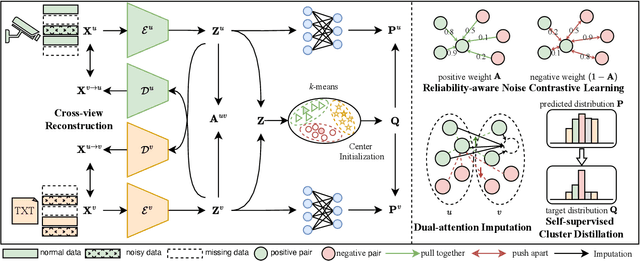
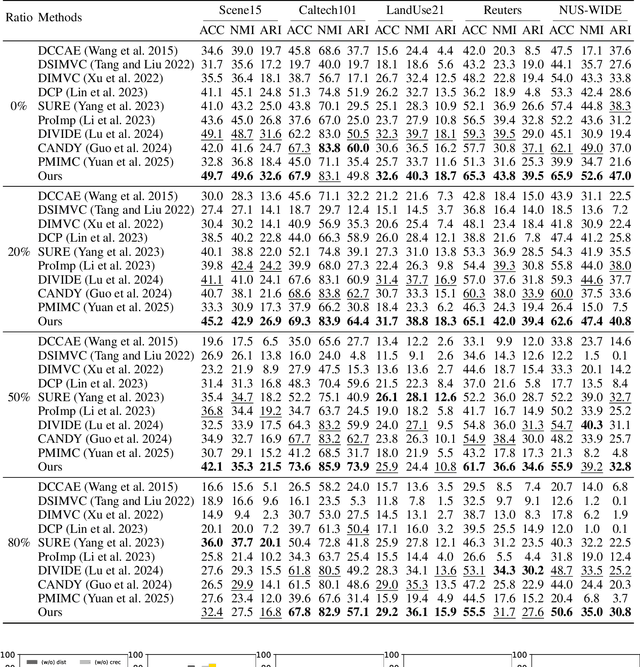

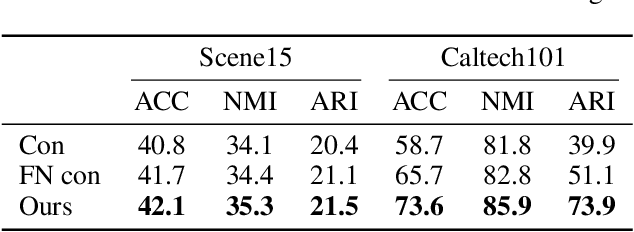
Multi-view clustering (MVC), which aims to separate the multi-view data into distinct clusters in an unsupervised manner, is a fundamental yet challenging task. To enhance its applicability in real-world scenarios, this paper addresses a more challenging task: MVC under multi-source noises, including missing noise and observation noise. To this end, we propose a novel framework, Reliability-Aware Contrastive Deep Multi-View Clustering (RAC-DMVC), which constructs a reliability graph to guide robust representation learning under noisy environments. Specifically, to address observation noise, we introduce a cross-view reconstruction to enhances robustness at the data level, and a reliability-aware noise contrastive learning to mitigates bias in positive and negative pairs selection caused by noisy representations. To handle missing noise, we design a dual-attention imputation to capture shared information across views while preserving view-specific features. In addition, a self-supervised cluster distillation module further refines the learned representations and improves the clustering performance. Extensive experiments on five benchmark datasets demonstrate that RAC-DMVC outperforms SOTA methods on multiple evaluation metrics and maintains excellent performance under varying ratios of noise.
Center-Oriented Prototype Contrastive Clustering
Aug 21, 2025Contrastive learning is widely used in clustering tasks due to its discriminative representation. However, the conflict problem between classes is difficult to solve effectively. Existing methods try to solve this problem through prototype contrast, but there is a deviation between the calculation of hard prototypes and the true cluster center. To address this problem, we propose a center-oriented prototype contrastive clustering framework, which consists of a soft prototype contrastive module and a dual consistency learning module. In short, the soft prototype contrastive module uses the probability that the sample belongs to the cluster center as a weight to calculate the prototype of each category, while avoiding inter-class conflicts and reducing prototype drift. The dual consistency learning module aligns different transformations of the same sample and the neighborhoods of different samples respectively, ensuring that the features have transformation-invariant semantic information and compact intra-cluster distribution, while providing reliable guarantees for the calculation of prototypes. Extensive experiments on five datasets show that the proposed method is effective compared to the SOTA. Our code is published on https://github.com/LouisDong95/CPCC.