 Add to Chrome
 Add to Firefox
 Add to Edge
Offline-to-Online Learning in Linear Bandits
Jun 03, 2026
We study online learning with an additional offline dataset in the stochastic linear bandit setting. Although this problem arises frequently in practice, the offline-to-online tradeoff remains poorly understood in structured environments. We propose a linear bandit algorithm that balances this tradeoff: it relies on offline data during early rounds, and increasingly favors exploration as the horizon grows. We establish regret bounds showing that our method is simultaneously competitive with both purely online and purely offline solutions. In particular, it achieves sublinear regret relative to the optimal action in the number of online interactions, while its regret relative to an offline reference decreases as the number of offline samples grows. Empirical results further demonstrate its effectiveness across various problem parameters.

Knowing When to Stop Matters: A Unified Algorithm for Online Conversion under Horizon Uncertainty
Feb 06, 2025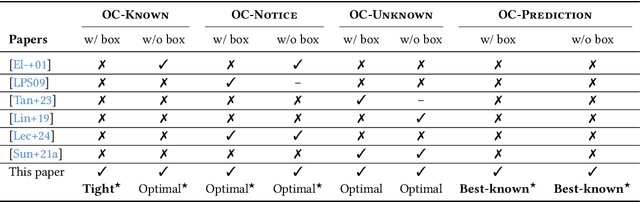
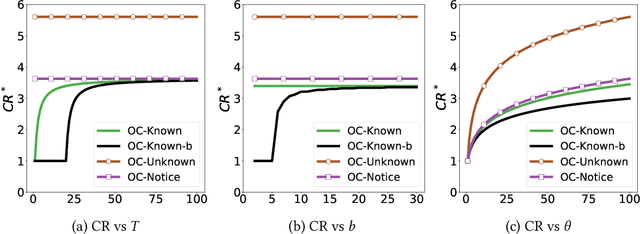

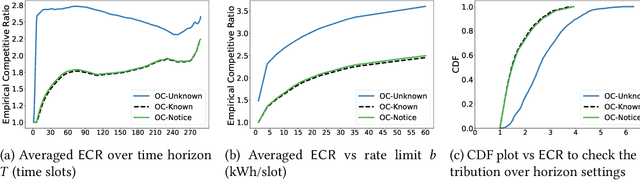
This paper investigates the online conversion problem, which involves sequentially trading a divisible resource (e.g., energy) under dynamically changing prices to maximize profit. A key challenge in online conversion is managing decisions under horizon uncertainty, where the duration of trading is either known, revealed partway, or entirely unknown. We propose a unified algorithm that achieves optimal competitive guarantees across these horizon models, accounting for practical constraints such as box constraints, which limit the maximum allowable trade per step. Additionally, we extend the algorithm to a learning-augmented version, leveraging horizon predictions to adaptively balance performance: achieving near-optimal results when predictions are accurate while maintaining strong guarantees when predictions are unreliable. These results advance the understanding of online conversion under various degrees of horizon uncertainty and provide more practical strategies to address real world constraints.
Almost Free: Self-concordance in Natural Exponential Families and an Application to Bandits
Oct 01, 2024We prove that single-parameter natural exponential families with subexponential tails are self-concordant with polynomial-sized parameters. For subgaussian natural exponential families we establish an exact characterization of the growth rate of the self-concordance parameter. Applying these findings to bandits allows us to fill gaps in the literature: We show that optimistic algorithms for generalized linear bandits enjoy regret bounds that are both second-order (scale with the variance of the optimal arm's reward distribution) and free of an exponential dependence on the bound of the problem parameter in the leading term. To the best of our knowledge, ours is the first regret bound for generalized linear bandits with subexponential tails, broadening the class of problems to include Poisson, exponential and gamma bandits.