 Add to Chrome
 Add to Firefox
 Add to Edge
IRPol-Fuse: Energy-structure coordination for infrared polarization fusion under low visibility
Aug 08, 2026
Robust perception under low-visibility conditions requires fused imagery that jointly preserves infrared thermal saliency and polarization-derived structural details. However, existing infrared-polarization image fusion (IPIF) methods often overemphasize dominant infrared responses, causing weak yet informative polarization textures in dark regions to be suppressed. To address this issue, we propose IRPol-Fuse, an energy-structure coordinated IPIF framework for challenging low-visibility scenarios. The proposed framework contains three key modules: Polarization Attention Fusion for adaptive infrared-polarization allocation, Infrared Highlight Injector for highlight-guided infrared preservation, and Polarization Texture Injector for polarization texture restoration and fine-detail recovery. We further construct LI-PI, a dedicated infrared-polarization evaluation dataset for low-visibility and visually concealed scenes. Experiments on LI-PI and the public LDDRS dataset demonstrate that IRPol-Fuse achieves favorable performance in thermal target preservation, structural detail recovery, and visual naturalness. Region-aware evaluation and downstream object detection further verify that the proposed energy-structure coordination strategy effectively preserves both infrared target saliency and polarization-derived structural information. Code is available at https://github.com/1hzf/IRPolar-Fuse .

FlexiD-Fuse: Flexible number of inputs multi-modal medical image fusion based on diffusion model
Sep 11, 2025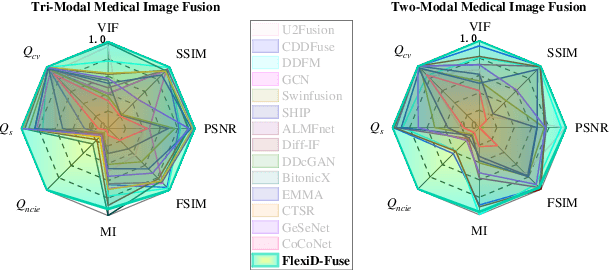

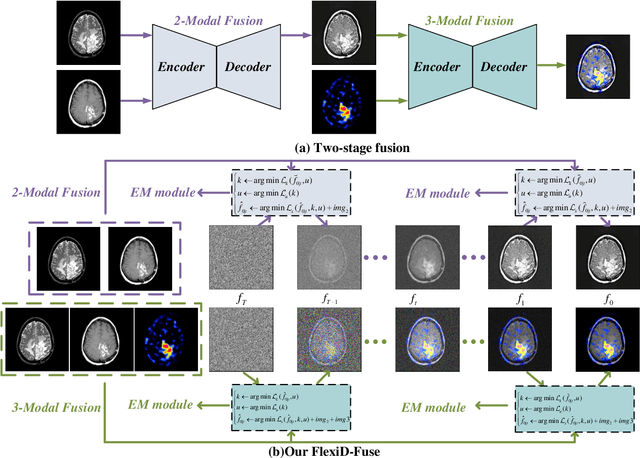
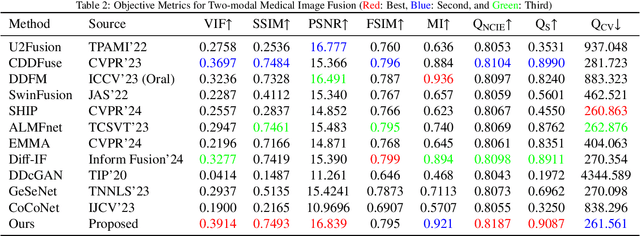
Different modalities of medical images provide unique physiological and anatomical information for diseases. Multi-modal medical image fusion integrates useful information from different complementary medical images with different modalities, producing a fused image that comprehensively and objectively reflects lesion characteristics to assist doctors in clinical diagnosis. However, existing fusion methods can only handle a fixed number of modality inputs, such as accepting only two-modal or tri-modal inputs, and cannot directly process varying input quantities, which hinders their application in clinical settings. To tackle this issue, we introduce FlexiD-Fuse, a diffusion-based image fusion network designed to accommodate flexible quantities of input modalities. It can end-to-end process two-modal and tri-modal medical image fusion under the same weight. FlexiD-Fuse transforms the diffusion fusion problem, which supports only fixed-condition inputs, into a maximum likelihood estimation problem based on the diffusion process and hierarchical Bayesian modeling. By incorporating the Expectation-Maximization algorithm into the diffusion sampling iteration process, FlexiD-Fuse can generate high-quality fused images with cross-modal information from source images, independently of the number of input images. We compared the latest two and tri-modal medical image fusion methods, tested them on Harvard datasets, and evaluated them using nine popular metrics. The experimental results show that our method achieves the best performance in medical image fusion with varying inputs. Meanwhile, we conducted extensive extension experiments on infrared-visible, multi-exposure, and multi-focus image fusion tasks with arbitrary numbers, and compared them with the perspective SOTA methods. The results of the extension experiments consistently demonstrate the effectiveness and superiority of our method.
MambaTrans: Multimodal Fusion Image Translation via Large Language Model Priors for Downstream Visual Tasks
Aug 11, 2025
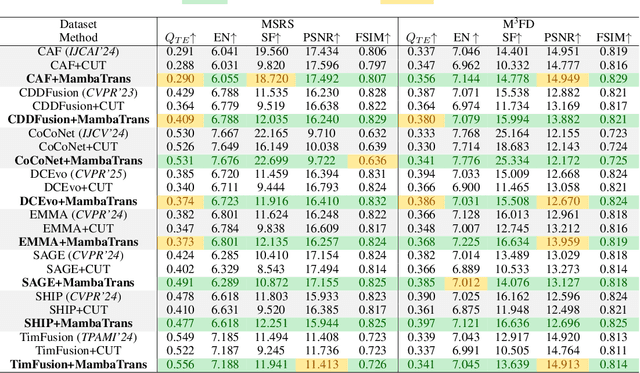
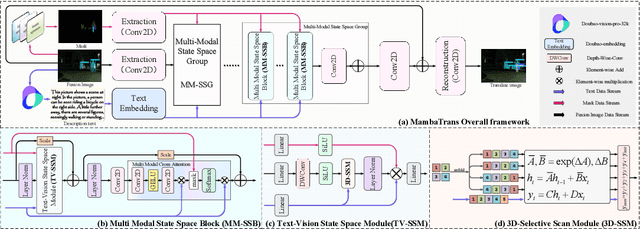
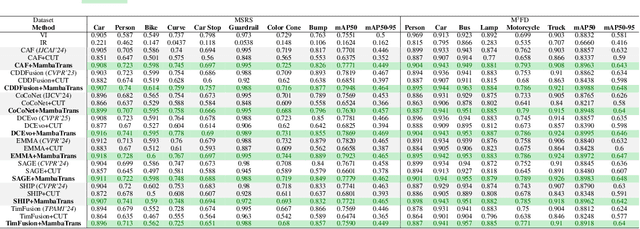
The goal of multimodal image fusion is to integrate complementary information from infrared and visible images, generating multimodal fused images for downstream tasks. Existing downstream pre-training models are typically trained on visible images. However, the significant pixel distribution differences between visible and multimodal fusion images can degrade downstream task performance, sometimes even below that of using only visible images. This paper explores adapting multimodal fused images with significant modality differences to object detection and semantic segmentation models trained on visible images. To address this, we propose MambaTrans, a novel multimodal fusion image modality translator. MambaTrans uses descriptions from a multimodal large language model and masks from semantic segmentation models as input. Its core component, the Multi-Model State Space Block, combines mask-image-text cross-attention and a 3D-Selective Scan Module, enhancing pure visual capabilities. By leveraging object detection prior knowledge, MambaTrans minimizes detection loss during training and captures long-term dependencies among text, masks, and images. This enables favorable results in pre-trained models without adjusting their parameters. Experiments on public datasets show that MambaTrans effectively improves multimodal image performance in downstream tasks.
Bridging the Gap between Multi-focus and Multi-modal: A Focused Integration Framework for Multi-modal Image Fusion
Nov 03, 2023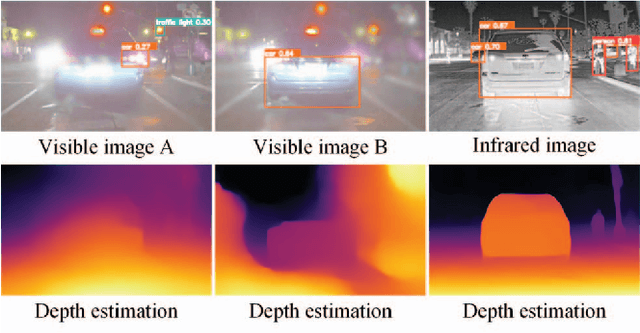
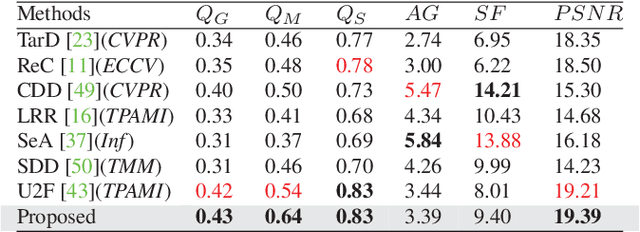
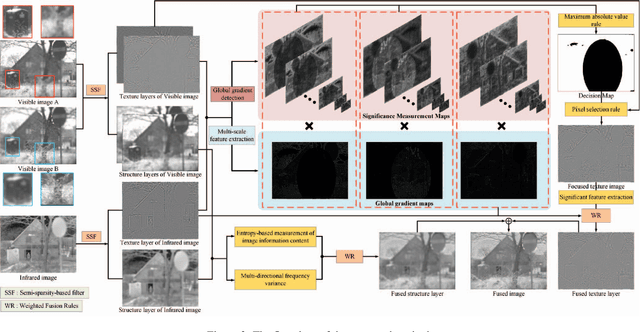
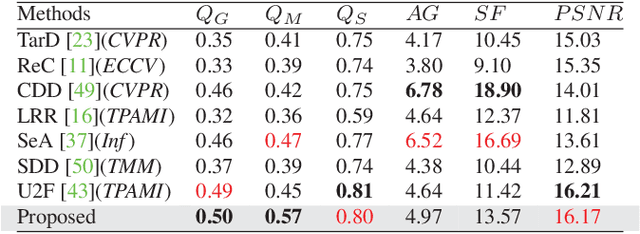
Multi-modal image fusion (MMIF) integrates valuable information from different modality images into a fused one. However, the fusion of multiple visible images with different focal regions and infrared images is a unprecedented challenge in real MMIF applications. This is because of the limited depth of the focus of visible optical lenses, which impedes the simultaneous capture of the focal information within the same scene. To address this issue, in this paper, we propose a MMIF framework for joint focused integration and modalities information extraction. Specifically, a semi-sparsity-based smoothing filter is introduced to decompose the images into structure and texture components. Subsequently, a novel multi-scale operator is proposed to fuse the texture components, capable of detecting significant information by considering the pixel focus attributes and relevant data from various modal images. Additionally, to achieve an effective capture of scene luminance and reasonable contrast maintenance, we consider the distribution of energy information in the structural components in terms of multi-directional frequency variance and information entropy. Extensive experiments on existing MMIF datasets, as well as the object detection and depth estimation tasks, consistently demonstrate that the proposed algorithm can surpass the state-of-the-art methods in visual perception and quantitative evaluation. The code is available at https://github.com/ixilai/MFIF-MMIF.