 Add to Chrome
 Add to Firefox
 Add to Edge
ELSA3D: Elastic Semantic Anchoring for Unified 3D Understanding and Generation
Jul 07, 2026
Unified 3D foundation models aspire to generate 3D assets and reason about them in language within a single backbone, but their text-3D interaction remains largely implicit. Existing methods concatenate text and 3D tokens into a flat sequence and rely on self-attention, collapsing coarse structural cues and fine geometric details into one undifferentiated representation. We introduce ELSA3D, a unified 3D model that addresses this with elastic semantic anchoring, structuring language and geometric reasoning jointly along matched abstraction scales. ELSA3D represents geometry with a scale-aware octree tokenizer and introduces Anchor Tokens, sparse cross-modal units that select semantic cues, route them to the most relevant 3D scale, retrieve scale-specific geometric evidence, and write the fused signal back into the unified representation, keeping interaction sparse yet precise. A lightweight per-block router makes both computation and reasoning elastic, choosing which text tokens instantiate anchors at which geometric scale so that cross-modal capacity concentrates where alignment is most needed. ELSA3D achieves state-of-the-art performance across image-to-3D generation, text-to-3D generation, and 3D captioning, outperforming the strongest unified baseline while roughly halving FLOPs and inference latency relative to the non-elastic version of the same model.

Tiny but Trusted: Efficient Vision-Language Reasoning for Time-Series Anomaly Detection
May 28, 2026Recent advances in Vision-Language Models (VLMs) have achieved impressive performance across many tasks, yet prior studies report unsatisfactory performance when applying large language or multimodal models to finding abnormal patterns in sequential data. Public anomaly detection benchmarks typically provide interval annotations but not natural-language rationales, making it difficult to fine-tune VLMs to produce grounded, interpretable decisions. To address this gap, we construct VisAnomBench, a curated benchmark built from public time-series datasets and augmented with high-quality anomaly explanations selected from multiple large VLMs using fine-grained, task-specific rewards. Through fine-tuning on this benchmark, we develop VisAnomReasoner, a parameter-efficient VLM for time-series anomaly detection. Experimental results on VisAnomBench show that VisAnomReasoner achieves more accurate anomaly localization and consistently outperforms all baselines, with improvements of at least 21.23 and 23.87 percentage points in precision and F1, respectively. Additional experiments on the TSB-AD-U benchmark demonstrate strong cross-benchmark generalization, with VisAnomReasoner improving precision and F1 by 9.57 and 13.39 percentage points, respectively.
Hierarchical Dataset Selection for High-Quality Data Sharing
Dec 24, 2025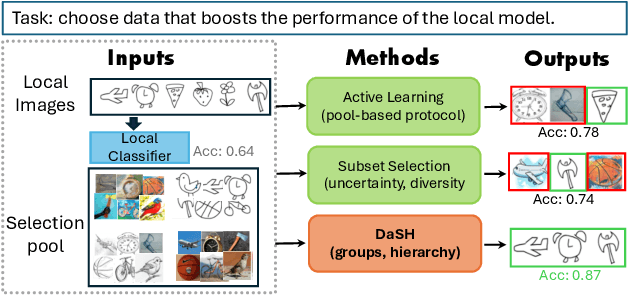

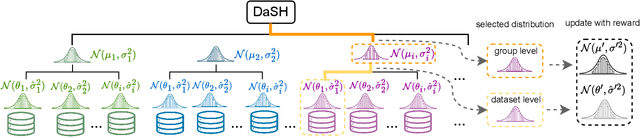

The success of modern machine learning hinges on access to high-quality training data. In many real-world scenarios, such as acquiring data from public repositories or sharing across institutions, data is naturally organized into discrete datasets that vary in relevance, quality, and utility. Selecting which repositories or institutions to search for useful datasets, and which datasets to incorporate into model training are therefore critical decisions, yet most existing methods select individual samples and treat all data as equally relevant, ignoring differences between datasets and their sources. In this work, we formalize the task of dataset selection: selecting entire datasets from a large, heterogeneous pool to improve downstream performance under resource constraints. We propose Dataset Selection via Hierarchies (DaSH), a dataset selection method that models utility at both dataset and group (e.g., collections, institutions) levels, enabling efficient generalization from limited observations. Across two public benchmarks (Digit-Five and DomainNet), DaSH outperforms state-of-the-art data selection baselines by up to 26.2% in accuracy, while requiring significantly fewer exploration steps. Ablations show DaSH is robust to low-resource settings and lack of relevant datasets, making it suitable for scalable and adaptive dataset selection in practical multi-source learning workflows.
mTSBench: Benchmarking Multivariate Time Series Anomaly Detection and Model Selection at Scale
Jun 26, 2025Multivariate time series anomaly detection (MTS-AD) is critical in domains like healthcare, cybersecurity, and industrial monitoring, yet remains challenging due to complex inter-variable dependencies, temporal dynamics, and sparse anomaly labels. We introduce mTSBench, the largest benchmark to date for MTS-AD and unsupervised model selection, spanning 344 labeled time series across 19 datasets and 12 diverse application domains. mTSBench evaluates 24 anomaly detection methods, including large language model (LLM)-based detectors for multivariate time series, and systematically benchmarks unsupervised model selection techniques under standardized conditions. Consistent with prior findings, our results confirm that no single detector excels across datasets, underscoring the importance of model selection. However, even state-of-the-art selection methods remain far from optimal, revealing critical gaps. mTSBench provides a unified evaluation suite to enable rigorous, reproducible comparisons and catalyze future advances in adaptive anomaly detection and robust model selection.
PRIMA: Multi-Image Vision-Language Models for Reasoning Segmentation
Dec 19, 2024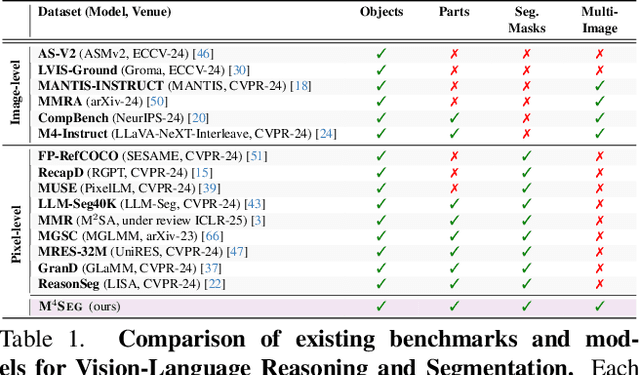
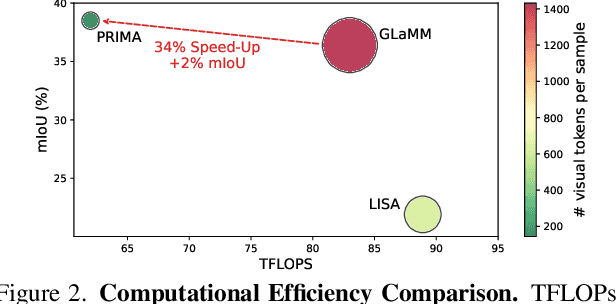
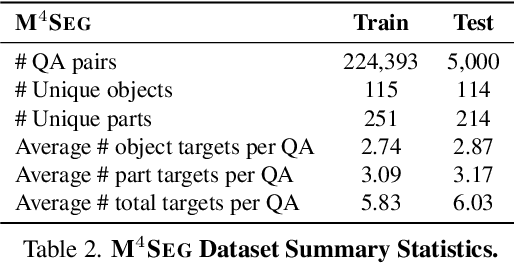
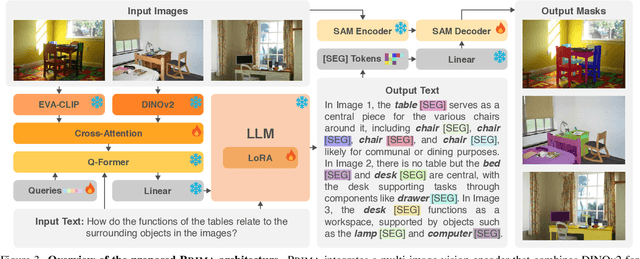
Despite significant advancements in Large Vision-Language Models (LVLMs), existing pixel-grounding models operate on single-image settings, limiting their ability to perform detailed, fine-grained comparisons across multiple images. Conversely, current multi-image understanding models lack pixel-level grounding. Our work addresses this gap by introducing the task of multi-image pixel-grounded reasoning segmentation, and PRIMA, a novel LVLM that integrates pixel-level grounding with robust multi-image reasoning capabilities to produce contextually rich, pixel-grounded explanations. Central to PRIMA is an efficient vision module that queries fine-grained visual representations across multiple images, reducing TFLOPs by $25.3\%$. To support training and evaluation, we curate $M^4Seg$, a new reasoning segmentation benchmark consisting of $\sim$224K question-answer pairs that require fine-grained visual understanding across multiple images. Experimental results demonstrate PRIMA outperforms state-of-the-art baselines.