 Add to Chrome
 Add to Firefox
 Add to Edge
CT-PrepAgent: Bounded Policy and Controlled Execution for Adaptive CT Data Preparation
Aug 02, 2026
Heterogeneous computed tomography (CT) acquisitions and diverse downstream task requirements limit the transferability of fixed data preparation workflows across data sources and tasks. Existing approaches typically rely on manually designed or dataset-specific rules, making it difficult to accommodate changes in acquisition conditions and analytical objectives without manual intervention. Large language model (LLM)-based agents have shown promise for automating medical workflows, yet their potential for adaptive CT data preparation remains largely unexplored. To bridge this gap, we propose CT-PrepAgent, which enables adaptive CT data preparation through a bounded policy and controlled deterministic execution. Deterministic inspection constructs structured data--task profiles, from which a policy decides an eligible DICOM series or predefined preprocessing profile, while the controlled execution flow guards, resolves, executes, and verifies the decision with bounded recovery when enabled and safe quarantine otherwise. Across three public CT segmentation tasks, CT-PrepAgent derived data-task adaptive preprocessing decisions and achieved the highest macro-average Dice. On two private raw-DICOM cohorts, CT-PrepAgent increased verified output yield from 61.7\% to 70.0\% and yielded similar registration metrics on common verified outputs. Controlled fault and replay tests validate bounded recovery, safe quarantine, and policy-free replay under tested fault and drift settings.

AVP-AP: Self-supervised Automatic View Positioning in 3D cardiac CT via Atlas Prompting
Apr 08, 2025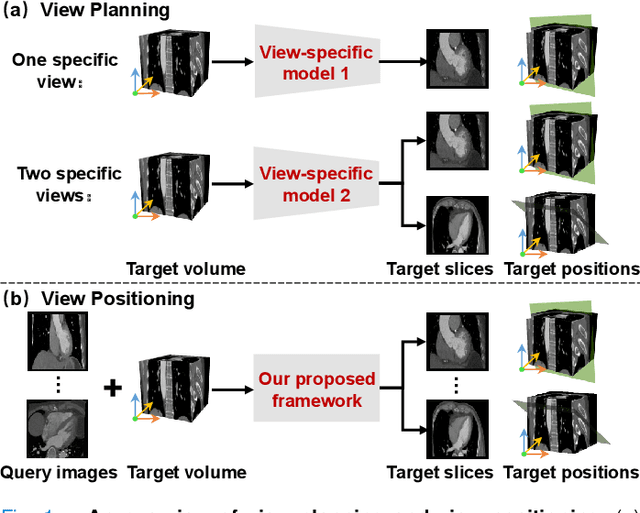
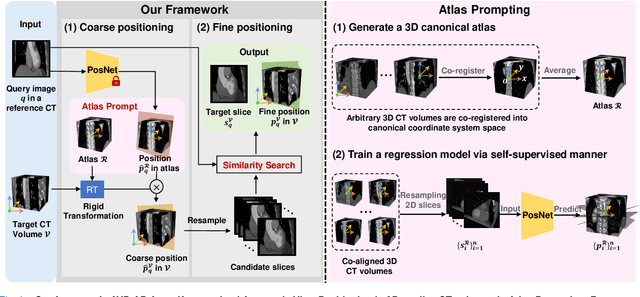
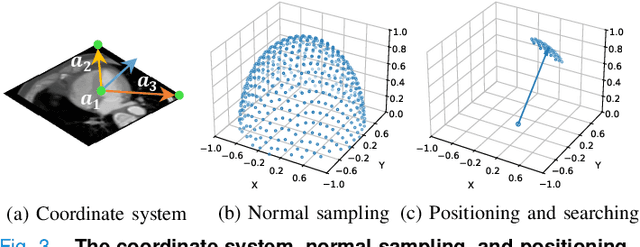
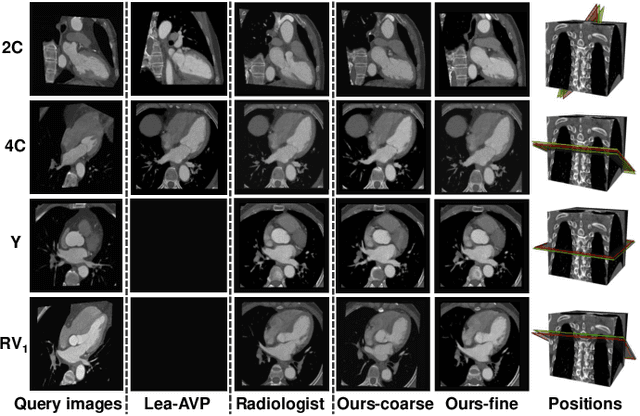
Automatic view positioning is crucial for cardiac computed tomography (CT) examinations, including disease diagnosis and surgical planning. However, it is highly challenging due to individual variability and large 3D search space. Existing work needs labor-intensive and time-consuming manual annotations to train view-specific models, which are limited to predicting only a fixed set of planes. However, in real clinical scenarios, the challenge of positioning semantic 2D slices with any orientation into varying coordinate space in arbitrary 3D volume remains unsolved. We thus introduce a novel framework, AVP-AP, the first to use Atlas Prompting for self-supervised Automatic View Positioning in the 3D CT volume. Specifically, this paper first proposes an atlas prompting method, which generates a 3D canonical atlas and trains a network to map slices into their corresponding positions in the atlas space via a self-supervised manner. Then, guided by atlas prompts corresponding to the given query images in a reference CT, we identify the coarse positions of slices in the target CT volume using rigid transformation between the 3D atlas and target CT volume, effectively reducing the search space. Finally, we refine the coarse positions by maximizing the similarity between the predicted slices and the query images in the feature space of a given foundation model. Our framework is flexible and efficient compared to other methods, outperforming other methods by 19.8% average structural similarity (SSIM) in arbitrary view positioning and achieving 9% SSIM in two-chamber view compared to four radiologists. Meanwhile, experiments on a public dataset validate our framework's generalizability.
* 12 pages, 8 figures, published to TMI