 Add to Chrome
 Add to Firefox
 Add to Edge
QAdapt: A Noise-Adaptive Neural Pre-Decoding Framework for Quantum Error Correction
Jul 30, 2026
Fault-tolerant quantum computing (FTQC) relies on quantum error correction to suppress physical errors and preserve logical information at scale. In practice, however, performance is constrained not only by physical noise but also by the latency of classical decoders processing rapidly generated syndrome data. This challenge is exacerbated by hardware noise that is strong, heterogeneous, and nonstationary, as well as by the simulation-to-hardware distribution shift that can substantially degrade fixed neural decoders. We present QAdapt, a noise-adaptive neural pre-decoding framework for surface-code quantum error correction. QAdapt captures local spatiotemporal correlations in syndrome data, sequentially adapts to evolving noise conditions while mitigating catastrophic forgetting, and forwards the residual syndrome to a conventional global decoder. Across 110 synthetic out-of-distribution noise configurations for rotated surface-code memory circuits, QAdapt consistently reduces the logical error rate relative to the neural pre-decoding baseline. On Google's Willow benchmark data, without target-domain fine-tuning, it achieves reductions of up to 5.79 percent in logical error rate and 9.32 percent in backend decoding latency on the residual syndrome. These results demonstrate that QAdapt provides a practical and decoder-compatible approach to improving the robustness and backend decoding efficiency of quantum error correction under evolving hardware noise.

PhaseNAS: Language-Model Driven Architecture Search with Dynamic Phase Adaptation
Jul 28, 2025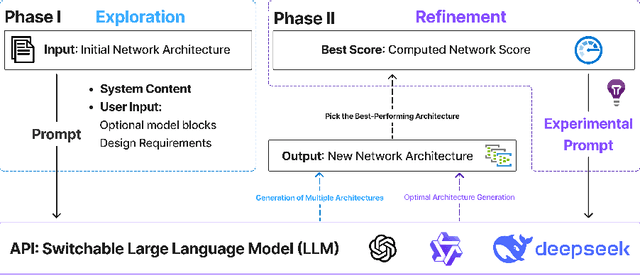
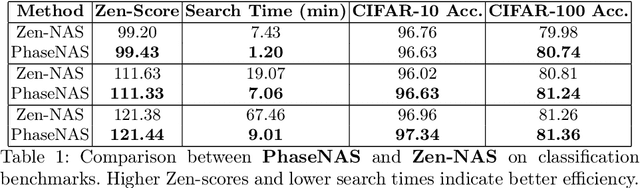

Neural Architecture Search (NAS) is challenged by the trade-off between search space exploration and efficiency, especially for complex tasks. While recent LLM-based NAS methods have shown promise, they often suffer from static search strategies and ambiguous architecture representations. We propose PhaseNAS, an LLM-based NAS framework with dynamic phase transitions guided by real-time score thresholds and a structured architecture template language for consistent code generation. On the NAS-Bench-Macro benchmark, PhaseNAS consistently discovers architectures with higher accuracy and better rank. For image classification (CIFAR-10/100), PhaseNAS reduces search time by up to 86% while maintaining or improving accuracy. In object detection, it automatically produces YOLOv8 variants with higher mAP and lower resource cost. These results demonstrate that PhaseNAS enables efficient, adaptive, and generalizable NAS across diverse vision tasks.