 Add to Chrome
 Add to Firefox
 Add to Edge
CausalGDP: Causality-Guided Diffusion Policies for Reinforcement Learning
Feb 09, 2026
Reinforcement learning (RL) has achieved remarkable success in a wide range of sequential decision-making problems. Recent diffusion-based policies further improve RL by modeling complex, high-dimensional action distributions. However, existing diffusion policies primarily rely on statistical associations and fail to explicitly account for causal relationships among states, actions, and rewards, limiting their ability to identify which action components truly cause high returns. In this paper, we propose Causality-guided Diffusion Policy (CausalGDP), a unified framework that integrates causal reasoning into diffusion-based RL. CausalGDP first learns a base diffusion policy and an initial causal dynamical model from offline data, capturing causal dependencies among states, actions, and rewards. During real-time interaction, the causal information is continuously updated and incorporated as a guidance signal to steer the diffusion process toward actions that causally influence future states and rewards. By explicitly considering causality beyond association, CausalGDP focuses policy optimization on action components that genuinely drive performance improvements. Experimental results demonstrate that CausalGDP consistently achieves competitive or superior performance over state-of-the-art diffusion-based and offline RL methods, especially in complex, high-dimensional control tasks.

Explainable Federated Bayesian Causal Inference and Its Application in Advanced Manufacturing
Jan 10, 2025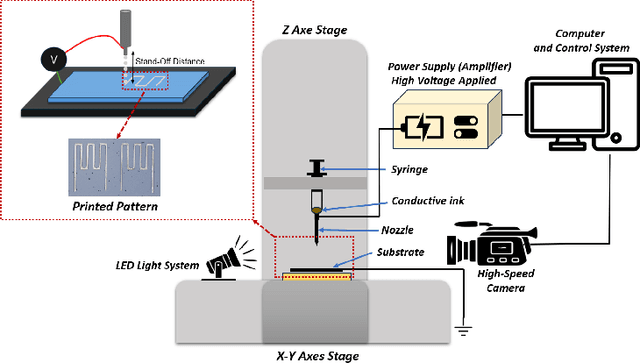
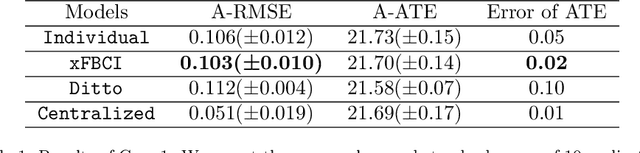
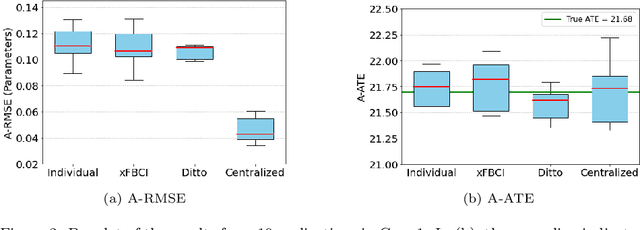
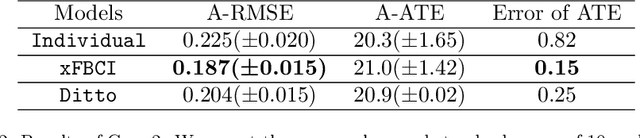
Causal inference has recently gained notable attention across various fields like biology, healthcare, and environmental science, especially within explainable artificial intelligence (xAI) systems, for uncovering the causal relationships among multiple variables and outcomes. Yet, it has not been fully recognized and deployed in the manufacturing systems. In this paper, we introduce an explainable, scalable, and flexible federated Bayesian learning framework, \texttt{xFBCI}, designed to explore causality through treatment effect estimation in distributed manufacturing systems. By leveraging federated Bayesian learning, we efficiently estimate posterior of local parameters to derive the propensity score for each client without accessing local private data. These scores are then used to estimate the treatment effect using propensity score matching (PSM). Through simulations on various datasets and a real-world Electrohydrodynamic (EHD) printing data, we demonstrate that our approach outperforms standard Bayesian causal inference methods and several state-of-the-art federated learning benchmarks.