 Add to Chrome
 Add to Firefox
 Add to Edge
Fine-Refine: Iterative Fine-grained Refinement for Mitigating Dialogue Hallucination
Feb 17, 2026
The tendency for hallucination in current large language models (LLMs) negatively impacts dialogue systems. Such hallucinations produce factually incorrect responses that may mislead users and undermine system trust. Existing refinement methods for dialogue systems typically operate at the response level, overlooking the fact that a single response may contain multiple verifiable or unverifiable facts. To address this gap, we propose Fine-Refine, a fine-grained refinement framework that decomposes responses into atomic units, verifies each unit using external knowledge, assesses fluency via perplexity, and iteratively corrects granular errors. We evaluate factuality across the HybriDialogue and OpendialKG datasets in terms of factual accuracy (fact score) and coverage (Not Enough Information Proportion), and experiments show that Fine-Refine substantially improves factuality, achieving up to a 7.63-point gain in dialogue fact score, with a small trade-off in dialogue quality.

Improving Factuality for Dialogue Response Generation via Graph-Based Knowledge Augmentation
Jun 14, 2025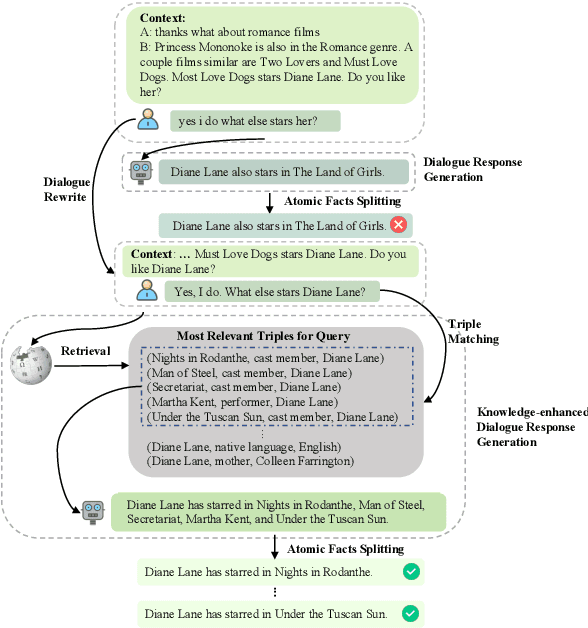
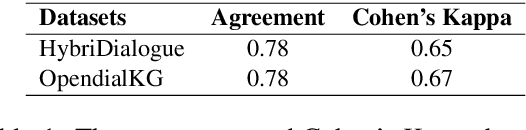
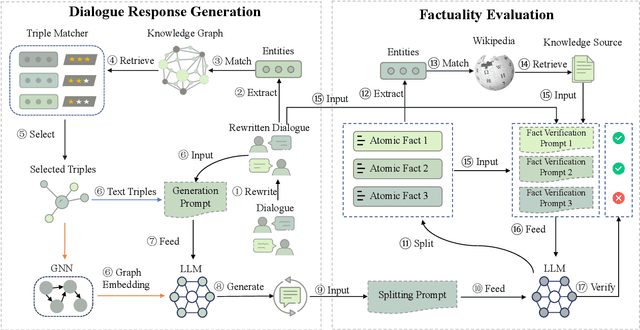
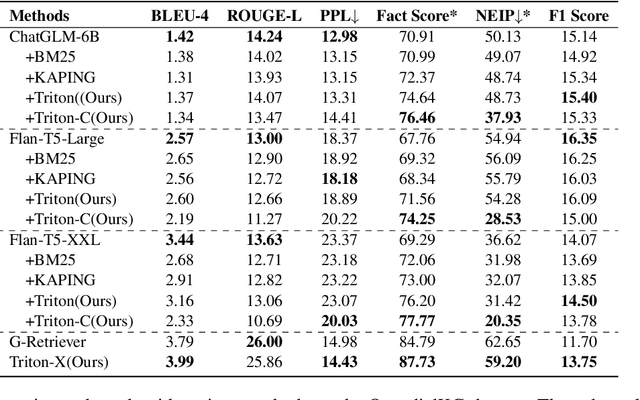
Large Language Models (LLMs) succeed in many natural language processing tasks. However, their tendency to hallucinate - generate plausible but inconsistent or factually incorrect text - can cause problems in certain tasks, including response generation in dialogue. To mitigate this issue, knowledge-augmented methods have shown promise in reducing hallucinations. Here, we introduce a novel framework designed to enhance the factuality of dialogue response generation, as well as an approach to evaluate dialogue factual accuracy. Our framework combines a knowledge triple retriever, a dialogue rewrite, and knowledge-enhanced response generation to produce more accurate and grounded dialogue responses. To further evaluate generated responses, we propose a revised fact score that addresses the limitations of existing fact-score methods in dialogue settings, providing a more reliable assessment of factual consistency. We evaluate our methods using different baselines on the OpendialKG and HybriDialogue datasets. Our methods significantly improve factuality compared to other graph knowledge-augmentation baselines, including the state-of-the-art G-retriever. The code will be released on GitHub.
MLLA-UNet: Mamba-like Linear Attention in an Efficient U-Shape Model for Medical Image Segmentation
Oct 31, 2024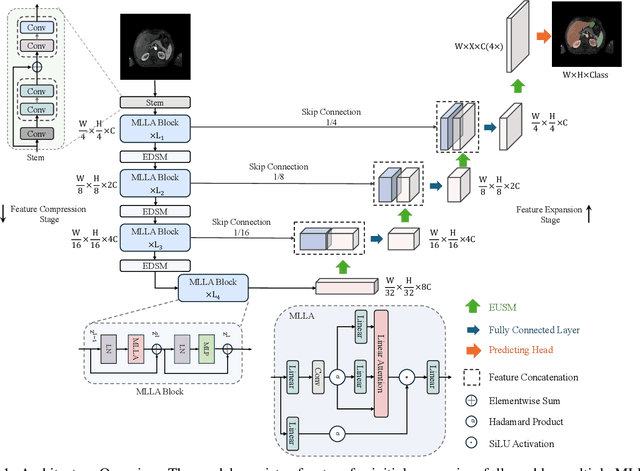
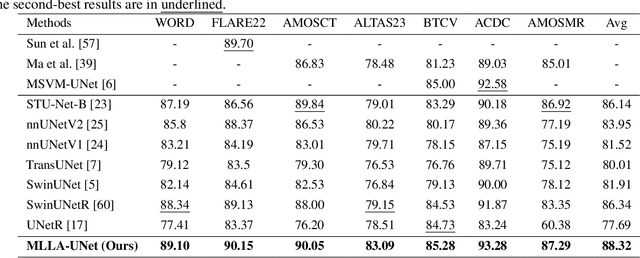
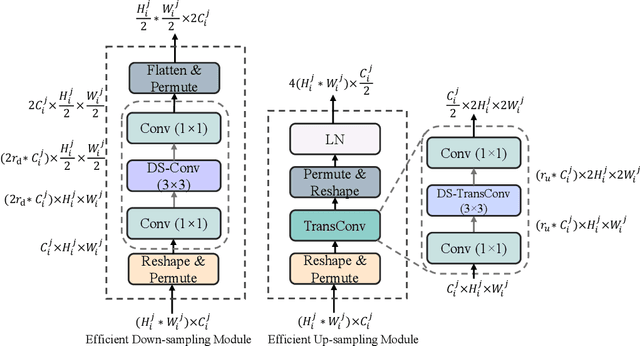
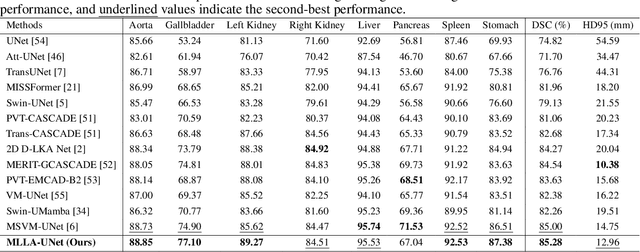
Recent advancements in medical imaging have resulted in more complex and diverse images, with challenges such as high anatomical variability, blurred tissue boundaries, low organ contrast, and noise. Traditional segmentation methods struggle to address these challenges, making deep learning approaches, particularly U-shaped architectures, increasingly prominent. However, the quadratic complexity of standard self-attention makes Transformers computationally prohibitive for high-resolution images. To address these challenges, we propose MLLA-UNet (Mamba-Like Linear Attention UNet), a novel architecture that achieves linear computational complexity while maintaining high segmentation accuracy through its innovative combination of linear attention and Mamba-inspired adaptive mechanisms, complemented by an efficient symmetric sampling structure for enhanced feature processing. Our architecture effectively preserves essential spatial features while capturing long-range dependencies at reduced computational complexity. Additionally, we introduce a novel sampling strategy for multi-scale feature fusion. Experiments demonstrate that MLLA-UNet achieves state-of-the-art performance on six challenging datasets with 24 different segmentation tasks, including but not limited to FLARE22, AMOS CT, and ACDC, with an average DSC of 88.32%. These results underscore the superiority of MLLA-UNet over existing methods. Our contributions include the novel 2D segmentation architecture and its empirical validation. The code is available via https://github.com/csyfjiang/MLLA-UNet.