 Add to Chrome
 Add to Firefox
 Add to Edge
Perturbation-based Regional Interpretability through Subtraction Mapping (PRISM): naming-error dissociations in language models and post-stroke aphasia
Aug 13, 2026
Mechanistic interpretability of large language models lacks spatially resolved, falsifiable tools for testing whether internal components are specialized for distinct cognitive operations. We adapt subtraction analysis, the standard framework of human neuroimaging, from biological brains to perturbed transformers, and apply the same logic to both substrates in parallel. Building on the Brain-LLM Unified Model (BLUM), which showed that layer-perturbed LLaVA-1.6-Vicuna-13B error profiles match the lesion patterns of aphasic patients, we develop PRISM (Perturbation-based Regional Interpretability through Subtraction Mapping). PRISM maps the seven clinical Philadelphia Naming Test categories, subtracts error classes pairwise, and treats each perturbation seed as a subject in a group analysis with threshold-free cluster enhancement along the layer axis. We run a structurally matched analysis on 213 chronic post-stroke aphasia patients using correlation-difference lesion-symptom mapping, and replicate both sides on held-out splits. The designs match in subject dimension (seeds, patients), spatial dimension (layers, atlas-parcellated cortex) and thresholding, but the contrast operator differs: a within-subject error-proportion difference for the LLM, a between-subject correlation difference for the cortex. Both substrates recover a robust phonemic-favoring dissociation, a deep layer cluster and a frontal-perisylvian cortical cluster, both replicating; the semantic-favoring direction is a consistently signed but non-significant trend on both. PRISM thus gives a falsifiable, spatially resolved test of functional-specialization claims in transformer language models. A confirmatory ROI-level intervention (PRISM Stage 3) licensing the strongest causal-mechanism claim is left to subsequent work.

Recovering Lesion Parameters from Aphasic Picture Naming Error Profiles in Large Language Models
Aug 05, 2026Interpretability methods for large language models (LLMs) describe internal state but do not directly test whether that state is causally sufficient to produce the observed behavior. In earlier work, we lesioned LLMs to produce error profiles in picture naming, a central task for assessing aphasia, and found that specific lesions produced errors resembling those of individual stroke survivors. Here we ask the inverse question: given an error profile, can the lesion parameters that produced it be recovered, and what does this inverse problem reveal about transformer computation? Lesions in LLaVA-Vicuna 13B were parameterized by layer index, modification percentage, and noise sigma across 4,840 configurations, and error profiles were characterized by a seven-category clinical taxonomy (correct, semantic, unrelated, formal, mixed, neologism, no-response). We trained a multi-task neural network to map error profiles back to perturbation parameters. The problem admitted a partial solution: across 10 independently trained inverse models, modification percentage and noise sigma were recoverable, whereas layer index was recoverable only within a neighborhood. In counterfactual validation, a fresh model instance perturbed with the recovered parameters reproduced the target behavior in 81.4% of cases. This dissociation between low layer recovery and high counterfactual fidelity is consistent with functional redundancy across transformer layers, a property not captured by standard interpretability methods. As an out-of-distribution test, we applied the trained model to picture-naming error profiles from 278 stroke survivors; recovered parameters were syndrome-discriminative, most strongly for perturbation intensity, indicating generalization beyond the training distribution. Counterfactual validation provides a general framework for LLM interpretability claims beyond inverse mapping.
Lesioned Multimodal Language Models Reproduce Aphasic Picture-Naming Patterns
Jul 13, 2026Aphasia following stroke commonly produces systematic naming errors with characteristic profiles, but whether general-purpose language models not designed for clinical simulation can reproduce these patterns remains untested. We investigated (1) whether lesions or controlled perturbations to a multimodal language model can reproduce different types of errors in picture naming, and (2) whether the framework can reproduce the complete error profile of individual persons with aphasia (PWAs). Using LLaVA 1.6, we evaluated perturbation configurations that varied the layer, proportion, and amount of noise applied to model units. We examined 278 PWAs on the Philadelphia Naming Test, classifying responses into seven categories using a validated neural classifier. Six of seven response categories (correct, semantic, mixed, unrelated, neologism, no response errors) emerged at clinically-comparable proportions across distinct parameter space regions, with formal paraphasia being the exception. Searching the perturbation space revealed configurations that reproduced the individual error profile in at least six of seven categories for 97.8% of PWAs and in all seven categories for 79.5% of PWAs. Monte Carlo baselines confirmed that this matching reflects joint inter-category structure rather than marginal overlap. These results establish a quantitative framework for reproducing individual aphasic error patterns in picture naming. They suggest the potential for language models to serve as digital twins of individuals with post-stroke aphasia.
Stroke Lesions as a Rosetta Stone for Language Model Interpretability
Feb 03, 2026Large language models (LLMs) have achieved remarkable capabilities, yet methods to verify which model components are truly necessary for language function remain limited. Current interpretability approaches rely on internal metrics and lack external validation. Here we present the Brain-LLM Unified Model (BLUM), a framework that leverages lesion-symptom mapping, the gold standard for establishing causal brain-behavior relationships for over a century, as an external reference structure for evaluating LLM perturbation effects. Using data from individuals with chronic post-stroke aphasia (N = 410), we trained symptom-to-lesion models that predict brain damage location from behavioral error profiles, applied systematic perturbations to transformer layers, administered identical clinical assessments to perturbed LLMs and human patients, and projected LLM error profiles into human lesion space. LLM error profiles were sufficiently similar to human error profiles that predicted lesions corresponded to actual lesions in error-matched humans above chance in 67% of picture naming conditions (p < 10^{-23}) and 68.3% of sentence completion conditions (p < 10^{-61}), with semantic-dominant errors mapping onto ventral-stream lesion patterns and phonemic-dominant errors onto dorsal-stream patterns. These findings open a new methodological avenue for LLM interpretability in which clinical neuroscience provides external validation, establishing human lesion-symptom mapping as a reference framework for evaluating artificial language systems and motivating direct investigation of whether behavioral alignment reflects shared computational principles.
Thick-Net: Parallel Network Structure for Sequential Modeling
Nov 19, 2019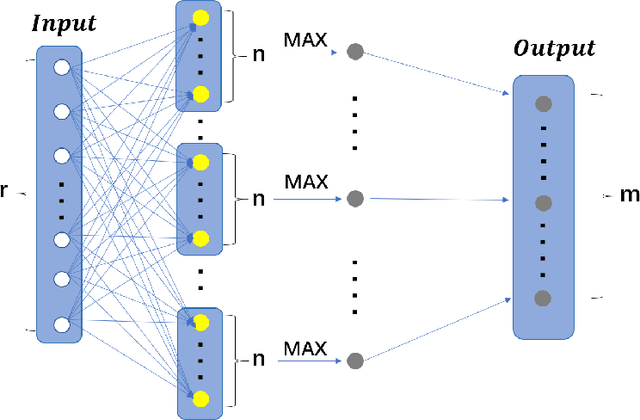
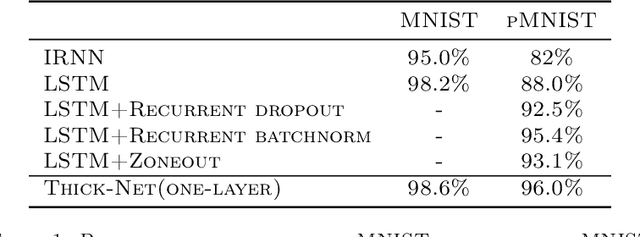
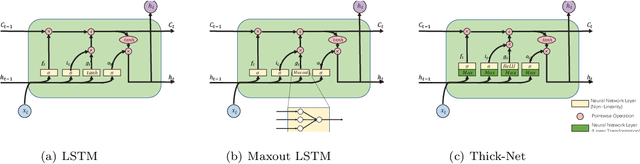
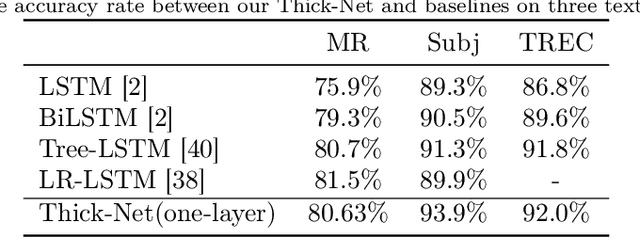
Recurrent neural networks have been widely used in sequence learning tasks. In previous studies, the performance of the model has always been improved by either wider or deeper structures. However, the former becomes more prone to overfitting, while the latter is difficult to optimize. In this paper, we propose a simple new model named Thick-Net, by expanding the network from another dimension: thickness. Multiple parallel values are obtained via more sets of parameters in each hidden state, and the maximum value is selected as the final output among parallel intermediate outputs. Notably, Thick-Net can efficiently avoid overfitting, and is easier to optimize than the vanilla structures due to the large dropout affiliated with it. Our model is evaluated on four sequential tasks including adding problem, permuted sequential MNIST, text classification and language modeling. The results of these tasks demonstrate that our model can not only improve accuracy with faster convergence but also facilitate a better generalization ability.