 Add to Chrome
 Add to Firefox
 Add to Edge
Stroke Lesions as a Rosetta Stone for Language Model Interpretability
Feb 03, 2026
Large language models (LLMs) have achieved remarkable capabilities, yet methods to verify which model components are truly necessary for language function remain limited. Current interpretability approaches rely on internal metrics and lack external validation. Here we present the Brain-LLM Unified Model (BLUM), a framework that leverages lesion-symptom mapping, the gold standard for establishing causal brain-behavior relationships for over a century, as an external reference structure for evaluating LLM perturbation effects. Using data from individuals with chronic post-stroke aphasia (N = 410), we trained symptom-to-lesion models that predict brain damage location from behavioral error profiles, applied systematic perturbations to transformer layers, administered identical clinical assessments to perturbed LLMs and human patients, and projected LLM error profiles into human lesion space. LLM error profiles were sufficiently similar to human error profiles that predicted lesions corresponded to actual lesions in error-matched humans above chance in 67% of picture naming conditions (p < 10^{-23}) and 68.3% of sentence completion conditions (p < 10^{-61}), with semantic-dominant errors mapping onto ventral-stream lesion patterns and phonemic-dominant errors onto dorsal-stream patterns. These findings open a new methodological avenue for LLM interpretability in which clinical neuroscience provides external validation, establishing human lesion-symptom mapping as a reference framework for evaluating artificial language systems and motivating direct investigation of whether behavioral alignment reflects shared computational principles.

Contrastive Diffusion Guidance for Spatial Inverse Problems
Sep 30, 2025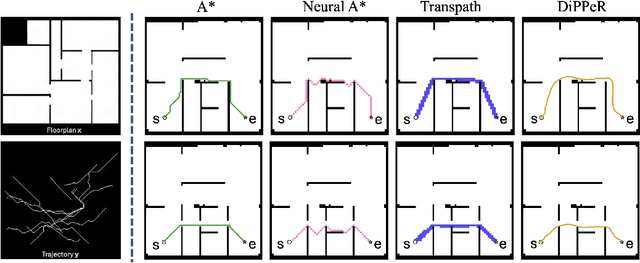
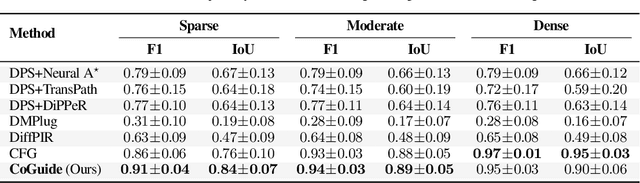
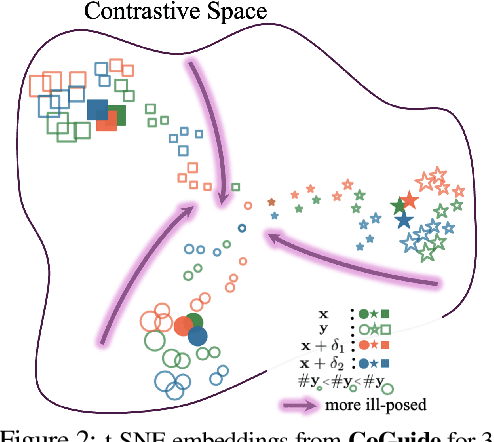
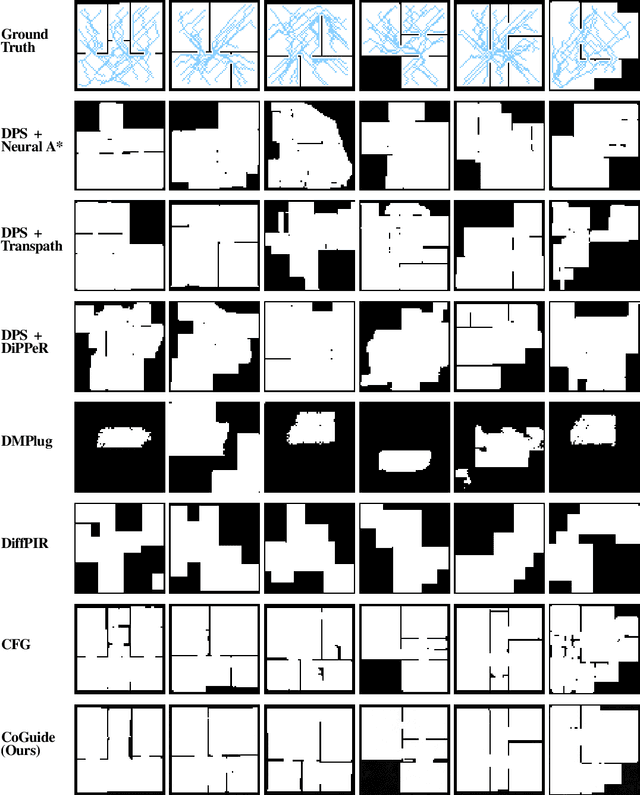
We consider the inverse problem of reconstructing the spatial layout of a place, a home floorplan for example, from a user`s movements inside that layout. Direct inversion is ill-posed since many floorplans can explain the same movement trajectories. We adopt a diffusion-based posterior sampler to generate layouts consistent with the measurements. While active research is in progress on generative inverse solvers, we find that the forward operator in our problem poses new challenges. The path-planning process inside a floorplan is a non-invertible, non-differentiable function, and causes instability while optimizing using the likelihood score. We break-away from existing approaches and reformulate the likelihood score in a smoother embedding space. The embedding space is trained with a contrastive loss which brings compatible floorplans and trajectories close to each other, while pushing mismatched pairs far apart. We show that a surrogate form of the likelihood score in this embedding space is a valid approximation of the true likelihood score, making it possible to steer the denoising process towards the posterior. Across extensive experiments, our model CoGuide produces more consistent floorplans from trajectories, and is more robust than differentiable-planner baselines and guided-diffusion methods.