 Add to Chrome
 Add to Firefox
 Add to Edge
Evolutionary Neural Architecture Search with Dual Contrastive Learning
Dec 23, 2025
Evolutionary Neural Architecture Search (ENAS) has gained attention for automatically designing neural network architectures. Recent studies use a neural predictor to guide the process, but the high computational costs of gathering training data -- since each label requires fully training an architecture -- make achieving a high-precision predictor with { limited compute budget (i.e., a capped number of fully trained architecture-label pairs)} crucial for ENAS success. This paper introduces ENAS with Dual Contrastive Learning (DCL-ENAS), a novel method that employs two stages of contrastive learning to train the neural predictor. In the first stage, contrastive self-supervised learning is used to learn meaningful representations from neural architectures without requiring labels. In the second stage, fine-tuning with contrastive learning is performed to accurately predict the relative performance of different architectures rather than their absolute performance, which is sufficient to guide the evolutionary search. Across NASBench-101 and NASBench-201, DCL-ENAS achieves the highest validation accuracy, surpassing the strongest published baselines by 0.05\% (ImageNet16-120) to 0.39\% (NASBench-101). On a real-world ECG arrhythmia classification task, DCL-ENAS improves performance by approximately 2.5 percentage points over a manually designed, non-NAS model obtained via random search, while requiring only 7.7 GPU-days.

Offline Multi-Task Multi-Objective Data-Driven Evolutionary Algorithm with Language Surrogate Model and Implicit Q-Learning
Dec 17, 2025Data-driven evolutionary algorithms has shown surprising results in addressing expensive optimization problems through robust surrogate modeling. Though promising, existing surrogate modeling schemes may encounter limitations in complex optimization problems with many sub-objectives, which rely on repeated and tedious approximation. To address such technical gap, we propose Q-MetaSur as a plug-and-play surrogate modeling scheme capable of providing unified and generalized surrogate learning. Specifically, we consider multi-task-multi-objective optimization~(MTMOO) in offline setting. Several key designs are proposed: 1) we transform objective approximation into sequence-to-sequence modeling where MTMOO problem can be represented by tenxual tokenization. To operate under such auto-regressive modeling, we introduce a Large Language Model-based surrogate model that first encodes a MTMOO instance and then decodes objective values of unseen decision variables. To ensure stability in training the proposed model, we propose a two-stage offline training strategy that operates as a synergy of supervised tuning and RL fine-tuning, which first exploits offline dataset to fit existing knowledge and then leverages RL to enhance model's generalization performance. Extensive empirical results on the CEC2019 benchmark demonstrate that Q-MetaSur not only outperforms representative surrogate baselines in objective approximation accuracy, but also helps underlying evolutionary algorithms achieve both desired optimization convergence and improved pareto optimality.
Island-Based Evolutionary Computation with Diverse Surrogates and Adaptive Knowledge Transfer for High-Dimensional Data-Driven Optimization
Mar 17, 2025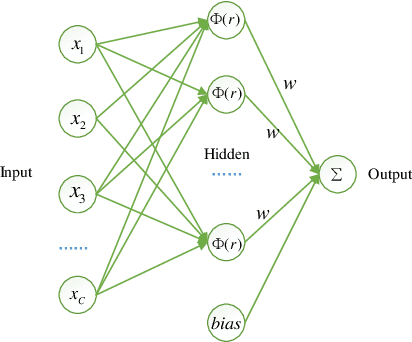
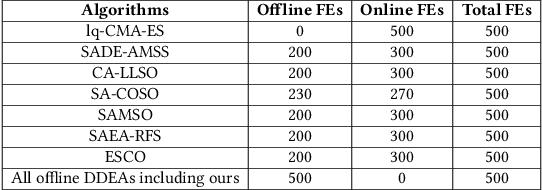
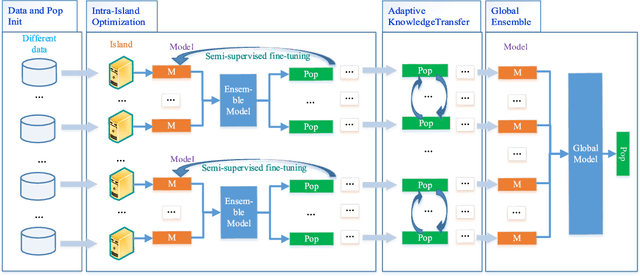
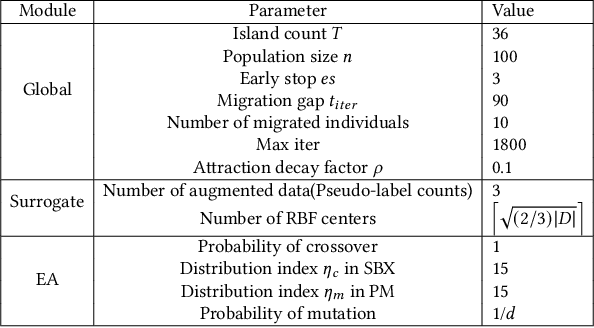
In recent years, there has been a growing interest in data-driven evolutionary algorithms (DDEAs) employing surrogate models to approximate the objective functions with limited data. However, current DDEAs are primarily designed for lower-dimensional problems and their performance drops significantly when applied to large-scale optimization problems (LSOPs). To address the challenge, this paper proposes an offline DDEA named DSKT-DDEA. DSKT-DDEA leverages multiple islands that utilize different data to establish diverse surrogate models, fostering diverse subpopulations and mitigating the risk of premature convergence. In the intra-island optimization phase, a semi-supervised learning method is devised to fine-tune the surrogates. It not only facilitates data argumentation, but also incorporates the distribution information gathered during the search process to align the surrogates with the evolving local landscapes. Then, in the inter-island knowledge transfer phase, the algorithm incorporates an adaptive strategy that periodically transfers individual information and evaluates the transfer effectiveness in the new environment, facilitating global optimization efficacy. Experimental results demonstrate that our algorithm is competitive with state-of-the-art DDEAs on problems with up to 1000 dimensions, while also exhibiting decent parallelism and scalability. Our DSKT-DDEA is open-source and accessible at: https://github.com/LabGong/DSKT-DDEA.
Large Language Model as Meta-Surrogate for Data-Driven Many-Task Optimization: A Proof-of-Principle Study
Mar 12, 2025In many-task optimization scenarios, surrogate models are valuable for mitigating the computational burden of repeated fitness evaluations across tasks. This study proposes a novel meta-surrogate framework to assist many-task optimization, by leveraging the knowledge transfer strengths and emergent capabilities of large language models (LLMs). We formulate a unified framework for many-task fitness prediction, by defining a universal model with metadata to fit a group of problems. Fitness prediction is performed on metadata and decision variables, enabling efficient knowledge sharing across tasks and adaptability to new tasks. The LLM-based meta-surrogate treats fitness prediction as conditional probability estimation, employing a unified token sequence representation for task metadata, inputs, and outputs. This approach facilitates efficient inter-task knowledge sharing through shared token embeddings and captures complex task dependencies via multi-task model training. Experimental results demonstrate the model's emergent generalization ability, including zero-shot performance on problems with unseen dimensions. When integrated into evolutionary transfer optimization (ETO), our framework supports dual-level knowledge transfer -- at both the surrogate and individual levels -- enhancing optimization efficiency and robustness. This work establishes a novel foundation for applying LLMs in surrogate modeling, offering a versatile solution for many-task optimization.