 Add to Chrome
 Add to Firefox
 Add to Edge
Spike-based Belief Propagation in Nonlinear Dynamical Systems
Aug 20, 2026
This paper presents a Bayesian control framework that integrates spike-based dynamics with probabilistic inference for adaptive control. Bayesian inference is widely regarded as a core computational principle of brain function, providing a normative framework for perception, decision-making, and learning under uncertainty. By combining a biologically inspired spiking neural model with Bayesian inference principles, we propose a brain-like control algorithm capable of operating in uncertain environments. We use the mountain car parking problem as a benchmark with non-linear dynamics. Our results demonstrate that the proposed controller can successfully update states in real time and generate goal-directed action plans through spike-driven dynamics. The results highlight the proposed model's potential as a bridge between computational neuroscience and probabilistic control theory.

Expected free energy as an information constraint on the Bethe Lagrangian
Aug 17, 2026Active inference selects actions by minimising an expected free energy functional over predicted futures. However, adding an expectation over yet-unobserved outcomes means the free energy functional no longer has a Kullback-Leibler structure, which hinders message passing treatments of inference procedures. We propose an alternative formulation based on a Bethe free energy functional, fully supporting inference by message passing. The epistemic drive is maintained by imposing an information constraint, next to normalisation, marginalisation and form constraints, insisting that the mutual information between future observations, states and parameters given actions must be at least as large as the entropy of the goal prior. For a specific value of the corresponding Karush-Kuhn-Tucker multiplier, the stationary point of this constrained Bethe Lagrangian recovers the expected free energy solution. We show that, as the information demand is varied, the solved multiplier moves through its inactive, interior, and saturated regimes. In the inactive regime the agent's epistemic drive switches off entirely, while in the saturated regime it is maximal. We compare the performance of the constrained Bethe agent on three tasks against EFE and Q-MDP.
A Factor Graph Approach to Scalable Multi-Output Gaussian Process Regression
Aug 12, 2026Multi-output Gaussian process regression scales cubically in the number of observations times outputs, and dense kernel-matrix methods need bespoke handling whenever different outputs are observed at different inputs. We express multi-output Gaussian process regression as a Forney-style factor graph in which a nearest-neighbor chain orders a fixed candidate set of $C$ inputs into a one-dimensional sequence. Along this chain, latent Matérn processes evolve through linear-Gaussian transition factors, while the linear model of coregionalization mixes $L$ latent processes into $D$ outputs through a deterministic mixing factor and per-output scalar observation factors. Posterior computation reduces to exact Gaussian message passing on the chain at cost $\mathcal{O}(C(DL^2 + L^3))$ after chain construction, and missing observations omit their local factor without any covariance-matrix restructuring. The formulation therefore scales in the number of data samples and in the rate of missing observations, while remaining best suited to candidate sets in low input dimension.We compare the factor-graph formulation against an exact kernel-matrix baseline, a sparse-variational inducing-point baseline, and a nearest-neighbor baseline on a synthetic input-dimension sweep and on electricity time series forecasting. At low input dimension the factor-graph posterior tracks the exact kernel-matrix posterior closely, and the gap grows gradually as input dimension increases while staying competitive with both approximate baselines. On the electricity time series our factor-graph formulation matches all three baselines in forecast accuracy while scaling linearly in the number of data points, where the exact kernel-matrix method becomes infeasible and the inducing-point baseline remains substantially slower.
Composing Non-Conjugate Factor Graphs with Closed-Form Variational Inference
May 28, 2026Stacking probabilistic building blocks into deeper architectures typically breaks closed-form inference. We show that closed-form inference can be preserved. We identify five factor-graph primitives: a bilinear factor, an exponential link, a Gamma prior, a Gaussian likelihood, and an equality node, and prove that any model composed from them admits closed-form variational message passing. The construction works because each primitive preserves a small set of message families: under mean-field factorization, messages on Gaussian variables remain Gaussian and messages on precision variables remain Gamma, while the only non-conjugate interface, the exponential link, remains tractable through the Gaussian moment-generating function and the sufficient statistics of the Gamma family. We demonstrate composition at increasing depth, from static ensembles through input-dependent gating to split-branch routing, and show that stacking routing layers encodes arbitrary decision trees, establishing universal function approximation with closed-form inference. Applied to ensemble time-series forecasting, the framework yields a Bayesian mixture of experts in which gating functions are inferred rather than learned, providing calibrated uncertainty over expert selection across five benchmark datasets.
Spike-Timing-Dependent Plasticity for Bernoulli Message Passing
Dec 19, 2025Bayesian inference provides a principled framework for understanding brain function, while neural activity in the brain is inherently spike-based. This paper bridges these two perspectives by designing spiking neural networks that simulate Bayesian inference through message passing for Bernoulli messages. To train the networks, we employ spike-timing-dependent plasticity, a biologically plausible mechanism for synaptic plasticity which is based on the Hebbian rule. Our results demonstrate that the network's performance closely matches the true numerical solution. We further demonstrate the versatility of our approach by implementing a factor graph example from coding theory, illustrating signal transmission over an unreliable channel.
A Spiking Neural Network Implementation of Gaussian Belief Propagation
Dec 11, 2025Bayesian inference offers a principled account of information processing in natural agents. However, it remains an open question how neural mechanisms perform their abstract operations. We investigate a hypothesis where a distributed form of Bayesian inference, namely message passing on factor graphs, is performed by a simulated network of leaky-integrate-and-fire neurons. Specifically, we perform Gaussian belief propagation by encoding messages that come into factor nodes as spike-based signals, propagating these signals through a spiking neural network (SNN) and decoding the spike-based signal back to an outgoing message. Three core linear operations, equality (branching), addition, and multiplication, are realized in networks of leaky integrate-and-fire models. Validation against the standard sum-product algorithm shows accurate message updates, while applications to Kalman filtering and Bayesian linear regression demonstrate the framework's potential for both static and dynamic inference tasks. Our results provide a step toward biologically grounded, neuromorphic implementations of probabilistic reasoning.
Coupled autoregressive active inference agents for control of multi-joint dynamical systems
Oct 14, 2024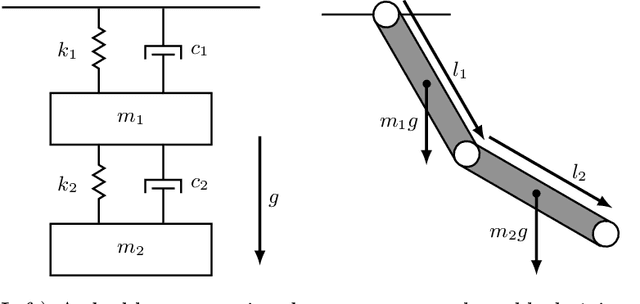
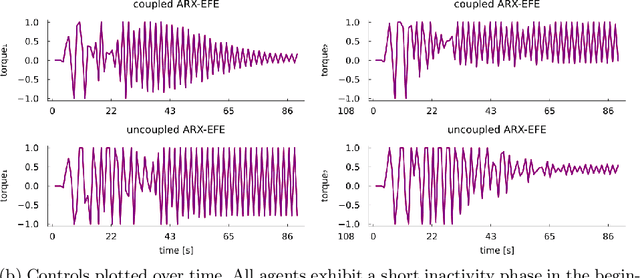
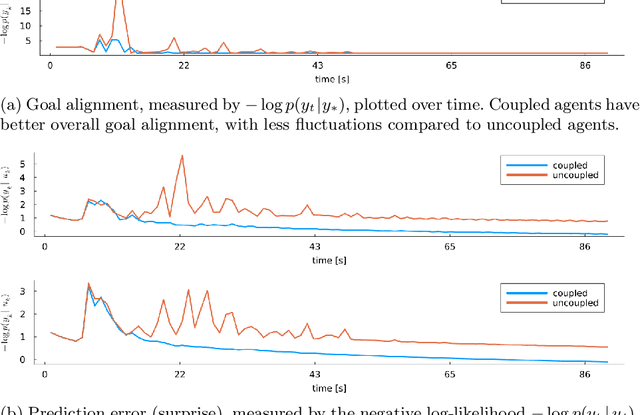
We propose an active inference agent to identify and control a mechanical system with multiple bodies connected by joints. This agent is constructed from multiple scalar autoregressive model-based agents, coupled together by virtue of sharing memories. Each subagent infers parameters through Bayesian filtering and controls by minimizing expected free energy over a finite time horizon. We demonstrate that a coupled agent of this kind is able to learn the dynamics of a double mass-spring-damper system, and drive it to a desired position through a balance of explorative and exploitative actions. It outperforms the uncoupled subagents in terms of surprise and goal alignment.
Planning to avoid ambiguous states through Gaussian approximations to non-linear sensors in active inference agents
Sep 03, 2024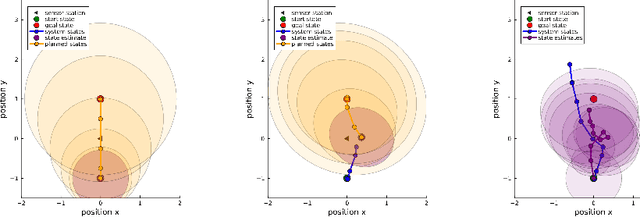
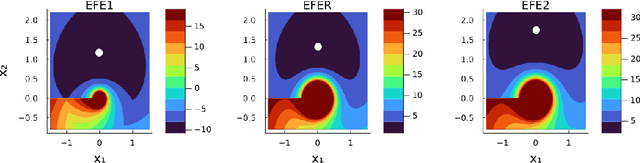
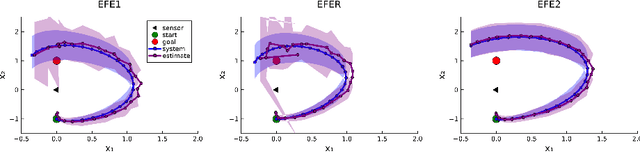
In nature, active inference agents must learn how observations of the world represent the state of the agent. In engineering, the physics behind sensors is often known reasonably accurately and measurement functions can be incorporated into generative models. When a measurement function is non-linear, the transformed variable is typically approximated with a Gaussian distribution to ensure tractable inference. We show that Gaussian approximations that are sensitive to the curvature of the measurement function, such as a second-order Taylor approximation, produce a state-dependent ambiguity term. This induces a preference over states, based on how accurately the state can be inferred from the observation. We demonstrate this preference with a robot navigation experiment where agents plan trajectories.
Bayesian grey-box identification of nonlinear convection effects in heat transfer dynamics
Jul 01, 2024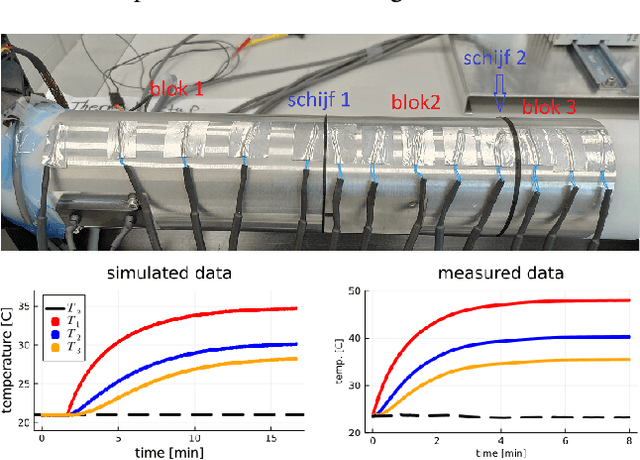
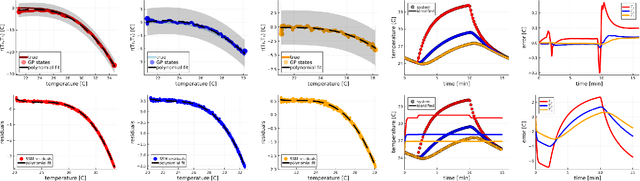
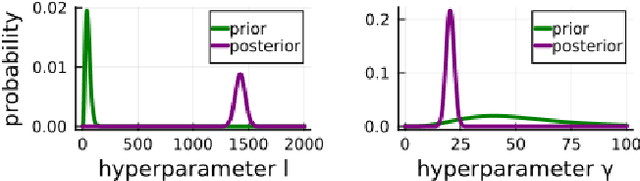
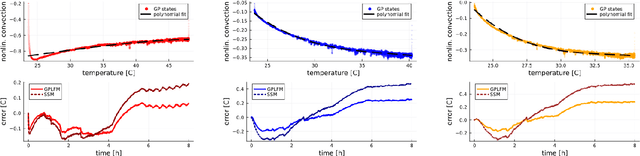
We propose a computational procedure for identifying convection in heat transfer dynamics. The procedure is based on a Gaussian process latent force model, consisting of a white-box component (i.e., known physics) for the conduction and linear convection effects and a Gaussian process that acts as a black-box component for the nonlinear convection effects. States are inferred through Bayesian smoothing and we obtain approximate posterior distributions for the kernel covariance function's hyperparameters using Laplace's method. The nonlinear convection function is recovered from the Gaussian process states using a Bayesian regression model. We validate the procedure by simulation error using the identified nonlinear convection function, on both data from a simulated system and measurements from a physical assembly.
Information-seeking polynomial NARX model-predictive control through expected free energy minimization
Dec 22, 2023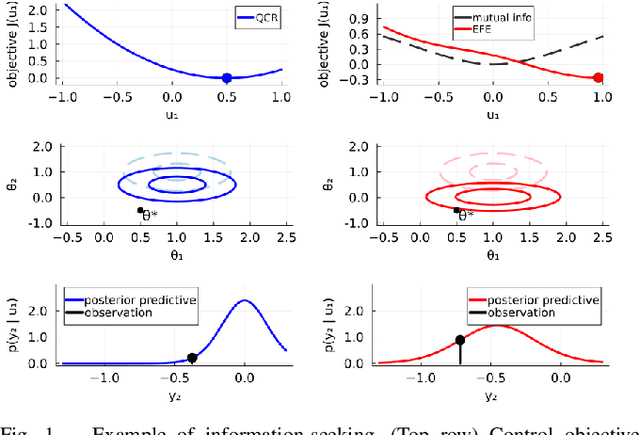
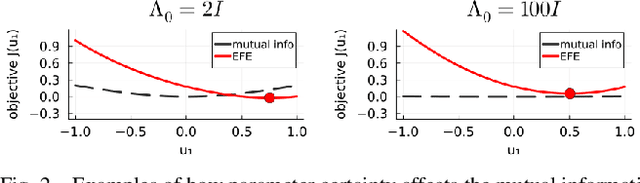
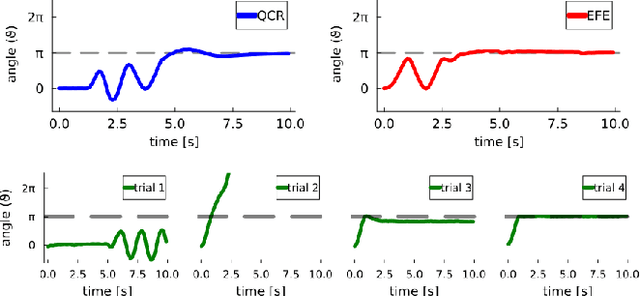
We propose an adaptive model-predictive controller that balances driving the system to a goal state and seeking system observations that are informative with respect to the parameters of a nonlinear autoregressive exogenous model. The controller's objective function is derived from an expected free energy functional and contains information-theoretic terms expressing uncertainty over model parameters and output predictions. Experiments illustrate how parameter uncertainty affects the control objective and evaluate the proposed controller for a pendulum swing-up task.