 Add to Chrome
 Add to Firefox
 Add to Edge
HeSS: Head Sensitivity Score for Sparsity Redistribution in VGGT
Mar 26, 2026
Visual Geometry Grounded Transformer (VGGT) has advanced 3D vision, yet its global attention layers suffer from quadratic computational costs that hinder scalability. Several sparsification-based acceleration techniques have been proposed to alleviate this issue, but they often suffer from substantial accuracy degradation. We hypothesize that the accuracy degradation stems from the heterogeneity in head-wise sparsification sensitivity, as the existing methods apply a uniform sparsity pattern across all heads. Motivated by this hypothesis, we present a two-stage sparsification pipeline that effectively quantifies and exploits headwise sparsification sensitivity. In the first stage, we measure head-wise sparsification sensitivity using a novel metric, the Head Sensitivity Score (HeSS), which approximates the Hessian with respect to two distinct error terms on a small calibration set. In the inference stage, we perform HeSS-Guided Sparsification, leveraging the pre-computed HeSS to reallocate the total attention budget-assigning denser attention to sensitive heads and sparser attention to more robust ones. We demonstrate that HeSS effectively captures head-wise sparsification sensitivity and empirically confirm that attention heads in the global attention layers exhibit heterogeneous sensitivity characteristics. Extensive experiments further show that our method effectively mitigates performance degradation under high sparsity, demonstrating strong robustness across varying sparsification levels. Code is available at https://github.com/libary753/HeSS.

KoBALT: Korean Benchmark For Advanced Linguistic Tasks
May 22, 2025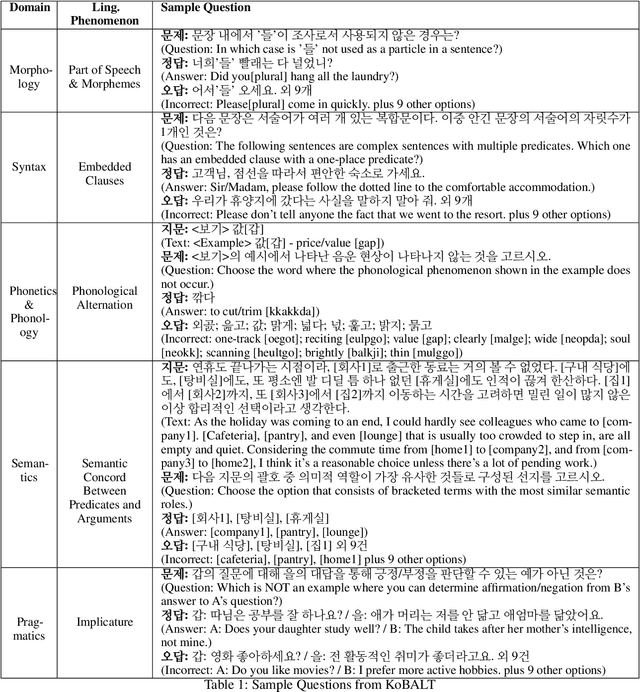
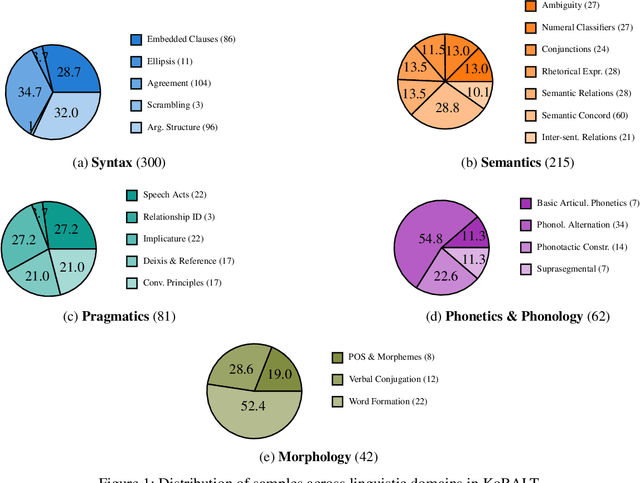
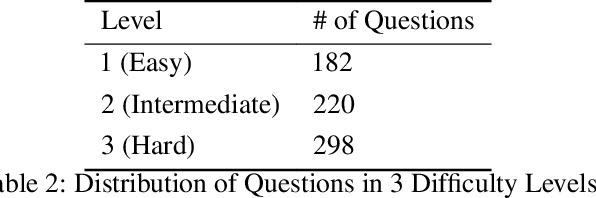
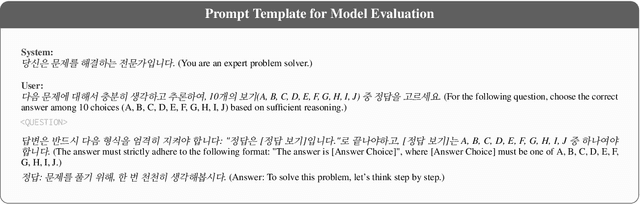
We introduce KoBALT (Korean Benchmark for Advanced Linguistic Tasks), a comprehensive linguistically-motivated benchmark comprising 700 multiple-choice questions spanning 24 phenomena across five linguistic domains: syntax, semantics, pragmatics, phonetics/phonology, and morphology. KoBALT is designed to advance the evaluation of large language models (LLMs) in Korean, a morphologically rich language, by addressing the limitations of conventional benchmarks that often lack linguistic depth and typological grounding. It introduces a suite of expert-curated, linguistically motivated questions with minimal n-gram overlap with standard Korean corpora, substantially mitigating the risk of data contamination and allowing a more robust assessment of true language understanding. Our evaluation of 20 contemporary LLMs reveals significant performance disparities, with the highest-performing model achieving 61\% general accuracy but showing substantial variation across linguistic domains - from stronger performance in semantics (66\%) to considerable weaknesses in phonology (31\%) and morphology (36\%). Through human preference evaluation with 95 annotators, we demonstrate a strong correlation between KoBALT scores and human judgments, validating our benchmark's effectiveness as a discriminative measure of Korean language understanding. KoBALT addresses critical gaps in linguistic evaluation for typologically diverse languages and provides a robust framework for assessing genuine linguistic competence in Korean language models.