 Add to Chrome
 Add to Firefox
 Add to Edge
Deep Filter Estimation from Inter-Frame Correlations for Monaural Speech Dereverberation
Mar 16, 2026
Speech dereverberation in distant-microphone scenarios remains challenging due to the high correlation between reverberation and target signals, often leading to poor generalization in real-world environments. We propose IF-CorrNet, a correlation-to-filter architecture designed for robustness against acoustic variability. Unlike conventional black-box mapping methods that directly estimate complex spectra, IF-CorrNet explicitly exploits inter-frame STFT correlations to estimate multi-frame deep filters for each time-frequency bin. By shifting the learning objective from direct mapping to filter estimation, the network effectively constrains the solution space, which simplifies the training process and mitigates overfitting to synthetic data. Experimental results on the REVERB Challenge dataset demonstrate that IF-CorrNet achieves a substantial gain in the SRMR metric on RealData, confirming its robustness in suppressing reverberation and noise in practical, non-synthetic environments.

REF$^2$-NeRF: Reflection and Refraction aware Neural Radiance Field
Nov 30, 2023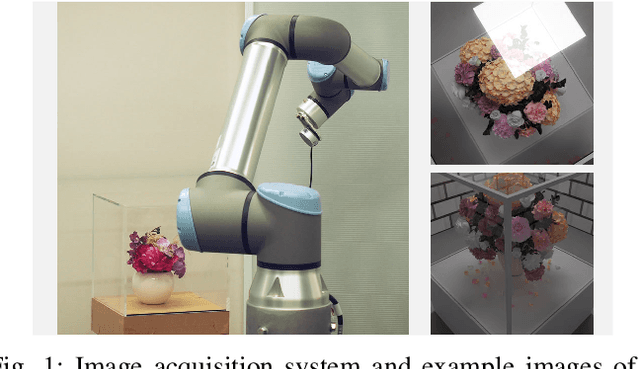
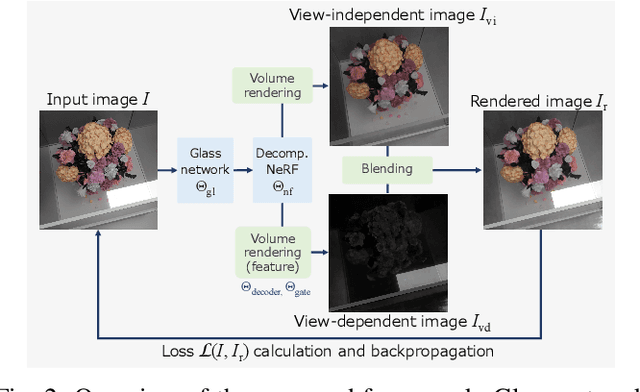
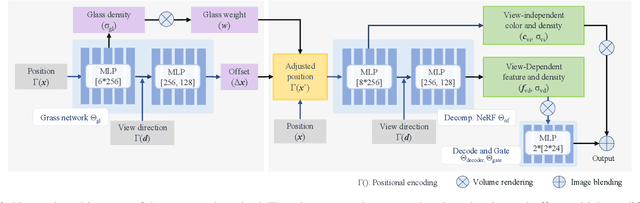
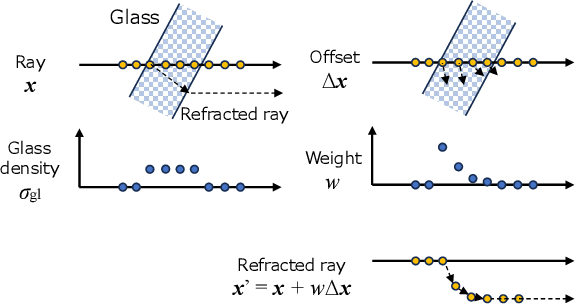
Recently, significant progress has been made in the study of methods for 3D reconstruction from multiple images using implicit neural representations, exemplified by the neural radiance field (NeRF) method. Such methods, which are based on volume rendering, can model various light phenomena, and various extended methods have been proposed to accommodate different scenes and situations. However, when handling scenes with multiple glass objects, e.g., objects in a glass showcase, modeling the target scene accurately has been challenging due to the presence of multiple reflection and refraction effects. Thus, this paper proposes a NeRF-based modeling method for scenes containing a glass case. In the proposed method, refraction and reflection are modeled using elements that are dependent and independent of the viewer's perspective. This approach allows us to estimate the surfaces where refraction occurs, i.e., glass surfaces, and enables the separation and modeling of both direct and reflected light components. Compared to existing methods, the proposed method enables more accurate modeling of both glass refraction and the overall scene.