 Add to Chrome
 Add to Firefox
 Add to Edge
AI Engram: In Search of Memory Traces in Artificial Intelligence
Jun 12, 2026
Memory formation is fundamental to intelligence, yet whether deep neural networks preserve identifiable memory traces analogous to biological memory units remains an open question. This work introduces a geometric framework to identify such "AI engrams" by formalizing the neuroscientific criteria of specificity, reactivation, sufficiency, and necessity into a constrained inverse problem. We derive a closed-form estimator that isolates individual memory traces from globally entangled parameters, and show that this biologically-derived solution corresponds to a natural gradient update on the parameter manifold. AI engrams enable surgical manipulation of learned knowledge: any subset of memories can be composed or erased through linear arithmetic, without iterative optimization. Experiments ranging from simple MLPs to LLMs demonstrate the causal validity and substantial scalability of AI engrams. Together, these results bridge theories of biological memory and artificial representation learning and offer geometric insight into how deep networks simultaneously support functional specificity within distributed storage.

An Arrhythmia Classification-Guided Segmentation Model for Electrocardiogram Delineation
Apr 13, 2023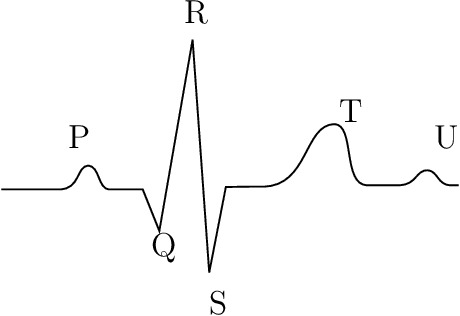

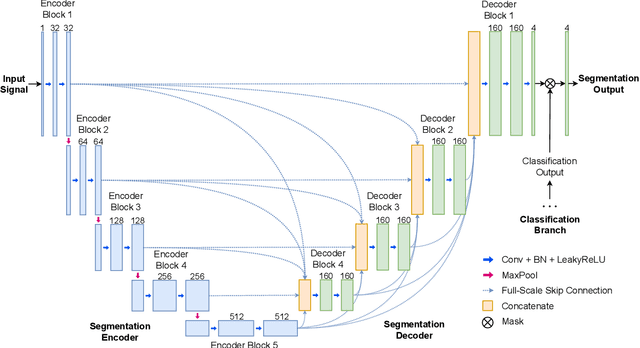
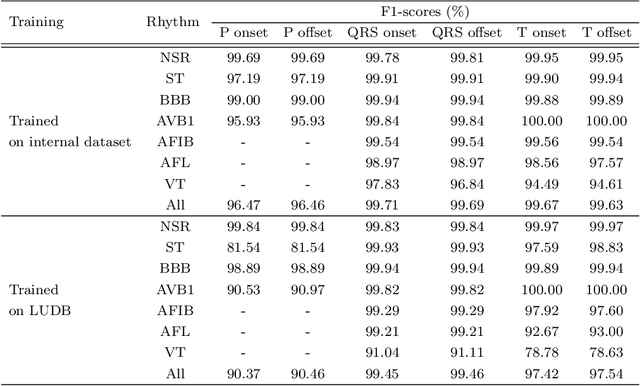
Accurate delineation of key waveforms in an ECG is a critical initial step in extracting relevant features to support the diagnosis and treatment of heart conditions. Although deep learning based methods using a segmentation model to locate P, QRS and T waves have shown promising results, their ability to handle signals exhibiting arrhythmia remains unclear. In this study, we propose a novel approach that leverages a deep learning model to accurately delineate signals with a wide range of arrhythmia. Our approach involves training a segmentation model using a hybrid loss function that combines segmentation with the task of arrhythmia classification. In addition, we use a diverse training set containing various arrhythmia types, enabling our model to handle a wide range of challenging cases. Experimental results show that our model accurately delineates signals with a broad range of abnormal rhythm types, and the combined training with classification guidance can effectively reduce false positive P wave predictions, particularly during atrial fibrillation and atrial flutter. Furthermore, our proposed method shows competitive performance with previous delineation algorithms on the Lobachevsky University Database (LUDB).