 Add to Chrome
 Add to Firefox
 Add to Edge
PropFly: Learning to Propagate via On-the-Fly Supervision from Pre-trained Video Diffusion Models
Feb 24, 2026
Propagation-based video editing enables precise user control by propagating a single edited frame into following frames while maintaining the original context such as motion and structures. However, training such models requires large-scale, paired (source and edited) video datasets, which are costly and complex to acquire. Hence, we propose the PropFly, a training pipeline for Propagation-based video editing, relying on on-the-Fly supervision from pre-trained video diffusion models (VDMs) instead of requiring off-the-shelf or precomputed paired video editing datasets. Specifically, our PropFly leverages one-step clean latent estimations from intermediate noised latents with varying Classifier-Free Guidance (CFG) scales to synthesize diverse pairs of 'source' (low-CFG) and 'edited' (high-CFG) latents on-the-fly. The source latent serves as structural information of the video, while the edited latent provides the target transformation for learning propagation. Our pipeline enables an additional adapter attached to the pre-trained VDM to learn to propagate edits via Guidance-Modulated Flow Matching (GMFM) loss, which guides the model to replicate the target transformation. Our on-the-fly supervision ensures the model to learn temporally consistent and dynamic transformations. Extensive experiments demonstrate that our PropFly significantly outperforms the state-of-the-art methods on various video editing tasks, producing high-quality editing results.

BiM-VFI: directional Motion Field-Guided Frame Interpolation for Video with Non-uniform Motions
Dec 16, 2024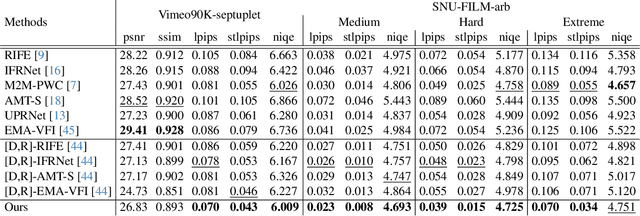
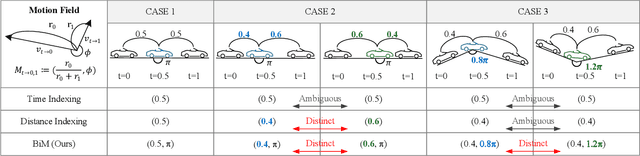
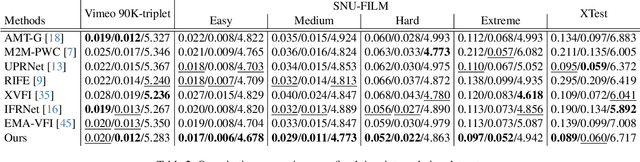
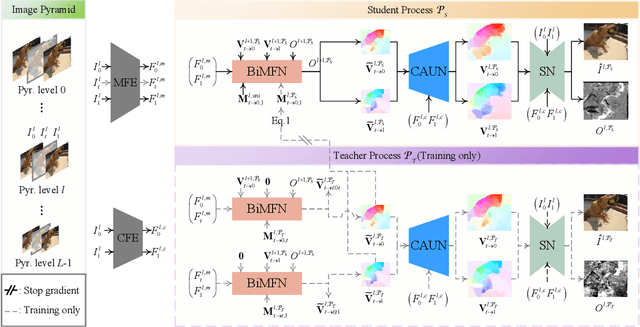
Existing Video Frame interpolation (VFI) models tend to suffer from time-to-location ambiguity when trained with video of non-uniform motions, such as accelerating, decelerating, and changing directions, which often yield blurred interpolated frames. In this paper, we propose (i) a novel motion description map, Bidirectional Motion field (BiM), to effectively describe non-uniform motions; (ii) a BiM-guided Flow Net (BiMFN) with Content-Aware Upsampling Network (CAUN) for precise optical flow estimation; and (iii) Knowledge Distillation for VFI-centric Flow supervision (KDVCF) to supervise the motion estimation of VFI model with VFI-centric teacher flows. The proposed VFI is called a Bidirectional Motion field-guided VFI (BiM-VFI) model. Extensive experiments show that our BiM-VFI model significantly surpasses the recent state-of-the-art VFI methods by 26% and 45% improvements in LPIPS and STLPIPS respectively, yielding interpolated frames with much fewer blurs at arbitrary time instances.