 Add to Chrome
 Add to Firefox
 Add to Edge
Horizon3D: Sparse Radar-Camera Fusion for Long-Range 3D Perception in Autonomous Driving
Jun 30, 2026
Long-range 3D object detection is critical for safe autonomous driving at highway speeds, yet existing radar-camera fusion methods remain limited at extended ranges. BEV-based methods capture scene-level context but incur rapidly growing computation and often lose fine-grained object detail, while query-based methods are efficient but provide limited scene-level context. Temporal fusion further requires both multi-frame accumulation for sparse distant observations and object-level motion modeling for fast-moving objects. We propose Horizon3D, a sparse radar-camera fusion framework for long-range 3D object detection that combines Gaussian primitives with sparse BEV features. Horizon3D initializes Gaussian primitives at radar- and camera-estimated object keypoints using Keypoint-Guided Gaussian Initialization, refines them through Object-Centric Sparse Fusion, and splats them onto the BEV plane to fuse object-level detail with sparse radar BEV context. It further introduces Dual-Path Temporal Fusion, which aggregates temporal cues through a BEV path for scene-level accumulation and a Gaussian path for object-level motion propagation. Experiments on TruckScenes show that Horizon3D achieves state-of-the-art radar-camera 3D detection performance. On the validation set, it outperforms the previous best method by +3.0 NDS and +1.6 mAP while maintaining competitive inference speed.

Comparison of Image Processing Models in Quark Gluon Jet Classification
Jan 29, 2026We present a comprehensive comparison of convolutional and transformer-based models for distinguishing quark and gluon jets using simulated jet images from Pythia 8. By encoding jet substructure into a three-channel representation of particle kinematics, we evaluate the performance of convolutional neural networks (CNNs), Vision Transformers (ViTs), and Swin Transformers (Swin-Tiny) under both supervised and self-supervised learning setups. Our results show that fine-tuning only the final two transformer blocks of the Swin-Tiny model achieves the best trade-off between efficiency and accuracy, reaching 81.4% accuracy and an AUC (area under the ROC curve) of 88.9%. Self-supervised pretraining with Momentum Contrast (MoCo) further enhances feature robustness and reduces the number of trainable parameters. These findings highlight the potential of hierarchical attention-based models for jet substructure studies and for domain transfer to real collision data.
Convergence and Generalization of Anti-Regularization for Parametric Models
Aug 24, 2025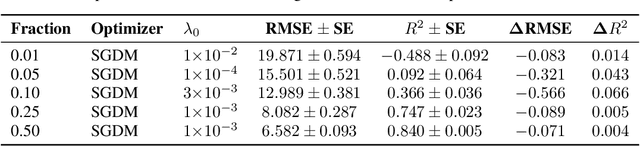
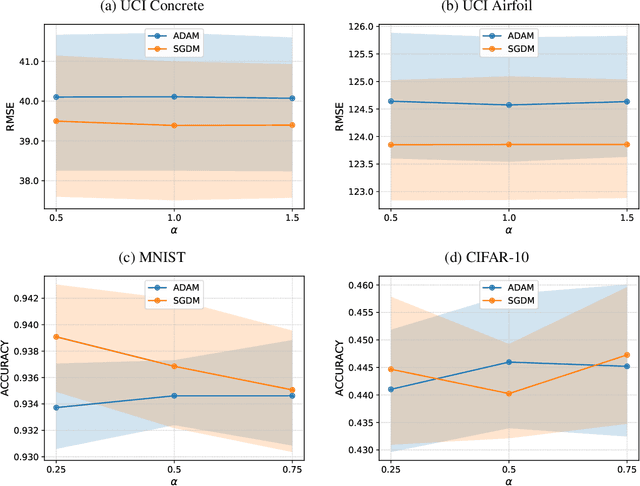
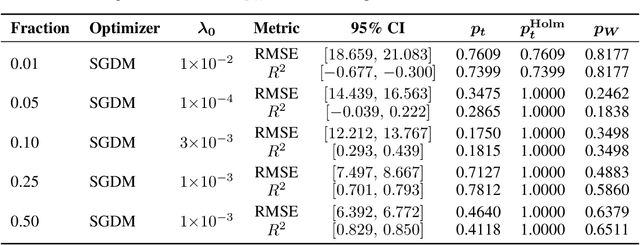

We propose Anti-regularization (AR), which adds a sign-reversed reward term to the loss to intentionally increase model expressivity in the small-sample regime, and then attenuates this intervention with a power-law decay as the sample size grows. We formalize spectral safety and trust-region conditions, and design a lightweight stability safeguard that combines a projection operator with gradient clipping, ensuring stable intervention under stated assumptions. Our analysis spans linear smoothers and the Neural Tangent Kernel (NTK) regime, providing practical guidance on selecting the decay exponent by balancing empirical risk against variance. Empirically, AR reduces underfitting while preserving generalization and improving calibration in both regression and classification. Ablation studies confirm that the decay schedule and the stability safeguard are critical to preventing overfitting and numerical instability. We further examine a degrees-of-freedom targeting schedule that keeps per-sample complexity approximately constant. AR is simple to implement and reproducible, integrating cleanly into standard empirical risk minimization pipelines. It enables robust learning in data- and resource-constrained settings by intervening only when beneficial and fading away when unnecessary.