 Add to Chrome
 Add to Firefox
 Add to Edge
MoRGS: Efficient Per-Gaussian Motion Reasoning for Streamable Dynamic 3D Scenes
Mar 26, 2026
Online reconstruction of dynamic scenes aims to learn from streaming multi-view inputs under low-latency constraints. The fast training and real-time rendering capabilities of 3D Gaussian Splatting have made on-the-fly reconstruction practically feasible, enabling online 4D reconstruction. However, existing online approaches, despite their efficiency and visual quality, fail to learn per-Gaussian motion that reflects true scene dynamics. Without explicit motion cues, appearance and motion are optimized solely under photometric loss, causing per-Gaussian motion to chase pixel residuals rather than true 3D motion. To address this, we propose MoRGS, an efficient online per-Gaussian motion reasoning framework that explicitly models per-Gaussian motion to improve 4D reconstruction quality. Specifically, we leverage optical flow on a sparse set of key views as lightweight motion cues that regularize per-Gaussian motion beyond photometric supervision. To compensate for the sparsity of flow supervision, we learn a per-Gaussian motion offset field that reconciles discrepancies between projected 3D motion and observed flow across views and time. In addition, we introduce a per-Gaussian motion confidence that separates dynamic from static Gaussians and weights Gaussian attribute residual updates, thereby suppressing redundant motion in static regions for better temporal consistency and accelerating the modeling of large motions. Extensive experiments demonstrate that MoRGS achieves state-of-the-art reconstruction quality and motion fidelity among online methods, while maintaining streamable performance.

CoMoGaussian: Continuous Motion-Aware Gaussian Splatting from Motion-Blurred Images
Mar 07, 20253D Gaussian Splatting (3DGS) has gained significant attention for their high-quality novel view rendering, motivating research to address real-world challenges. A critical issue is the camera motion blur caused by movement during exposure, which hinders accurate 3D scene reconstruction. In this study, we propose CoMoGaussian, a Continuous Motion-Aware Gaussian Splatting that reconstructs precise 3D scenes from motion-blurred images while maintaining real-time rendering speed. Considering the complex motion patterns inherent in real-world camera movements, we predict continuous camera trajectories using neural ordinary differential equations (ODEs). To ensure accurate modeling, we employ rigid body transformations, preserving the shape and size of the object but rely on the discrete integration of sampled frames. To better approximate the continuous nature of motion blur, we introduce a continuous motion refinement (CMR) transformation that refines rigid transformations by incorporating additional learnable parameters. By revisiting fundamental camera theory and leveraging advanced neural ODE techniques, we achieve precise modeling of continuous camera trajectories, leading to improved reconstruction accuracy. Extensive experiments demonstrate state-of-the-art performance both quantitatively and qualitatively on benchmark datasets, which include a wide range of motion blur scenarios, from moderate to extreme blur.
ProDepth: Boosting Self-Supervised Multi-Frame Monocular Depth with Probabilistic Fusion
Jul 12, 2024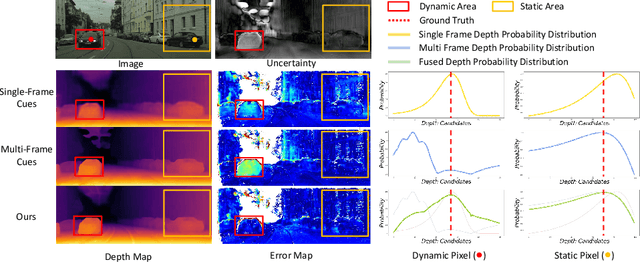
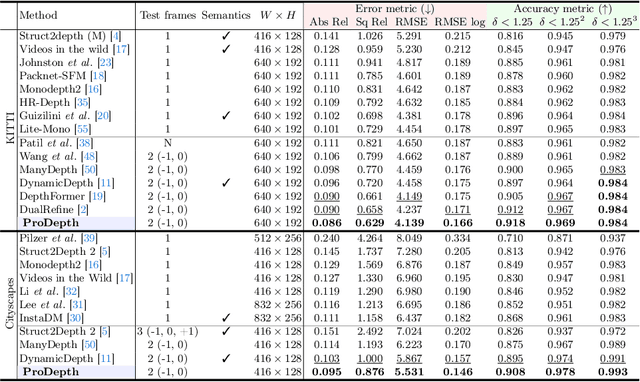
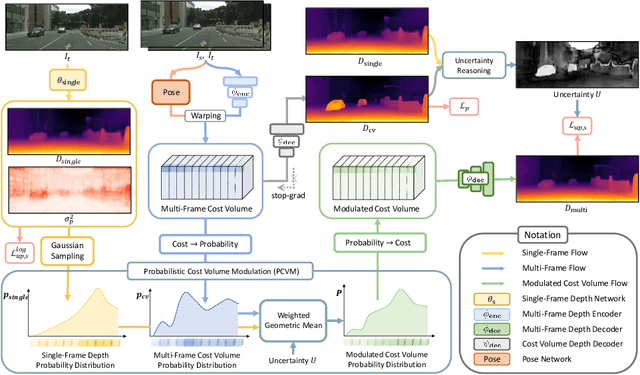

Self-supervised multi-frame monocular depth estimation relies on the geometric consistency between successive frames under the assumption of a static scene. However, the presence of moving objects in dynamic scenes introduces inevitable inconsistencies, causing misaligned multi-frame feature matching and misleading self-supervision during training. In this paper, we propose a novel framework called ProDepth, which effectively addresses the mismatch problem caused by dynamic objects using a probabilistic approach. We initially deduce the uncertainty associated with static scene assumption by adopting an auxiliary decoder. This decoder analyzes inconsistencies embedded in the cost volume, inferring the probability of areas being dynamic. We then directly rectify the erroneous cost volume for dynamic areas through a Probabilistic Cost Volume Modulation (PCVM) module. Specifically, we derive probability distributions of depth candidates from both single-frame and multi-frame cues, modulating the cost volume by adaptively fusing those distributions based on the inferred uncertainty. Additionally, we present a self-supervision loss reweighting strategy that not only masks out incorrect supervision with high uncertainty but also mitigates the risks in remaining possible dynamic areas in accordance with the probability. Our proposed method excels over state-of-the-art approaches in all metrics on both Cityscapes and KITTI datasets, and demonstrates superior generalization ability on the Waymo Open dataset.