 Add to Chrome
 Add to Firefox
 Add to Edge
Event-based Photometric Stereo via Rotating Illumination and Per-Pixel Learning
Mar 11, 2026
Photometric stereo is a technique for estimating surface normals using images captured under varying illumination. However, conventional frame-based photometric stereo methods are limited in real-world applications due to their reliance on controlled lighting, and susceptibility to ambient illumination. To address these limitations, we propose an event-based photometric stereo system that leverages an event camera, which is effective in scenarios with continuously varying scene radiance and high dynamic range conditions. Our setup employs a single light source moving along a predefined circular trajectory, eliminating the need for multiple synchronized light sources and enabling a more compact and scalable design. We further introduce a lightweight per-pixel multi-layer neural network that directly predicts surface normals from event signals generated by intensity changes as the light source rotates, without system calibration. Experimental results on benchmark datasets and real-world data collected with our data acquisition system demonstrate the effectiveness of our method, achieving a 7.12\% reduction in mean angular error compared to existing event-based photometric stereo methods. In addition, our method demonstrates robustness in regions with sparse event activity, strong ambient illumination, and scenes affected by specularities.

Enhanced fringe-to-phase framework using deep learning
Feb 01, 2024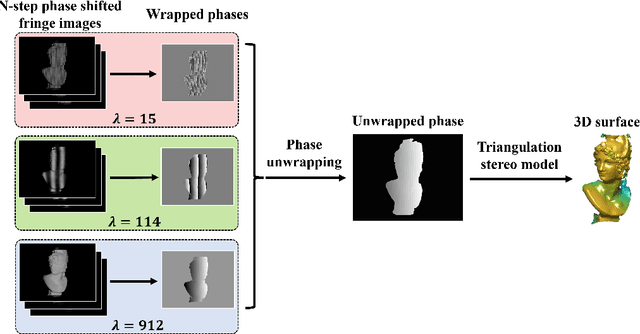
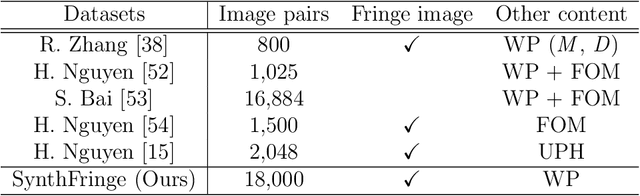
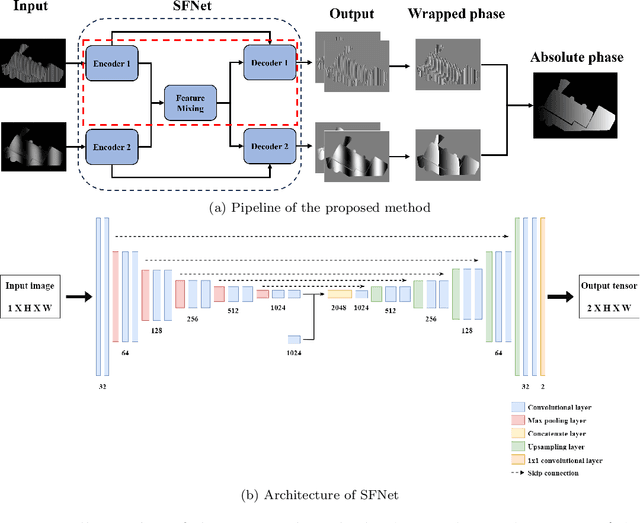
In Fringe Projection Profilometry (FPP), achieving robust and accurate 3D reconstruction with a limited number of fringe patterns remains a challenge in structured light 3D imaging. Conventional methods require a set of fringe images, but using only one or two patterns complicates phase recovery and unwrapping. In this study, we introduce SFNet, a symmetric fusion network that transforms two fringe images into an absolute phase. To enhance output reliability, Our framework predicts refined phases by incorporating information from fringe images of a different frequency than those used as input. This allows us to achieve high accuracy with just two images. Comparative experiments and ablation studies validate the effectiveness of our proposed method. The dataset and code are publicly accessible on our project page https://wonhoe-kim.github.io/SFNet.