 Add to Chrome
 Add to Firefox
 Add to Edge
Contact-Based Fringe Projection Profilometry for High-Resolution 3-D Surface Measurement of Reflective and Transparent Objects
Jun 16, 2026
This paper presents a contact-based 3-D surface measurement method based on a Digital Fringe Projection (DFP) system, belonging to the vision-based tactile sensing family pioneered by the commercially successful GelSight sensor. Such sensors have proven effective for robotic fingertip manipulation and contact sensing. However, because GelSight employs photometric stereo with RGB LEDs, it does not measure absolute depth directly but instead infers it by integrating estimated surface gradients, which can accumulate reconstruction errors; in addition, it becomes increasingly difficult to calibrate as the sensing area grows, and its depth accuracy is challenged on highly reflective or transparent objects. To overcome these drawbacks, we propose a fringe-projection-based contact measurement technique that performs triangulation-based 3-D reconstruction on a coated silicone contact surface, providing dense per-pixel surface geometry and full-field 3-D shape measurement over the contact region. By integrating high-accuracy digital fringe projection into the sensor, our approach simplifies calibration over larger areas and enhances depth precision for complex surfaces. Experimental results, including a direct comparison with a GelSight Mini sensor, a sphere-fitting accuracy evaluation, and an uncertainty analysis, confirm that the proposed method significantly improves the accuracy and stability of structured-light-based 3-D measurements, allowing reliable reconstruction of objects with diverse optical properties.

Enhanced fringe-to-phase framework using deep learning
Feb 01, 2024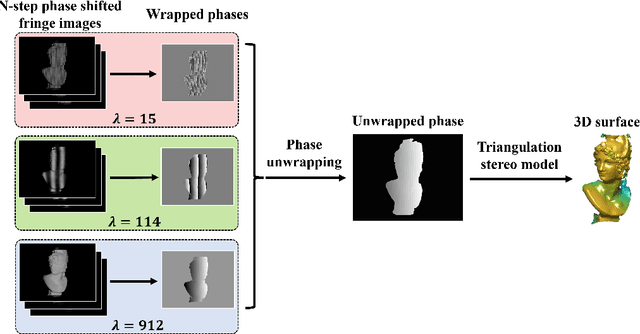
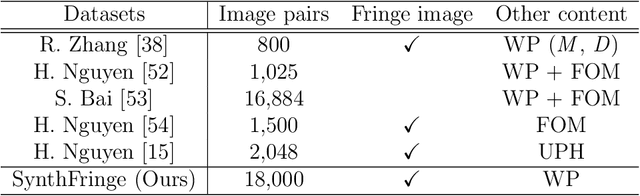
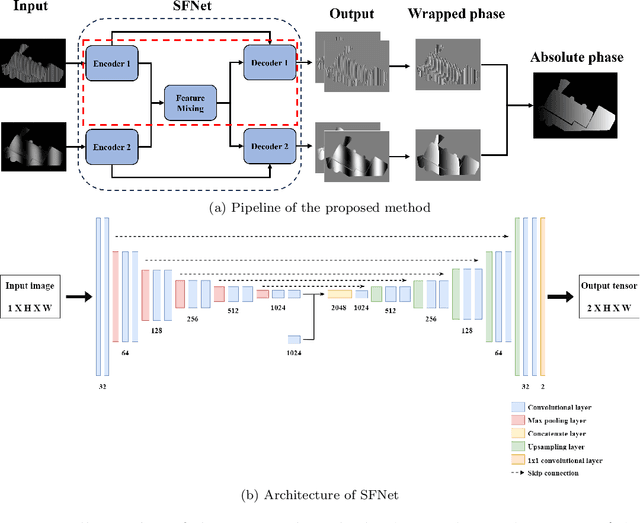
In Fringe Projection Profilometry (FPP), achieving robust and accurate 3D reconstruction with a limited number of fringe patterns remains a challenge in structured light 3D imaging. Conventional methods require a set of fringe images, but using only one or two patterns complicates phase recovery and unwrapping. In this study, we introduce SFNet, a symmetric fusion network that transforms two fringe images into an absolute phase. To enhance output reliability, Our framework predicts refined phases by incorporating information from fringe images of a different frequency than those used as input. This allows us to achieve high accuracy with just two images. Comparative experiments and ablation studies validate the effectiveness of our proposed method. The dataset and code are publicly accessible on our project page https://wonhoe-kim.github.io/SFNet.