 Add to Chrome
 Add to Firefox
 Add to Edge
VIHD: Visual Intervention-based Hallucination Detection for Medical Visual Question Answering
May 20, 2026
While medical Multimodal Large Language Models (MLLMs) have shown promise in assisting diagnosis, they still frequently generate hallucinated responses that appear linguistically plausible but lack visual evidence. Such hallucinations pose risks to clinical decision-making and necessitate effective detection. Existing introspective detection methods primarily perform uncertainty estimation or logical verification by analyzing model responses conditioned on original or perturbed inputs. However, such external perturbations are often heuristic and context-agnostic, which overlooks the internal cross-modal dependency between generated tokens and related visual tokens during decoding. To address this issue, we propose VIHD, a Visual Intervention-based Hallucination Detection method that leverages targeted visual token masking to calibrate semantic entropy for more effective hallucination detection. VIHD locates visually dominant decoder layers via Visual Dependency Probing (VDP), executes Visual Intervention Decoding (VID) via token masking to calibrate the semantic distribution, and quantifies the resulting Calibrated Semantic Entropy (CSE) as a reliable hallucination signal. Extensive experiments on three medical VQA benchmarks with two medical MLLMs demonstrate that VIHD consistently outperforms state-of-the-art methods, underscoring the importance of fine-grained visual dependency for hallucination detection. The code will be available at https://github.com/Jiayi-Chen-AU/VIHD

EviATTA: Evidential Active Test-Time Adaptation for Medical Segment Anything Models
Mar 15, 2026Deploying foundational medical Segment Anything Models (SAMs) via test-time adaptation (TTA) is challenging under large distribution shifts, where test-time supervision is often unreliable. While active test-time adaptation (ATTA) introduces limited expert feedback to improve reliability, existing ATTA methods still suffer from unreliable uncertainty estimation and inefficient utilization of sparse annotations. To address these issues, we propose Evidential Active Test-Time Adaptation (EviATTA), which is, to our knowledge, the first ATTA framework tailored for medical SAMs. Specifically, we adopt the Dirichlet-based Evidential Modeling to decompose overall predictive uncertainty into distribution uncertainty and data uncertainty. Building on this decomposition, we design a Hierarchical Evidential Sampling strategy, where image-wise distribution uncertainty is used to select informative shifted samples, while distance-aware data uncertainty guides sparse pixel annotations to resolve data ambiguities. We further introduce Dual Consistency Regularization, which enforces progressive prompt consistency on sparsely labeled samples to better exploit sparse supervision and applies variational feature consistency on unlabeled samples to stabilize adaptation. Extensive experiments on six medical image segmentation datasets demonstrate that EviATTA consistently improves adaptation reliability with minimal expert feedback under both batch-wise and instance-wise test-time adaptation settings.
CoactSeg: Learning from Heterogeneous Data for New Multiple Sclerosis Lesion Segmentation
Jul 10, 2023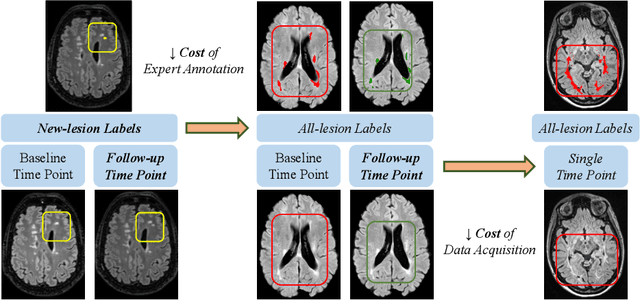

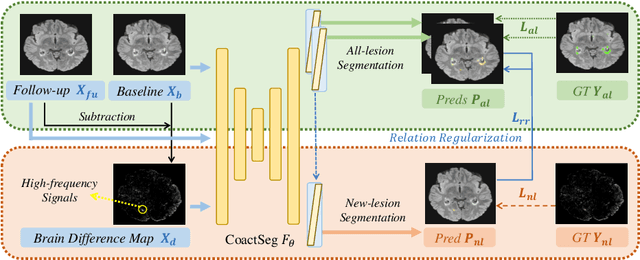

New lesion segmentation is essential to estimate the disease progression and therapeutic effects during multiple sclerosis (MS) clinical treatments. However, the expensive data acquisition and expert annotation restrict the feasibility of applying large-scale deep learning models. Since single-time-point samples with all-lesion labels are relatively easy to collect, exploiting them to train deep models is highly desirable to improve new lesion segmentation. Therefore, we proposed a coaction segmentation (CoactSeg) framework to exploit the heterogeneous data (i.e., new-lesion annotated two-time-point data and all-lesion annotated single-time-point data) for new MS lesion segmentation. The CoactSeg model is designed as a unified model, with the same three inputs (the baseline, follow-up, and their longitudinal brain differences) and the same three outputs (the corresponding all-lesion and new-lesion predictions), no matter which type of heterogeneous data is being used. Moreover, a simple and effective relation regularization is proposed to ensure the longitudinal relations among the three outputs to improve the model learning. Extensive experiments demonstrate that utilizing the heterogeneous data and the proposed longitudinal relation constraint can significantly improve the performance for both new-lesion and all-lesion segmentation tasks. Meanwhile, we also introduce an in-house MS-23v1 dataset, including 38 Oceania single-time-point samples with all-lesion labels. Codes and the dataset are released at https://github.com/ycwu1997/CoactSeg.