 Add to Chrome
 Add to Firefox
 Add to Edge
Active Learning for Generalizable Detonation Performance Prediction of Energetic Materials
Apr 09, 2026
The discovery of new energetic materials is critical for advancing technologies from defense to private industry. However, experimental approaches remain slow and expensive while computational alternatives require accurate material property inputs that are often costly to obtain, limiting their ability to efficiently predict detonation performance across a vast chemical space. We address this challenge through an active learning strategy that integrates density functional theory calculations, thermochemical modeling, message-passing neural networks, and Bayesian optimization. The resulting high-throughput workflow iteratively expands the training dataset by selecting new molecules in a targeted manner that balances the exploration of broad chemical space with the exploitation of promising high-performing candidates. This approach yields the largest publicly available database of potential CHNO explosives drawn from an initial pool of more than 70 billion candidates and a generalizable surrogate model capable of accurately predicting detonation performance (R$^2$ > 0.98). Feature importance analysis on this largest-to-date dataset reveals that oxygen balance is the dominant driver of detonation performance, complemented by contributions from local electronic structure, density, and the presence of specific functional groups. Cheminformatics analysis highlights how energetic materials with similar performance metrics tend to cluster in distinct chemical spaces offering a clearer direction for future synthesis studies. Together, the surrogate model, database, and resulting chemical insights provide a valuable foundation for high-throughput screening and targeted discovery of new energetic materials spanning diverse and previously unexplored regions of chemical space.

Generative Chemical Language Models for Energetic Materials Discovery
Mar 30, 2026The discovery of new energetic materials remains a pressing challenge hindered by limited availability of high-quality data. To address this, we have developed generative molecular language models that have been pretrained on extensive chemical data and then fine-tuned with curated energetic materials datasets. This transfer-learning strategy extends the chemical language model capabilities beyond the pharmacological space in which they have been predominantly developed, offering a framework applicable to other data-spare discovery problems. Furthermore, we discuss the benefits of fragment-based molecular encodings for chemical language models, in particular in constructing synthetically accessible structures. Together, these advances provide a foundation for accelerating the design of next-generation energetic materials with demanding performance requirements.
Meta-GPT: Decoding the Metasurface Genome with Generative Artificial Intelligence
Dec 15, 2025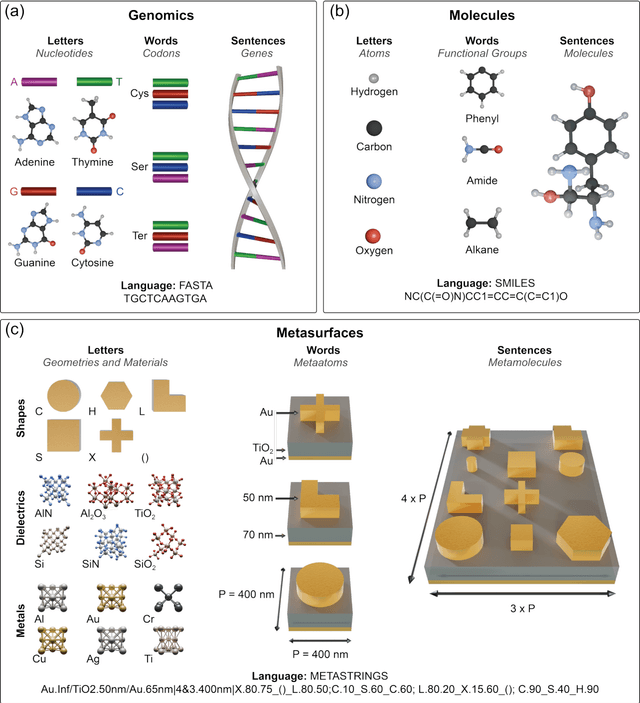
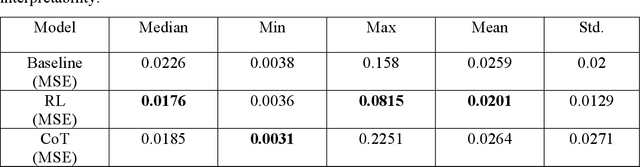
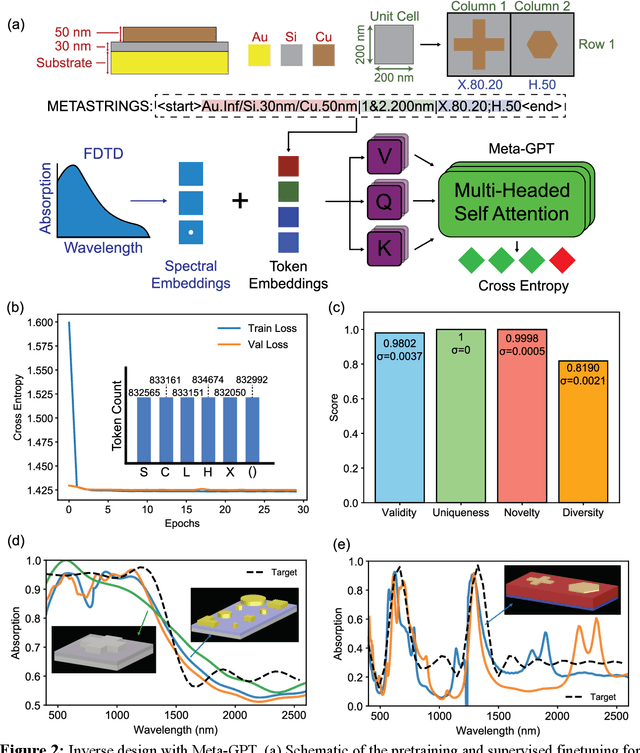
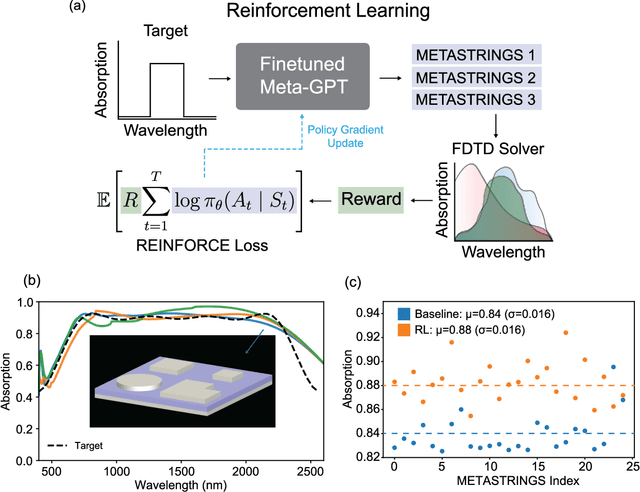
Advancing artificial intelligence for physical sciences requires representations that are both interpretable and compatible with the underlying laws of nature. We introduce METASTRINGS, a symbolic language for photonics that expresses nanostructures as textual sequences encoding materials, geometries, and lattice configurations. Analogous to molecular textual representations in chemistry, METASTRINGS provides a framework connecting human interpretability with computational design by capturing the structural hierarchy of photonic metasurfaces. Building on this representation, we develop Meta-GPT, a foundation transformer model trained on METASTRINGS and finetuned with physics-informed supervised, reinforcement, and chain-of-thought learning. Across various design tasks, the model achieves <3% mean-squared spectral error and maintains >98% syntactic validity, generating diverse metasurface prototypes whose experimentally measured optical responses match their target spectra. These results demonstrate that Meta-GPT can learn the compositional rules of light-matter interactions through METASTRINGS, laying a rigorous foundation for AI-driven photonics and representing an important step toward a metasurface genome project.
Hierarchical Multi-agent Large Language Model Reasoning for Autonomous Functional Materials Discovery
Dec 15, 2025Artificial intelligence is reshaping scientific exploration, but most methods automate procedural tasks without engaging in scientific reasoning, limiting autonomy in discovery. We introduce Materials Agents for Simulation and Theory in Electronic-structure Reasoning (MASTER), an active learning framework where large language models autonomously design, execute, and interpret atomistic simulations. In MASTER, a multimodal system translates natural language into density functional theory workflows, while higher-level reasoning agents guide discovery through a hierarchy of strategies, including a single agent baseline and three multi-agent approaches: peer review, triage-ranking, and triage-forms. Across two chemical applications, CO adsorption on Cu-surface transition metal (M) adatoms and on M-N-C catalysts, reasoning-driven exploration reduces required atomistic simulations by up to 90% relative to trial-and-error selection. Reasoning trajectories reveal chemically grounded decisions that cannot be explained by stochastic sampling or semantic bias. Altogether, multi-agent collaboration accelerates materials discovery and marks a new paradigm for autonomous scientific exploration.