 Add to Chrome
 Add to Firefox
 Add to Edge
Training-Induced Bias Toward LLM-Generated Content in Dense Retrieval
Feb 11, 2026
Dense retrieval is a promising approach for acquiring relevant context or world knowledge in open-domain natural language processing tasks and is now widely used in information retrieval applications. However, recent reports claim a broad preference for text generated by large language models (LLMs). This bias is called "source bias", and it has been hypothesized that lower perplexity contributes to this effect. In this study, we revisit this claim by conducting a controlled evaluation to trace the emergence of such preferences across training stages and data sources. Using parallel human- and LLM-generated counterparts of the SciFact and Natural Questions (NQ320K) datasets, we compare unsupervised checkpoints with models fine-tuned using in-domain human text, in-domain LLM-generated text, and MS MARCO. Our results show the following: 1) Unsupervised retrievers do not exhibit a uniform pro-LLM preference. The direction and magnitude depend on the dataset. 2) Across the settings tested, supervised fine-tuning on MS MARCO consistently shifts the rankings toward LLM-generated text. 3) In-domain fine-tuning produces dataset-specific and inconsistent shifts in preference. 4) Fine-tuning on LLM-generated corpora induces a pronounced pro-LLM bias. Finally, a retriever-centric perplexity probe involving the reattachment of a language modeling head to the fine-tuned dense retriever encoder indicates agreement with relevance near chance, thereby weakening the explanatory power of perplexity. Our study demonstrates that source bias is a training-induced phenomenon rather than an inherent property of dense retrievers.

RAGtifier: Evaluating RAG Generation Approaches of State-of-the-Art RAG Systems for the SIGIR LiveRAG Competition
Jun 17, 2025
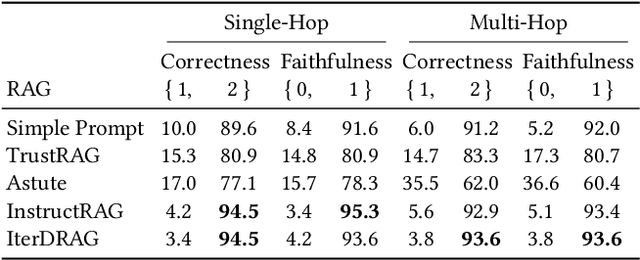
Retrieval-Augmented Generation (RAG) enriches Large Language Models (LLMs) by combining their internal, parametric knowledge with external, non-parametric sources, with the goal of improving factual correctness and minimizing hallucinations. The LiveRAG 2025 challenge explores RAG solutions to maximize accuracy on DataMorgana's QA pairs, which are composed of single-hop and multi-hop questions. The challenge provides access to sparse OpenSearch and dense Pinecone indices of the Fineweb 10BT dataset. It restricts model use to LLMs with up to 10B parameters and final answer generation with Falcon-3-10B. A judge-LLM assesses the submitted answers along with human evaluators. By exploring distinct retriever combinations and RAG solutions under the challenge conditions, our final solution emerged using InstructRAG in combination with a Pinecone retriever and a BGE reranker. Our solution achieved a correctness score of 1.13 and a faithfulness score of 0.55, placing fourth in the SIGIR 2025 LiveRAG Challenge.