 Add to Chrome
 Add to Firefox
 Add to Edge
LGSE: Lexically Grounded Subword Embedding Initialization for Low-Resource Language Adaptation
Mar 23, 2026
Adapting pretrained language models to low-resource, morphologically rich languages remains a significant challenge. Existing vocabulary expansion methods typically rely on arbitrarily segmented subword units, resulting in fragmented lexical representations and loss of critical morphological information. To address this limitation, we propose the Lexically Grounded Subword Embedding Initialization (LGSE) framework, which introduces morphologically informed segmentation for initializing embeddings of novel tokens. Instead of using random vectors or arbitrary subwords, LGSE decomposes words into their constituent morphemes and constructs semantically coherent embeddings by averaging pretrained subword or FastText-based morpheme representations. When a token cannot be segmented into meaningful morphemes, its embedding is constructed using character n-gram representations to capture structural information. During Language-Adaptive Pretraining, we apply a regularization term that penalizes large deviations of newly introduced embeddings from their initialized values, preserving alignment with the original pretrained embedding space while enabling adaptation to the target language. To isolate the effect of initialization, we retain the original pre-trained model vocabulary and tokenizer and update only the new embeddings during adaptation. We evaluate LGSE on three NLP tasks: Question Answering, Named Entity Recognition, and Text Classification, in two morphologically rich, low-resource languages: Amharic and Tigrinya, where morphological segmentation resources are available. Experimental results show that LGSE consistently outperforms baseline methods across all tasks, demonstrating the effectiveness of morphologically grounded embedding initialization for improving representation quality in underrepresented languages. Project resources are available in the GitHub link.

RAGtifier: Evaluating RAG Generation Approaches of State-of-the-Art RAG Systems for the SIGIR LiveRAG Competition
Jun 17, 2025
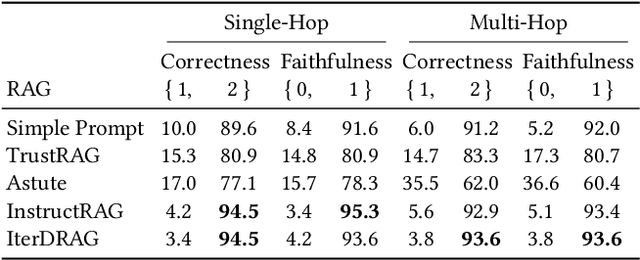
Retrieval-Augmented Generation (RAG) enriches Large Language Models (LLMs) by combining their internal, parametric knowledge with external, non-parametric sources, with the goal of improving factual correctness and minimizing hallucinations. The LiveRAG 2025 challenge explores RAG solutions to maximize accuracy on DataMorgana's QA pairs, which are composed of single-hop and multi-hop questions. The challenge provides access to sparse OpenSearch and dense Pinecone indices of the Fineweb 10BT dataset. It restricts model use to LLMs with up to 10B parameters and final answer generation with Falcon-3-10B. A judge-LLM assesses the submitted answers along with human evaluators. By exploring distinct retriever combinations and RAG solutions under the challenge conditions, our final solution emerged using InstructRAG in combination with a Pinecone retriever and a BGE reranker. Our solution achieved a correctness score of 1.13 and a faithfulness score of 0.55, placing fourth in the SIGIR 2025 LiveRAG Challenge.
TIGQA:An Expert Annotated Question Answering Dataset in Tigrinya
Apr 26, 2024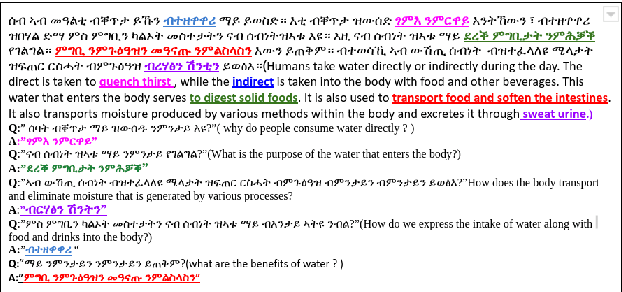

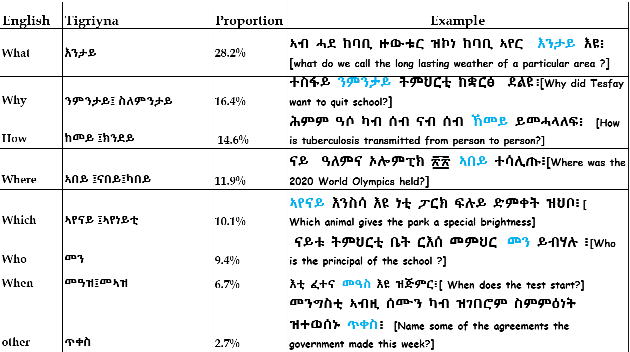
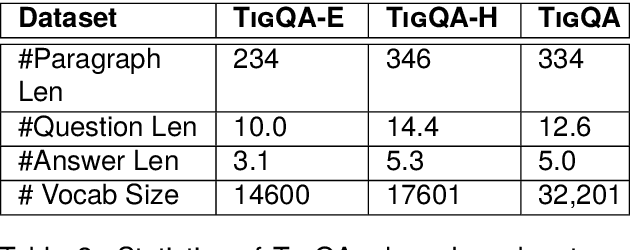
The absence of explicitly tailored, accessible annotated datasets for educational purposes presents a notable obstacle for NLP tasks in languages with limited resources.This study initially explores the feasibility of using machine translation (MT) to convert an existing dataset into a Tigrinya dataset in SQuAD format. As a result, we present TIGQA, an expert annotated educational dataset consisting of 2.68K question-answer pairs covering 122 diverse topics such as climate, water, and traffic. These pairs are from 537 context paragraphs in publicly accessible Tigrinya and Biology books. Through comprehensive analyses, we demonstrate that the TIGQA dataset requires skills beyond simple word matching, requiring both single-sentence and multiple-sentence inference abilities. We conduct experiments using state-of-the art MRC methods, marking the first exploration of such models on TIGQA. Additionally, we estimate human performance on the dataset and juxtapose it with the results obtained from pretrained models.The notable disparities between human performance and best model performance underscore the potential for further enhancements to TIGQA through continued research. Our dataset is freely accessible via the provided link to encourage the research community to address the challenges in the Tigrinya MRC.
* 9 pages,3 figures, 7 tables,2 listings