 Add to Chrome
 Add to Firefox
 Add to Edge
Mechanistic Interpretability of EEG Foundation Models via Sparse Autoencoders
May 13, 2026
EEG foundation models achieve state-of-the-art clinical performance, yet the internal computations driving their predictions remain opaque: a barrier to clinical trust. We apply TopK Sparse Autoencoders (SAEs) across three architecturally distinct EEG transformers: SleepFM, REVE, and LaBraM to extract sparse feature dictionaries from their embeddings. By grounding these features in a clinical taxonomy (abnormality, age, sex, and medication), we benchmark monosemanticity and entanglement across architectures. A single hyperparameter procedure, driven by an intrinsic dictionary health audit, transfers robustly across all three architectures. Via concept steering, we introduce a "target vs. off-target" probe area metric to quantify steering selectivity and reveal three operational regimes: selectively steerable, encoded but entangled, and non-encoded. This framework exposes critical representational failures: "wrecking-ball" interventions that collapse global model performance, and clinical entanglements, such as age-pathology confounding, where it is impossible to suppress one concept without corrupting the other. Finally, a spectral decoder maps these interventions back to the amplitude spectrum, translating latent manipulations into physiologically interpretable frequency signatures, such as pathological slow-wave suppression and $α$-band restoration.

Pretraining on Sleep Data Improves non-Sleep Biosignal Tasks
May 04, 2026Sleep foundation models have recently demonstrated strong performance on in-domain polysomnography tasks, including sleep staging, apnea detection, and disease risk prediction. In this work, we investigate whether sleep biosignals can serve as an effective pretraining distribution for learning representations that transfer beyond sleep to adjacent domains. Following sleep foundation models, we perform sleep-only multimodal contrastive pretraining (with a leave-one-out objective) and evaluate transfer to non-sleep EEG and ECG, two well-benchmarked biosignal modalities with heterogeneous datasets and clinically meaningful downstream tasks. Across eight downstream tasks spanning multiple EEG and ECG datasets, sleep pretraining consistently improves performance relative to training from scratch. Moreover, on several tasks, we achieve performance competitive with or surpassing prior specialized state-of-the-art and foundation models.
SPEED: Scalable Preprocessing of EEG Data for Self-Supervised Learning
Aug 15, 2024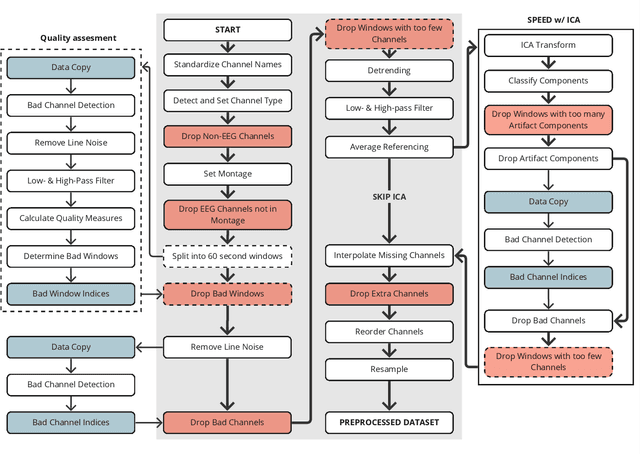
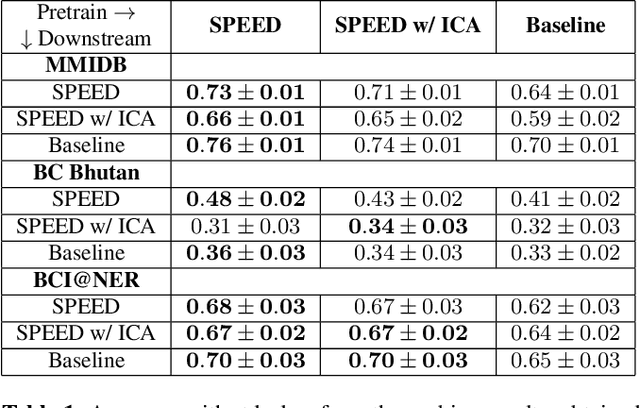
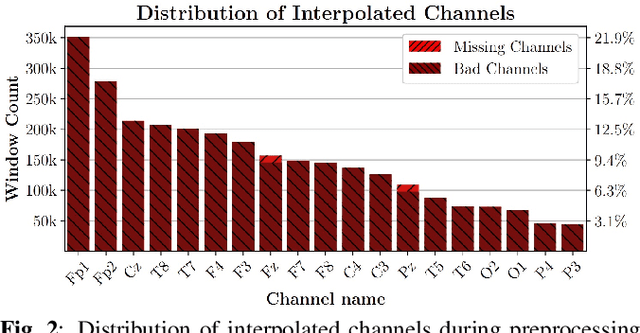
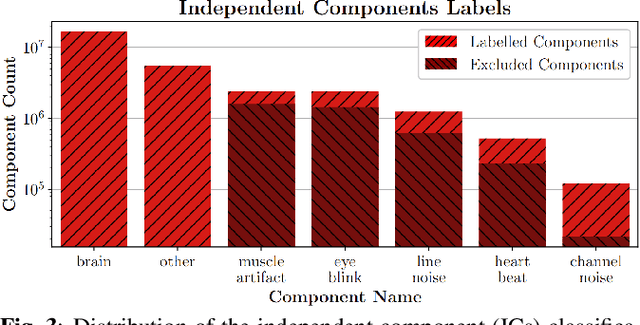
Electroencephalography (EEG) research typically focuses on tasks with narrowly defined objectives, but recent studies are expanding into the use of unlabeled data within larger models, aiming for a broader range of applications. This addresses a critical challenge in EEG research. For example, Kostas et al. (2021) show that self-supervised learning (SSL) outperforms traditional supervised methods. Given the high noise levels in EEG data, we argue that further improvements are possible with additional preprocessing. Current preprocessing methods often fail to efficiently manage the large data volumes required for SSL, due to their lack of optimization, reliance on subjective manual corrections, and validation processes or inflexible protocols that limit SSL. We propose a Python-based EEG preprocessing pipeline optimized for self-supervised learning, designed to efficiently process large-scale data. This optimization not only stabilizes self-supervised training but also enhances performance on downstream tasks compared to training with raw data.