 Add to Chrome
 Add to Firefox
 Add to Edge
PanoVine: Whole-Body Visuomotor Control for Soft Growing Vine Robot
Jun 23, 2026
Vine robots, a class of soft, growing robots, are suitable for navigating complex and confined environments due to their compliant bodies and self-supporting growth mechanism. However, hysteresis, tether interactions, and deformations make them difficult to predict and model, which in turn limits the effectiveness of conventional planning and control approaches. In this work, we present a data-driven, vision-based control framework for the first autonomous vine robot system. Our system integrates 19 cameras distributed along the robot's body to provide comprehensive feedback of both the robot state and the surrounding environment. Using this rich whole-body vision feedback, we train an end-to-end visuomotor policy from demonstrations for closed-loop autonomous control in complex environments. The policy efficiently aggregates information from distributed sensing while maintaining robustness to inaccurate robot states and actuation. Experimental results demonstrate that the learned policy enables robust navigation and manipulation in challenging scenarios, including steering through branched structures, climbing up slopes, traversing unsupported terrain, reaching objects precisely, and maneuvering through confined spaces and obstacles. Project website https://panovine-bot.github.io

3D Steering and Localization in Pipes and Burrows using an Externally Steered Soft Growing Robot
Jul 09, 2025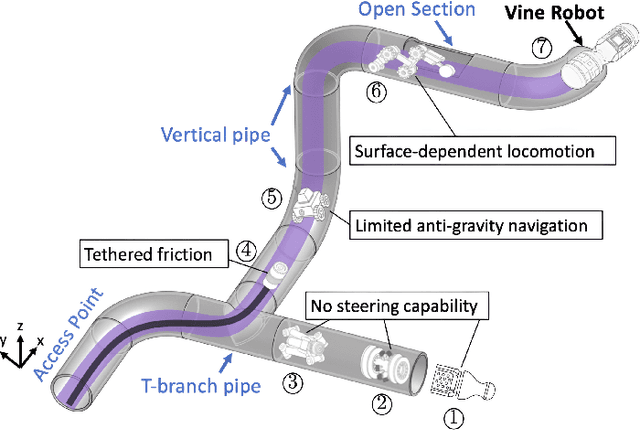
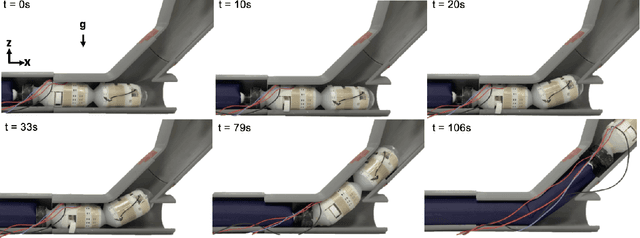
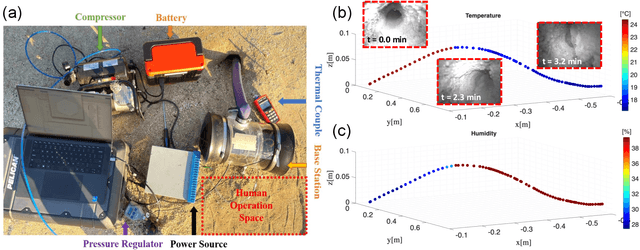
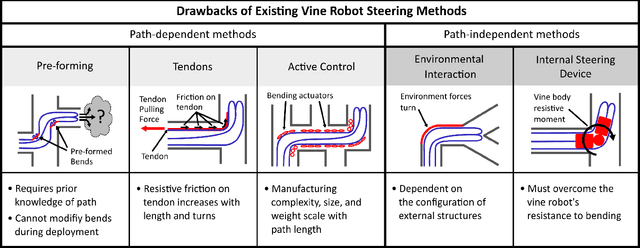
Navigation and inspection in confined environments, such as tunnels and pipes, pose significant challenges for existing robots due to limitations in maneuverability and adaptability to varying geometries. Vine robots, which are soft growing continuum robots that extend their length through soft material eversion at their tip, offer unique advantages due to their ability to navigate tight spaces, adapt to complex paths, and minimize friction. However, existing vine robot designs struggle with navigation in manmade and natural passageways, with branches and sharp 3D turns. In this letter, we introduce a steerable vine robot specifically designed for pipe and burrow environments. The robot features a simple tubular body and an external tip mount that steers the vine robot in three degrees of freedom by changing the growth direction and, when necessary, bracing against the wall of the pipe or burrow. Our external tip steering approach enables: (1) active branch selection in 3D space with a maximum steerable angle of 51.7{\deg}, (2) navigation of pipe networks with radii as small as 2.5 cm, (3) a compliant tip enabling navigation of sharp turns, and (4) real-time 3D localization in GPS-denied environments using tip-mounted sensors and continuum body odometry. We describe the forward kinematics, characterize steerability, and demonstrate the system in a 3D pipe system as well as a natural animal burrow.