 Add to Chrome
 Add to Firefox
 Add to Edge
MOO: A Multi-view Oriented Observations Dataset for Viewpoint Analysis in Cattle Re-Identification
Mar 04, 2026
Animal re-identification (ReID) faces critical challenges due to viewpoint variations, particularly in Aerial-Ground (AG-ReID) settings where models must match individuals across drastic elevation changes. However, existing datasets lack the precise angular annotations required to systematically analyze these geometric variations. To address this, we introduce the Multi-view Oriented Observation (MOO) dataset, a large-scale synthetic AG-ReID dataset of $1,000$ cattle individuals captured from $128$ uniformly sampled viewpoints ($128,000$ annotated images). Using this controlled dataset, we quantify the influence of elevation and identify a critical elevation threshold, above which models generalize significantly better to unseen views. Finally, we validate the transferability to real-world applications in both zero-shot and supervised settings, demonstrating performance gains across four real-world cattle datasets and confirming that synthetic geometric priors effectively bridge the domain gap. Collectively, this dataset and analysis lay the foundation for future model development in cross-view animal ReID. MOO is publicly available at https://github.com/TurtleSmoke/MOO.

MonoProb: Self-Supervised Monocular Depth Estimation with Interpretable Uncertainty
Nov 10, 2023
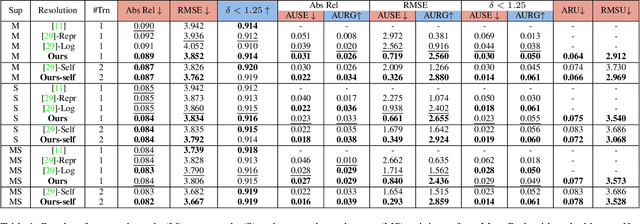
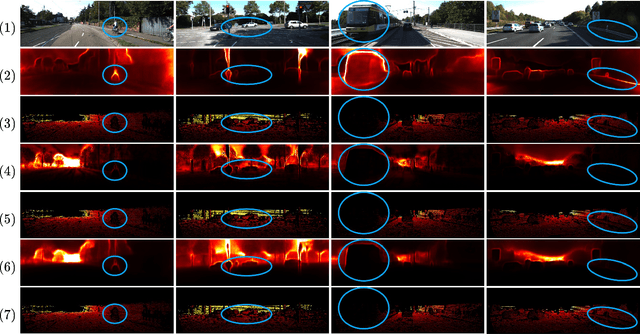

Self-supervised monocular depth estimation methods aim to be used in critical applications such as autonomous vehicles for environment analysis. To circumvent the potential imperfections of these approaches, a quantification of the prediction confidence is crucial to guide decision-making systems that rely on depth estimation. In this paper, we propose MonoProb, a new unsupervised monocular depth estimation method that returns an interpretable uncertainty, which means that the uncertainty reflects the expected error of the network in its depth predictions. We rethink the stereo or the structure-from-motion paradigms used to train unsupervised monocular depth models as a probabilistic problem. Within a single forward pass inference, this model provides a depth prediction and a measure of its confidence, without increasing the inference time. We then improve the performance on depth and uncertainty with a novel self-distillation loss for which a student is supervised by a pseudo ground truth that is a probability distribution on depth output by a teacher. To quantify the performance of our models we design new metrics that, unlike traditional ones, measure the absolute performance of uncertainty predictions. Our experiments highlight enhancements achieved by our method on standard depth and uncertainty metrics as well as on our tailored metrics. https://github.com/CEA-LIST/MonoProb