 Add to Chrome
 Add to Firefox
 Add to Edge
Multimodal embodiment-aware navigation transformer
Apr 21, 2026
Goal-conditioned navigation models for ground robots trained using supervised learning show promising zero-shot transfer, but their collision-avoidance capability nevertheless degrades under distribution shift, i.e. environmental, robot or sensor configuration changes. We propose ViLiNT a multimodal, attention-based policy for goal navigation, trained on heterogeneous data from multiple platforms and environments, which improves robustness with two key features. First, we fuse RGB images, 3D LiDAR point clouds, a goal embedding and a robot's embodiment descriptor with a transformer architecture to capture complementary geometry and appearance cues. The transformer's output is used to condition a diffusion model that generates navigable trajectories. Second, using automatically generated offline labels, we train a path clearance prediction head for scoring and ranking trajectories produced by the diffusion model. The diffusion conditioning as well as the trajectory ranking head depend on a robot's embodiment token that allows our model to generate and select trajectories with respect to the robot's dimensions. Across three simulated environments, ViLiNT improves Success Rate on average by 166\% over equivalent state-of-the-art vision-only baseline (NoMaD). This increase in performance is confirmed through real-world deployments of a rover navigating in obstacle fields. These results highlight that combining multimodal fusion with our collision prediction mechanism leads to improved off-road navigation robustness.

An Open-Source LiDAR and Monocular Off-Road Autonomous Navigation Stack
Apr 03, 2026Off-road autonomous navigation demands reliable 3D perception for robust obstacle detection in challenging unstructured terrain. While LiDAR is accurate, it is costly and power-intensive. Monocular depth estimation using foundation models offers a lightweight alternative, but its integration into outdoor navigation stacks remains underexplored. We present an open-source off-road navigation stack supporting both LiDAR and monocular 3D perception without task-specific training. For the monocular setup, we combine zero-shot depth prediction (Depth Anything V2) with metric depth rescaling using sparse SLAM measurements (VINS-Mono). Two key enhancements improve robustness: edge-masking to reduce obstacle hallucination and temporal smoothing to mitigate the impact of SLAM instability. The resulting point cloud is used to generate a robot-centric 2.5D elevation map for costmap-based planning. Evaluated in photorealistic simulations (Isaac Sim) and real-world unstructured environments, the monocular configuration matches high-resolution LiDAR performance in most scenarios, demonstrating that foundation-model-based monocular depth estimation is a viable LiDAR alternative for robust off-road navigation. By open-sourcing the navigation stack and the simulation environment, we provide a complete pipeline for off-road navigation as well as a reproducible benchmark. Code available at https://github.com/LARIAD/Offroad-Nav.
Foundation Models Meet Low-Cost Sensors: Test-Time Adaptation for Rescaling Disparity for Zero-Shot Metric Depth Estimation
Dec 18, 2024


The recent development of foundation models for monocular depth estimation such as Depth Anything paved the way to zero-shot monocular depth estimation. Since it returns an affine-invariant disparity map, the favored technique to recover the metric depth consists in fine-tuning the model. However, this stage is costly to perform because of the training but also due to the creation of the dataset. It must contain images captured by the camera that will be used at test time and the corresponding ground truth. Moreover, the fine-tuning may also degrade the generalizing capacity of the original model. Instead, we propose in this paper a new method to rescale Depth Anything predictions using 3D points provided by low-cost sensors or techniques such as low-resolution LiDAR, stereo camera, structure-from-motion where poses are given by an IMU. Thus, this approach avoids fine-tuning and preserves the generalizing power of the original depth estimation model while being robust to the noise of the sensor or of the depth model. Our experiments highlight improvements relative to other metric depth estimation methods and competitive results compared to fine-tuned approaches. Code available at https://gitlab.ensta.fr/ssh/monocular-depth-rescaling.
MonoProb: Self-Supervised Monocular Depth Estimation with Interpretable Uncertainty
Nov 10, 2023
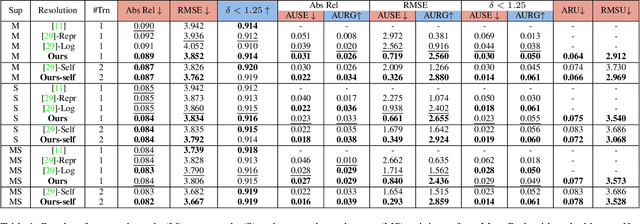
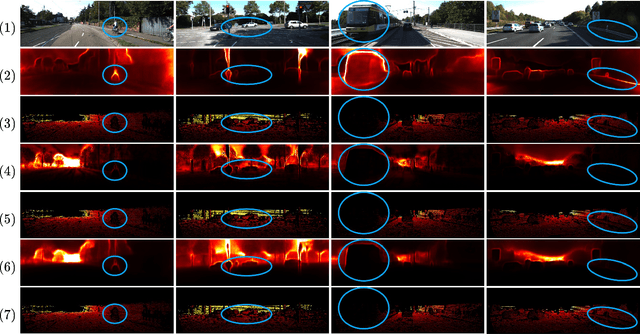

Self-supervised monocular depth estimation methods aim to be used in critical applications such as autonomous vehicles for environment analysis. To circumvent the potential imperfections of these approaches, a quantification of the prediction confidence is crucial to guide decision-making systems that rely on depth estimation. In this paper, we propose MonoProb, a new unsupervised monocular depth estimation method that returns an interpretable uncertainty, which means that the uncertainty reflects the expected error of the network in its depth predictions. We rethink the stereo or the structure-from-motion paradigms used to train unsupervised monocular depth models as a probabilistic problem. Within a single forward pass inference, this model provides a depth prediction and a measure of its confidence, without increasing the inference time. We then improve the performance on depth and uncertainty with a novel self-distillation loss for which a student is supervised by a pseudo ground truth that is a probability distribution on depth output by a teacher. To quantify the performance of our models we design new metrics that, unlike traditional ones, measure the absolute performance of uncertainty predictions. Our experiments highlight enhancements achieved by our method on standard depth and uncertainty metrics as well as on our tailored metrics. https://github.com/CEA-LIST/MonoProb