 Add to Chrome
 Add to Firefox
 Add to Edge
Privately Learning Decision Lists and a Differentially Private Winnow
Feb 07, 2026
We give new differentially private algorithms for the classic problems of learning decision lists and large-margin halfspaces in the PAC and online models. In the PAC model, we give a computationally efficient algorithm for learning decision lists with minimal sample overhead over the best non-private algorithms. In the online model, we give a private analog of the influential Winnow algorithm for learning halfspaces with mistake bound polylogarithmic in the dimension and inverse polynomial in the margin. As an application, we describe how to privately learn decision lists in the online model, qualitatively matching state-of-the art non-private guarantees.

Roleplay-doh: Enabling Domain-Experts to Create LLM-simulated Patients via Eliciting and Adhering to Principles
Jul 01, 2024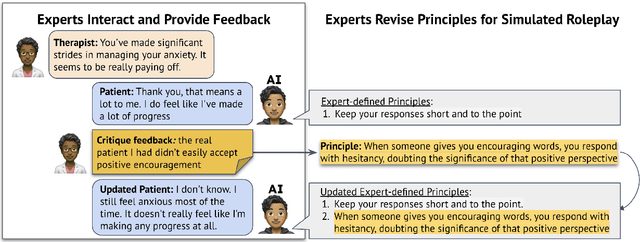
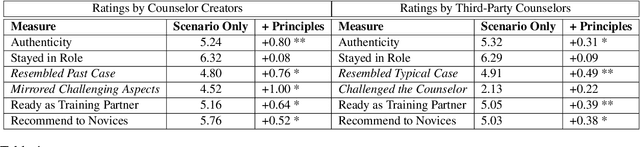
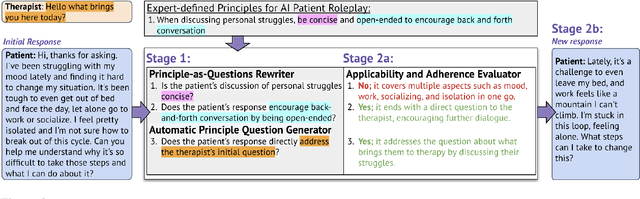
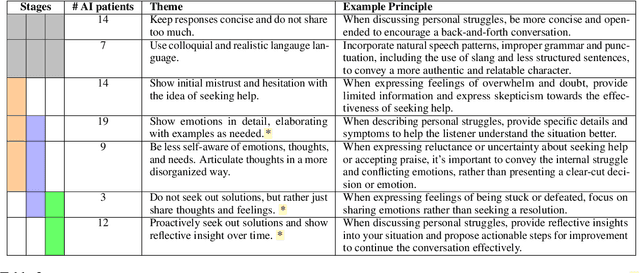
Recent works leverage LLMs to roleplay realistic social scenarios, aiding novices in practicing their social skills. However, simulating sensitive interactions, such as in mental health, is challenging. Privacy concerns restrict data access, and collecting expert feedback, although vital, is laborious. To address this, we develop Roleplay-doh, a novel human-LLM collaboration pipeline that elicits qualitative feedback from a domain-expert, which is transformed into a set of principles, or natural language rules, that govern an LLM-prompted roleplay. We apply this pipeline to enable senior mental health supporters to create customized AI patients for simulated practice partners for novice counselors. After uncovering issues in GPT-4 simulations not adhering to expert-defined principles, we also introduce a novel principle-adherence prompting pipeline which shows 30\% improvements in response quality and principle following for the downstream task. Via a user study with 25 counseling experts, we demonstrate that the pipeline makes it easy and effective to create AI patients that more faithfully resemble real patients, as judged by creators and third-party counselors.