 Add to Chrome
 Add to Firefox
 Add to Edge
BMFA: Boundary-Minority Free-Energy Adaptive Screening
Jul 20, 2026
Vision Transformers process spatially redundant tokens efficiently only when coarse token summaries preserve the evidence required by exponential attention aggregation. We identify a boundary-minority underestimation failure in which a spatially small, high-response region contributes dominant Gibbs mass while remaining nearly invisible to a block mean. We formalize the failure through the discrepancy between normalized log-mean-exp free energy and mean summarization, prove that minority Gibbs mass can remain non-vanishing as its spatial support and mean contribution vanish, and characterize the limitations of finite-order moment corrections. Building on the resulting analysis, we introduce Boundary-Minority Free-Energy Adaptive Screening (BMFA), which constructs a hierarchical piecewise-constant approximation and recursively refines blocks according to a computable lower-bound increment of local free energy. Controlled synthetic tests, COCO and LVIS diagnostic probes, closed-loop DeiT-Tiny evaluations, and ImageNet-1K experiments establish a consistent evidence chain. BMFA reduces the mean synthetic underestimate from 2.582 to 0.261 at a 5.794% leaf ratio, lowers the COCO image-edge mean gap from 2.254 to 0.526, and preserves 71.520% ImageNet Top-1 accuracy at a 55.861% leaf ratio. The current prototype evaluates selection quality after full QK computation; the reported leaf ratio therefore characterizes representation granularity rather than verified sparse-kernel speedup.

Stage-Aware Adaptation and Distribution Calibration for Subject-Driven Personalized Text-to-Image Generation
Jul 08, 2026Subject-driven personalized text-to-image generation requires a pretrained diffusion model to acquire a specific subject from a few reference images while preserving subject identity, following novel text prompts, and maintaining sample diversity. Existing optimization-based methods instantiate subject adaptation through full fine-tuning, textual embedding optimization, or low-rank parameter updates; PaRa further constrains personalization from the perspective of parameter rank reduction. However, a uniform low-rank constraint or a uniform adapter strength cannot explicitly distinguish the capacity requirements of different denoising stages. Moreover, inference-time candidate selection driven mainly by identity similarity may compress the selected samples in the visual representation space. We decompose the problem into two complementary components: SPaRa denotes training-side stage-aware low-rank adaptation, DCAL denotes inference-side distribution-calibrated candidate selection, and SPaRa-DCAL denotes the combined framework. Theoretical analysis shows that timestep-dependent scaling controls the effective perturbation magnitude of a low-rank adapter, while identity-biased candidate selection restricts the radius of selected features around the reference center under explicit conditions. Auditable experiments under the SDXL and DreamBooth 30-subject protocol show that DCAL improves 1-LPIPS, CLIP-I, DINO-I, and CLIP-T on a fixed LoRA candidate pool, while revealing a clear trade-off with CLIP/DINO pairwise diversity and pairwise LPIPS. These results indicate that personalized generation should be evaluated through identity consistency, text alignment, and representation diversity rather than identity metrics alone.
PromptSculptor: Multi-Agent Based Text-to-Image Prompt Optimization
Sep 15, 2025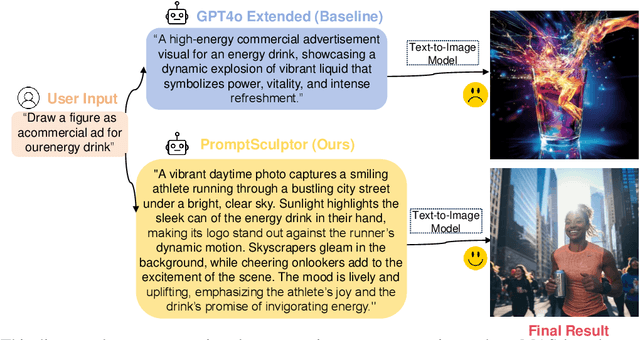
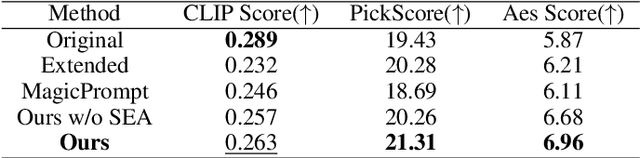
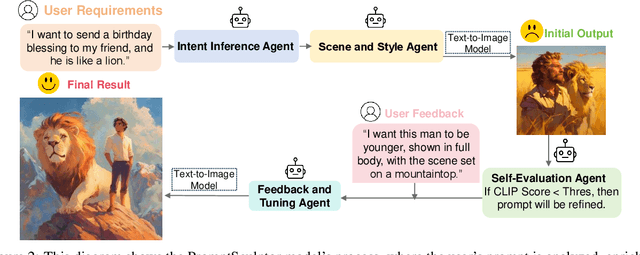
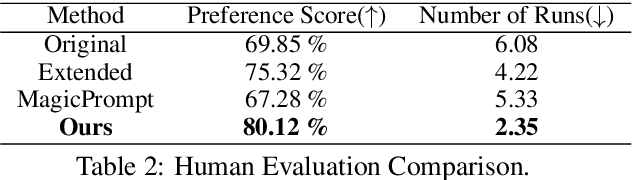
The rapid advancement of generative AI has democratized access to powerful tools such as Text-to-Image models. However, to generate high-quality images, users must still craft detailed prompts specifying scene, style, and context-often through multiple rounds of refinement. We propose PromptSculptor, a novel multi-agent framework that automates this iterative prompt optimization process. Our system decomposes the task into four specialized agents that work collaboratively to transform a short, vague user prompt into a comprehensive, refined prompt. By leveraging Chain-of-Thought reasoning, our framework effectively infers hidden context and enriches scene and background details. To iteratively refine the prompt, a self-evaluation agent aligns the modified prompt with the original input, while a feedback-tuning agent incorporates user feedback for further refinement. Experimental results demonstrate that PromptSculptor significantly enhances output quality and reduces the number of iterations needed for user satisfaction. Moreover, its model-agnostic design allows seamless integration with various T2I models, paving the way for industrial applications.