 Add to Chrome
 Add to Firefox
 Add to Edge
DLR: Zero-Inference-Cost Latent Residuals for Low-Rank Pre-Training
Jun 27, 2026
Large language models have driven recent progress in language and multimodal AI, yet pre-training them at scale is prohibitively expensive. Low-rank pre-training, which factorizes each weight matrix into a rank-r product to reduce both parameters and FLOPs, is a promising response but typically lags full-rank training in quality. We propose Duplicated Latent Residual (DLR), a training-only, parameter-free, foldable plug-in for low-rank pre-training. DLR augments the standard low-rank output Bz with a fixed structured residual alpha/sqrt(K) * Expand_K(z) that replicates each latent coordinate K = ceil(d_out/r) times across the output. With alpha fixed, DLR adds zero learnable parameters per layer; after training, it is absorbed into the up-projection in closed form, B* = B + alpha/sqrt(K) R^T, so deployment parameter count, FLOPs and memory match the underlying low-rank backbone exactly. Across LLaMA models from 60M to 7B parameters, DLR strengthens low-rank pre-training on C4 validation perplexity in most settings, with the clearest gains at 130M and above; folded checkpoints transfer cleanly to supervised fine-tuning on standard benchmarks.

GRAIL: Post-hoc Compensation by Linear Reconstruction for Compressed Networks
Mar 02, 2026Structured deep model compression methods are hardware-friendly and substantially reduce memory and inference costs. However, under aggressive compression, the resulting accuracy degradation often necessitates post-compression finetuning, which can be impractical due to missing labeled data or high training cost. We propose post-hoc blockwise compensation, called GRAIL, a simple zero-finetuning step applied after model compression that restores each block's input-output behavior using a small calibration set. The method summarizes hidden activations via a Gram matrix and applies ridge regression to linearly reconstruct the original hidden representation from the reduced one. The resulting reconstruction map is absorbed into the downstream projection weights, while the upstream layer is compressed. The approach is selector-agnostic (Magnitude, Wanda, Gram-based selection, or folding), data-aware (requiring only a few forward passes without gradients or labels), and recovers classic pruning or folding when the Gram matrix is near identity, indicating weak inter-channel correlations. Across ResNets, ViTs, and decoder-only LLMs, GRAIL consistently improves accuracy or perplexity over data-free and data-aware pruning or folding baselines in practical compression regimes, with manageable overhead and no backpropagation. The code is available at https://github.com/TWWinde/GRAIL_Compensation.
PrivatEyes: Appearance-based Gaze Estimation Using Federated Secure Multi-Party Computation
Feb 29, 2024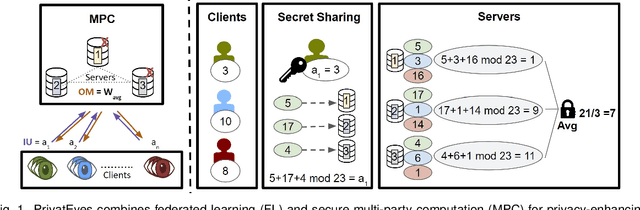
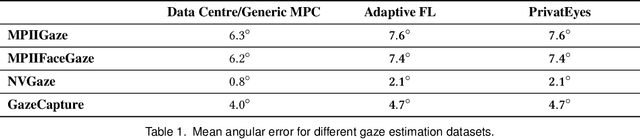
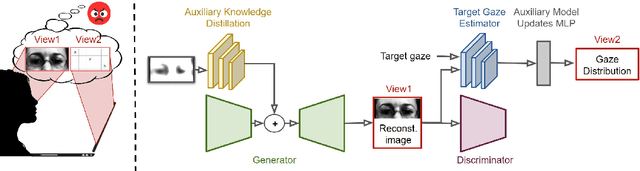
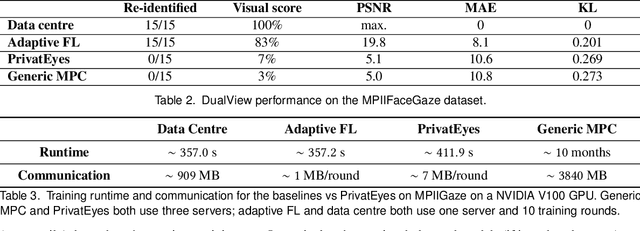
Latest gaze estimation methods require large-scale training data but their collection and exchange pose significant privacy risks. We propose PrivatEyes - the first privacy-enhancing training approach for appearance-based gaze estimation based on federated learning (FL) and secure multi-party computation (MPC). PrivatEyes enables training gaze estimators on multiple local datasets across different users and server-based secure aggregation of the individual estimators' updates. PrivatEyes guarantees that individual gaze data remains private even if a majority of the aggregating servers is malicious. We also introduce a new data leakage attack DualView that shows that PrivatEyes limits the leakage of private training data more effectively than previous approaches. Evaluations on the MPIIGaze, MPIIFaceGaze, GazeCapture, and NVGaze datasets further show that the improved privacy does not lead to a lower gaze estimation accuracy or substantially higher computational costs - both of which are on par with its non-secure counterparts.