 Add to Chrome
 Add to Firefox
 Add to Edge
Ontology-Guided Diffusion for Zero-Shot Visual Sim2Real Transfer
Mar 19, 2026
Bridging the simulation-to-reality (sim2real) gap remains challenging as labelled real-world data is scarce. Existing diffusion-based approaches rely on unstructured prompts or statistical alignment, which do not capture the structured factors that make images look real. We introduce Ontology- Guided Diffusion (OGD), a neuro-symbolic zero-shot sim2real image translation framework that represents realism as structured knowledge. OGD decomposes realism into an ontology of interpretable traits -- such as lighting and material properties -- and encodes their relationships in a knowledge graph. From a synthetic image, OGD infers trait activations and uses a graph neural network to produce a global embedding. In parallel, a symbolic planner uses the ontology traits to compute a consistent sequence of visual edits needed to narrow the realism gap. The graph embedding conditions a pretrained instruction-guided diffusion model via cross-attention, while the planned edits are converted into a structured instruction prompt. Across benchmarks, our graph-based embeddings better distinguish real from synthetic imagery than baselines, and OGD outperforms state-of-the-art diffusion methods in sim2real image translations. Overall, OGD shows that explicitly encoding realism structure enables interpretable, data-efficient, and generalisable zero-shot sim2real transfer.

QualitEye: Public and Privacy-preserving Gaze Data Quality Verification
Jun 06, 2025Gaze-based applications are increasingly advancing with the availability of large datasets but ensuring data quality presents a substantial challenge when collecting data at scale. It further requires different parties to collaborate, therefore, privacy concerns arise. We propose QualitEye--the first method for verifying image-based gaze data quality. QualitEye employs a new semantic representation of eye images that contains the information required for verification while excluding irrelevant information for better domain adaptation. QualitEye covers a public setting where parties can freely exchange data and a privacy-preserving setting where parties cannot reveal their raw data nor derive gaze features/labels of others with adapted private set intersection protocols. We evaluate QualitEye on the MPIIFaceGaze and GazeCapture datasets and achieve a high verification performance (with a small overhead in runtime for privacy-preserving versions). Hence, QualitEye paves the way for new gaze analysis methods at the intersection of machine learning, human-computer interaction, and cryptography.
PrivatEyes: Appearance-based Gaze Estimation Using Federated Secure Multi-Party Computation
Feb 29, 2024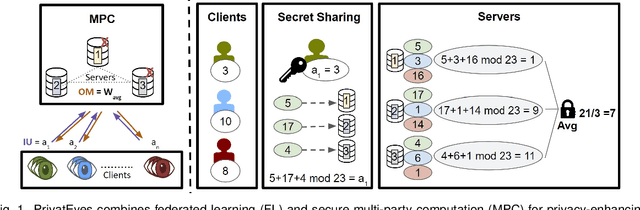
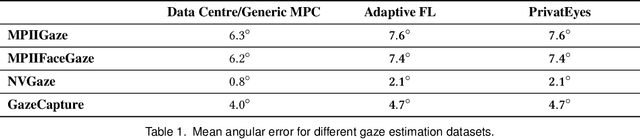
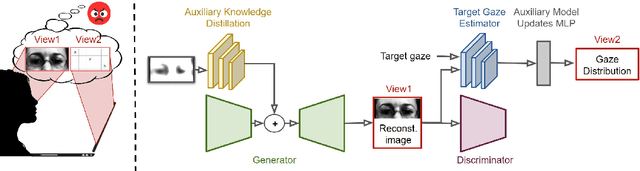
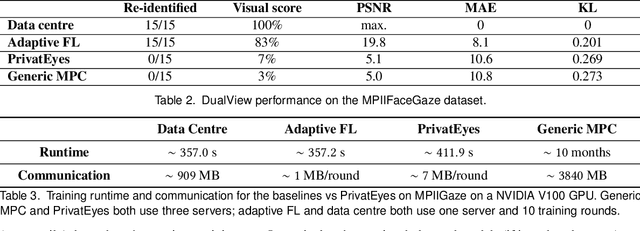
Latest gaze estimation methods require large-scale training data but their collection and exchange pose significant privacy risks. We propose PrivatEyes - the first privacy-enhancing training approach for appearance-based gaze estimation based on federated learning (FL) and secure multi-party computation (MPC). PrivatEyes enables training gaze estimators on multiple local datasets across different users and server-based secure aggregation of the individual estimators' updates. PrivatEyes guarantees that individual gaze data remains private even if a majority of the aggregating servers is malicious. We also introduce a new data leakage attack DualView that shows that PrivatEyes limits the leakage of private training data more effectively than previous approaches. Evaluations on the MPIIGaze, MPIIFaceGaze, GazeCapture, and NVGaze datasets further show that the improved privacy does not lead to a lower gaze estimation accuracy or substantially higher computational costs - both of which are on par with its non-secure counterparts.