 Add to Chrome
 Add to Firefox
 Add to Edge
Learning the Geometry of Data: A Mathematical Review of Shape Space Analysis
Jun 15, 2026
A central objective of machine learning is to identify structure and patterns in data. Advances in data acquisition have increasingly produced datasets whose observations possess rich geometric form, giving rise to shape spaces that encode variability in object geometry. Such datasets arise across a wide range of disciplines, including biology, medicine, anthropology, and computer vision, where subtle geometric differences often carry important scientific information. Traditional machine learning methods, however, are frequently ill-equipped to account for the nonlinear geometric structure underlying these data. This survey synthesizes a rapidly growing body of work on shape space analysis, which provides a mathematical and computational framework for the study of geometric data. Drawing on ideas from differential geometry, statistics, and machine learning, we organize the literature around a common analytical pipeline: shape representation and parameterization, the rigorous construction of robust geodesic metrics, statistical analysis on shape spaces, and geometry-aware learning methods. We discuss how these tools enable the characterization of shape variability, the comparison of geometric objects, and the analysis of structural trajectories across populations and time. To illustrate the breadth of the field, we highlight applications spanning multiple scales of biological organization, including studies of subcellular morphology and primate tooth evolution. Across these and many other domains, researchers face common challenges arising from complex, nonlinear, and often unaligned geometric variation. The review concludes by identifying key theoretical and computational challenges, as well as emerging opportunities driven by increasingly large and diverse geometric datasets.

The Llama 4 Herd: Architecture, Training, Evaluation, and Deployment Notes
Jan 15, 2026This document consolidates publicly reported technical details about Metas Llama 4 model family. It summarizes (i) released variants (Scout and Maverick) and the broader herd context including the previewed Behemoth teacher model, (ii) architectural characteristics beyond a high-level MoE description covering routed/shared-expert structure, early-fusion multimodality, and long-context design elements reported for Scout (iRoPE and length generalization strategies), (iii) training disclosures spanning pre-training, mid-training for long-context extension, and post-training methodology (lightweight SFT, online RL, and lightweight DPO) as described in release materials, (iv) developer-reported benchmark results for both base and instruction-tuned checkpoints, and (v) practical deployment constraints observed across major serving environments, including provider-specific context limits and quantization packaging. The manuscript also summarizes licensing obligations relevant to redistribution and derivative naming, and reviews publicly described safeguards and evaluation practices. The goal is to provide a compact technical reference for researchers and practitioners who need precise, source-backed facts about Llama 4.
Rapid and Accurate Diagnosis of Acute Aortic Syndrome using Non-contrast CT: A Large-scale, Retrospective, Multi-center and AI-based Study
Jun 25, 2024

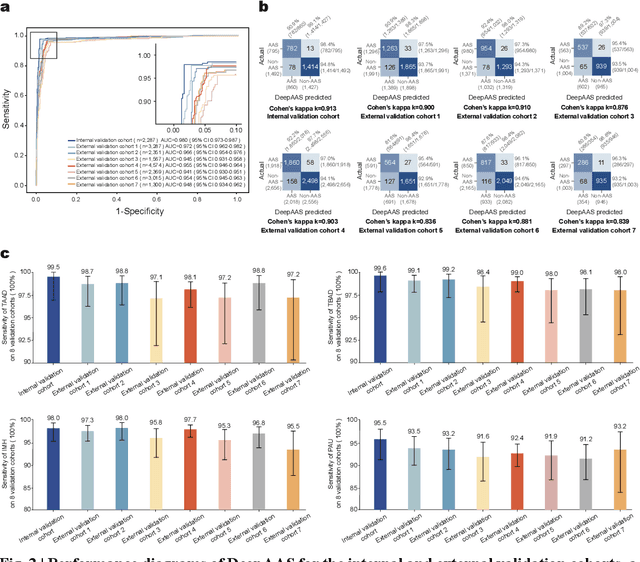

Chest pain symptoms are highly prevalent in emergency departments (EDs), where acute aortic syndrome (AAS) is a catastrophic cardiovascular emergency with a high fatality rate, especially when timely and accurate treatment is not administered. However, current triage practices in the ED can cause up to approximately half of patients with AAS to have an initially missed diagnosis or be misdiagnosed as having other acute chest pain conditions. Subsequently, these AAS patients will undergo clinically inaccurate or suboptimal differential diagnosis. Fortunately, even under these suboptimal protocols, nearly all these patients underwent non-contrast CT covering the aorta anatomy at the early stage of differential diagnosis. In this study, we developed an artificial intelligence model (DeepAAS) using non-contrast CT, which is highly accurate for identifying AAS and provides interpretable results to assist in clinical decision-making. Performance was assessed in two major phases: a multi-center retrospective study (n = 20,750) and an exploration in real-world emergency scenarios (n = 137,525). In the multi-center cohort, DeepAAS achieved a mean area under the receiver operating characteristic curve of 0.958 (95% CI 0.950-0.967). In the real-world cohort, DeepAAS detected 109 AAS patients with misguided initial suspicion, achieving 92.6% (95% CI 76.2%-97.5%) in mean sensitivity and 99.2% (95% CI 99.1%-99.3%) in mean specificity. Our AI model performed well on non-contrast CT at all applicable early stages of differential diagnosis workflows, effectively reduced the overall missed diagnosis and misdiagnosis rate from 48.8% to 4.8% and shortened the diagnosis time for patients with misguided initial suspicion from an average of 681.8 (74-11,820) mins to 68.5 (23-195) mins. DeepAAS could effectively fill the gap in the current clinical workflow without requiring additional tests.
PNODE: A memory-efficient neural ODE framework based on high-level adjoint differentiation
Jun 02, 2022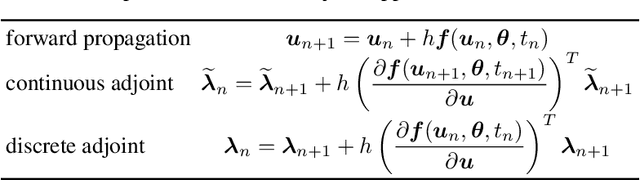

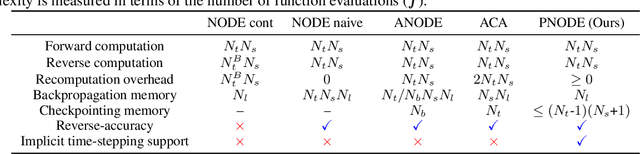
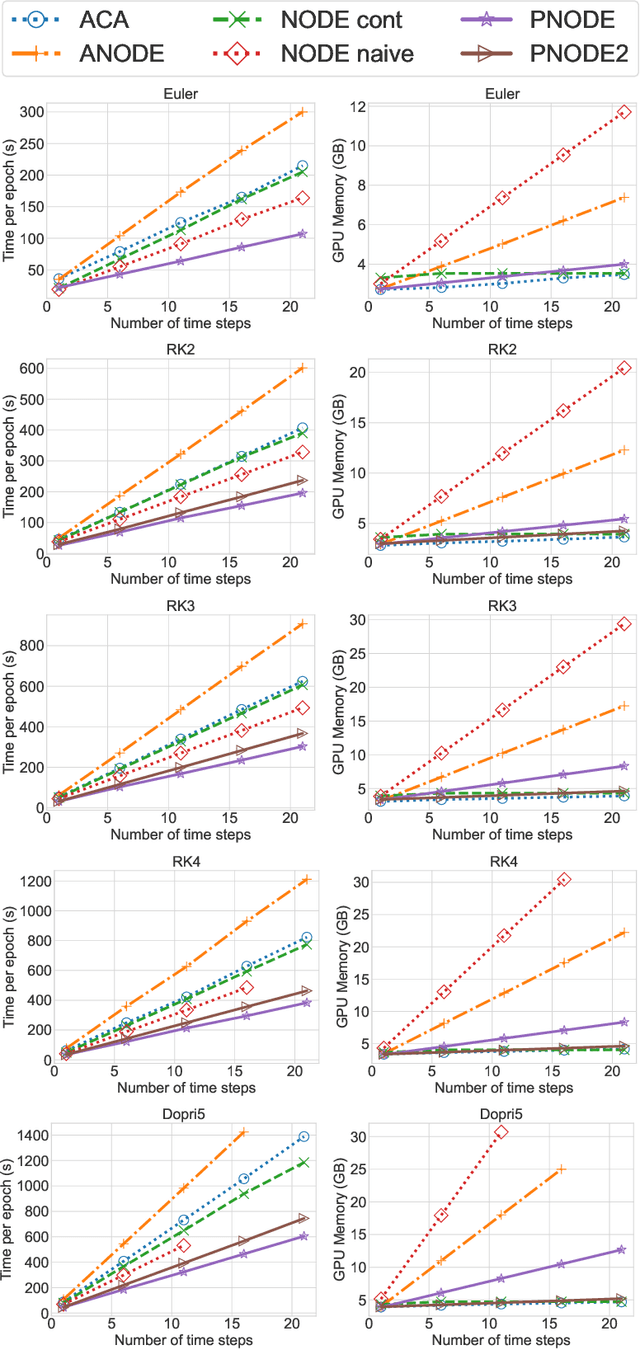
Neural ordinary differential equations (neural ODEs) have emerged as a novel network architecture that bridges dynamical systems and deep learning. However, the gradient obtained with the continuous adjoint method in the vanilla neural ODE is not reverse-accurate. Other approaches suffer either from excessive memory requirement due to deep computational graphs or from limited choices for the time integration scheme, hampering their application to large-scale complex dynamical systems. To achieve accurate gradients without compromising memory efficiency and flexibility, we present a new neural ODE framework, PNODE, based on high-level discrete adjoint algorithmic differentiation. By leveraging discrete adjoint time integrators and advanced checkpointing strategies tailored for these integrators, PNODE can provide a balance between memory and computational costs, while computing the gradients consistently and accurately. We provide an open-source implementation based on PyTorch and PETSc, one of the most commonly used portable, scalable scientific computing libraries. We demonstrate the performance through extensive numerical experiments on image classification and continuous normalizing flow problems. We show that PNODE achieves the highest memory efficiency when compared with other reverse-accurate methods. On the image classification problems, PNODE is up to two times faster than the vanilla neural ODE and up to 2.3 times faster than the best existing reverse-accurate method. We also show that PNODE enables the use of the implicit time integration methods that are needed for stiff dynamical systems.