 Add to Chrome
 Add to Firefox
 Add to Edge
ScienceFlow: A long-horizon agent for ML research, scientific discovery and beyond
Aug 14, 2026
Enabling LLM agents to sustain productive, stable, and goal-aligned research over extended horizons is a central challenge for autonomous machine learning and scientific discovery, as progress hinges on continuously managing evolving state, exploration decisions, and computational resources. Pioneering autoresearch agents, despite great success, still lack mechanisms for continuity, recovery from dead ends, and value-driven compute allocation, which inherently undermines overall search efficiency, wastes computational resources, and lowers the chance of ultimate success. To bridge this gap, we introduce ScienceFlow, an end-to-end autoresearch agent framework that organizes long-horizon research work into research segments grounded in executable workspaces. It represents research progress as recoverable executable states, enabling efficient exploration, revision, and execution. Transitions between research segments are governed by Executable-State Transition through Re-Anchoring (ESTRA), which selects either the live state or an archived state as the next anchor and determines whether to continue or redirect the research trajectory. An evidence-aware execution controller allocates resources to physical jobs based on resource availability, remaining budget, and validated progress. We evaluate ScienceFlow on tasks spanning machine learning, scientific modeling, and mathematical optimization. Results on diverse long-horizon benchmarks demonstrate its ability to sustain effective research processes, highlighted by a SOTA 70.22 percent Any-Medal score on the full MLE-bench within a 24-hour budget, outperforming prior reported results by 4.92 percentage points. The efficacy of ScienceFlow further demonstrates that efficient state management, adaptive exploration, and objective-aligned execution are critical for scaling autonomous research beyond short-horizon interactions.

Universality of parametric Coupling Flows over parametric diffeomorphisms
Feb 08, 2022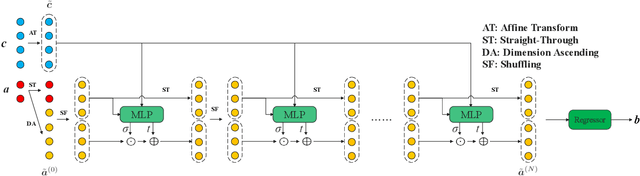
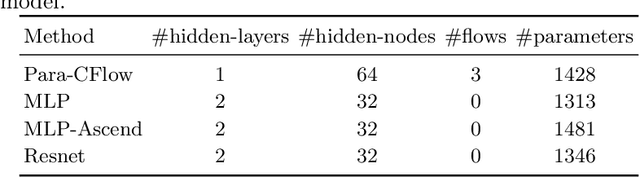
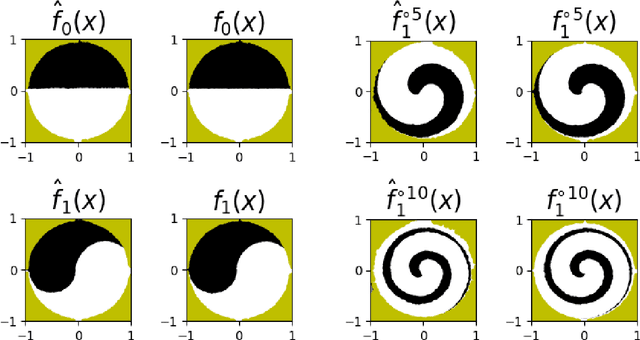
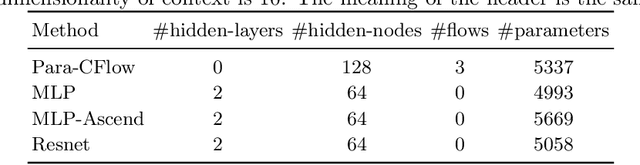
Invertible neural networks based on Coupling Flows CFlows) have various applications such as image synthesis and data compression. The approximation universality for CFlows is of paramount importance to ensure the model expressiveness. In this paper, we prove that CFlows can approximate any diffeomorphism in C^k-norm if its layers can approximate certain single-coordinate transforms. Specifically, we derive that a composition of affine coupling layers and invertible linear transforms achieves this universality. Furthermore, in parametric cases where the diffeomorphism depends on some extra parameters, we prove the corresponding approximation theorems for our proposed parametric coupling flows named Para-CFlows. In practice, we apply Para-CFlows as a neural surrogate model in contextual Bayesian optimization tasks, to demonstrate its superiority over other neural surrogate models in terms of optimization performance.