 Add to Chrome
 Add to Firefox
 Add to Edge
Detecting Hallucinations in Retrieval-Augmented Generation via Semantic-level Internal Reasoning Graph
Jan 06, 2026
The Retrieval-augmented generation (RAG) system based on Large language model (LLM) has made significant progress. It can effectively reduce factuality hallucinations, but faithfulness hallucinations still exist. Previous methods for detecting faithfulness hallucinations either neglect to capture the models' internal reasoning processes or handle those features coarsely, making it difficult for discriminators to learn. This paper proposes a semantic-level internal reasoning graph-based method for detecting faithfulness hallucination. Specifically, we first extend the layer-wise relevance propagation algorithm from the token level to the semantic level, constructing an internal reasoning graph based on attribution vectors. This provides a more faithful semantic-level representation of dependency. Furthermore, we design a general framework based on a small pre-trained language model to utilize the dependencies in LLM's reasoning for training and hallucination detection, which can dynamically adjust the pass rate of correct samples through a threshold. Experimental results demonstrate that our method achieves better overall performance compared to state-of-the-art baselines on RAGTruth and Dolly-15k.

Generic Reversible Visible Watermarking Via Regularized Graph Fourier Transform Coding
May 18, 2021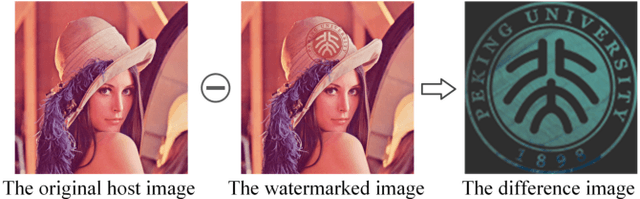
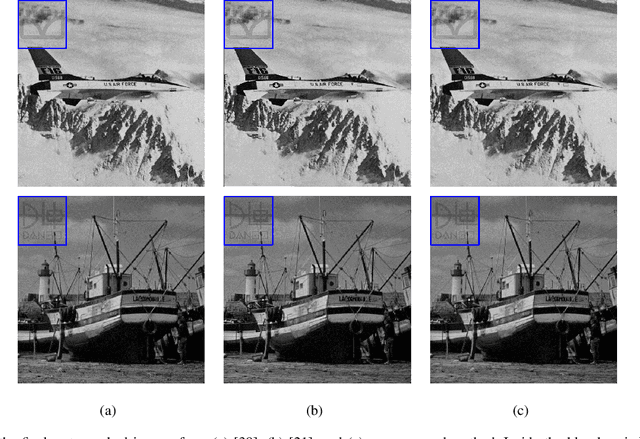
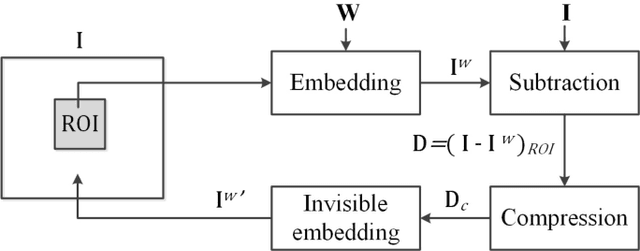
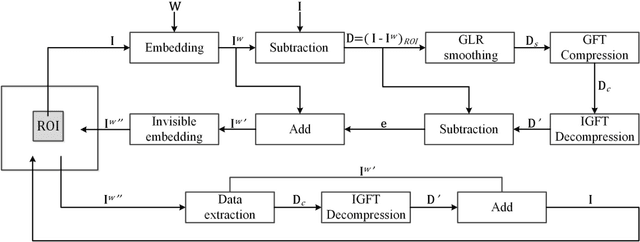
Reversible visible watermarking (RVW) is an active copyright protection mechanism. It not only transparently superimposes copyright patterns on specific positions of digital images or video frames to declare the copyright ownership information, but also completely erases the visible watermark image and thus enables restoring the original host image without any distortion. However, existing RVW algorithms mostly construct the reversible mapping mechanism for a specific visible watermarking scheme, which is not general. Hence, we propose a generic RVW framework to accommodate various visible watermarking schemes, which is based on Regularized Graph Fourier Transform (GFT) coding. In particular, we obtain a reconstruction data packet -- the compressed difference image between the watermarked image and the original host image, which is embedded into the watermarked image via any conventional reversible data hiding method to facilitate the blind recovery of the host image. The key is to achieve compact compression of the difference image for efficient embedding of the reconstruction data packet. To this end, we propose regularized GFT coding, where the difference image is smoothed via the graph Laplacian regularizer for more efficient compression and then encoded by multi-resolution GFTs in an approximately optimal manner. Experimental results show that the proposed method achieves the state-of-the-art performance with high data compression efficiency, which is applicable to both gray-scale and color images. In addition, the proposed generic framework accommodates various visible watermarking algorithms, which demonstrates strong versatility.