 Add to Chrome
 Add to Firefox
 Add to Edge
Is There Really a Camouflaged Object? Towards Realistic Camouflaged Object Detection
Aug 11, 2026
Camouflaged object detection (COD) aims to segment objects that are visually concealed in their surroundings and has attracted increasing attention in recent years. However, most existing COD methods are developed under a closed-world assumption, where each input image is assumed to contain a camouflaged object. This assumption ignores realistic scenarios with pure backgrounds or non-camouflaged objects, causing existing models to produce severe false positives when deployed in open-world environments. To address this limitation, we propose OPC16K, a large-scale benchmark for realistic COD. OPC16K contains 16,245 images from 14 sources and is carefully organized into camouflaged-object images, pure background images, and non-camouflaged-object images, enabling comprehensive evaluation of both segmentation quality and negative-sample rejection. Based on this benchmark, we further propose OPCNet, a presence-aware camouflage network that reformulates COD from a pure segmentation task into a joint problem of object localization and camouflage existence reasoning. Specifically, OPCNet introduces hierarchical existence reasoning to distinguish CO, BG, and NOCOD scenarios, similarity-aware camouflage relation modeling to capture foreground-background camouflage cues, and existence-aware feature refinement to regulate segmentation features with existence predictions. Extensive experiments on OPC16K demonstrate that OPCNet achieves superior performance under the proposed realistic COD evaluation protocol, significantly reducing false positives on negative samples while maintaining accurate camouflaged-object segmentation. Code and dataset will be released at https://github.com/2231122/OPCOD.

AURORA-LM: Autoencoding Unified Representation for Continuous-Latent Diffusion Language Modeling
Aug 03, 2026Language remains an outlier in generative modeling: while images, video, and audio are increasingly modeled in continuous latent spaces, text generation still relies predominantly on discrete tokens. Existing continuous language models either inherit embedding spaces not designed for joint generation and decoding, or compress autoencoded latents to ease diffusion, sacrificing token-level fidelity. Instead of simplifying the representation to suit the generative model, we preserve a high-capacity, decodable text latent and design the diffusion model to learn its distribution directly. We introduce AURORA-LM, a continuous-latent diffusion language model that separates the construction of a decodable text representation from the modeling of its distribution. A Query-based Encoder-Decoder organizes text into a high-capacity, prefix-aligned latent sequence, and a Block-causal Diffusion Transformer learns its distribution through flow matching, generating blocks left to right while denoising positions within each block in parallel. Because such a latent is harder for diffusion to model, AURORA-LM restricts only the noisy-input pathway while retaining the full clean-latent prediction target, accommodating full-width latents without reducing decoder-facing capacity. We further calibrate the noise-level distribution to the latent width, and introduce self-trajectory consistency to bridge independently sampled training noise and iterative denoising at inference. AURORA-LM achieves the strongest performance among evaluated continuous and diffusion-based language models on OpenWebText free generation and XSum summarization. Scaling to 1B parameters with about 1500 EFLOPs of total compute yields further gains, surpassing a larger publicly released latent-diffusion language model under a matched evaluation protocol. All experiments are conducted on Ascend NPUs.
TZC: Efficient Inter-Process Communication for Robotics Middleware with Partial Serialization
Mar 01, 2019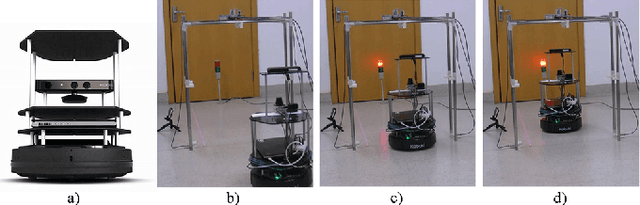
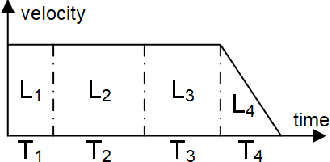
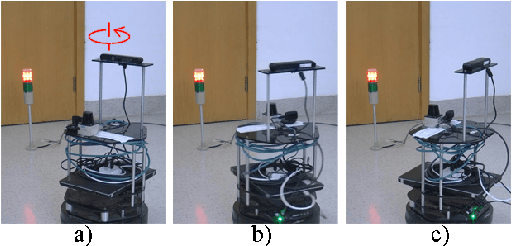
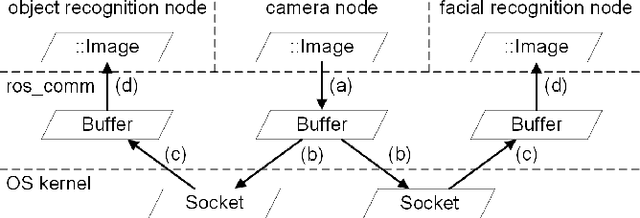
Inter-process communication (IPC) is one of the core functions of modern robotics middleware. We propose an efficient IPC technique called TZC (Towards Zero-Copy). As a core component of TZC, we design a novel algorithm called partial serialization. Our formulation can generate messages that can be divided into two parts. During message transmission, one part is transmitted through a socket and the other part uses shared memory. The part within shared memory is never copied or serialized during its lifetime. We have integrated TZC with ROS and ROS2 and find that TZC can be easily combined with current open-source platforms. By using TZC, the overhead of IPC remains constant when the message size grows. In particular, when the message size is 4MB (less than the size of a full HD image), TZC can reduce the overhead of ROS IPC from tens of milliseconds to hundreds of microseconds and can reduce the overhead of ROS2 IPC from hundreds of milliseconds to less than 1 millisecond. We also demonstrate the benefits of TZC by integrating with TurtleBot2 that are used in autonomous driving scenarios. We show that by using TZC, the braking distance can be shortened by 16% than ROS.