 Add to Chrome
 Add to Firefox
 Add to Edge
SurgRFO: Foundation Model Based Compositional Synthesis of Critical Retained Foreign Objects in Intraoperative Chest X-rays
May 24, 2026
Critical retained foreign objects (RFOs) on intraoperative chest radiographs are rare but high-risk events. Their scarcity limits robust automated detection model training and generalization. We introduce SurgRFO, a two-stage synthesis framework for generating realistic RFO-present intraoperative chest X-rays. In Stage 1, a Roentgen chest X-ray foundation model is fine-tuned on surgical-domain images to generate realistic RFO-free backgrounds that preserve anatomy, indwelling lines and tubes, and intraoperative imaging characteristics. In Stage 2, a lightweight generator trained on localized RFO patches from limited positive cases synthesizes diverse RFO instances, which are composited onto generated backgrounds using conditional Poisson fusion to improve photometric consistency. We evaluate SurgRFO through (i) a blinded clinician study assessing realism and clinical plausibility, and (ii) downstream detection experiments in which synthesized data are used to augment Faster R-CNN, YOLOv8, and RetinaNet. SurgRFO consistently improves sensitivity at low false-positive-per-image (FPPI) operating points on internal and external test sets. Clinician ratings indicate that the synthesized images achieve realism comparable to real intraoperative images. Ablation analyses further examine fusion strategies and synthesis scale. Ethical safeguards for synthetic surgical data are also discussed.

Optimizing Prompt Strategies for SAM: Advancing lesion Segmentation Across Diverse Medical Imaging Modalities
Dec 28, 2024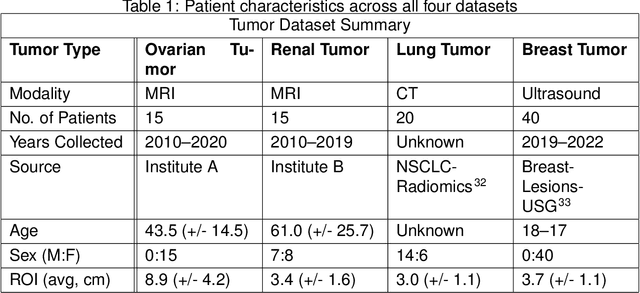
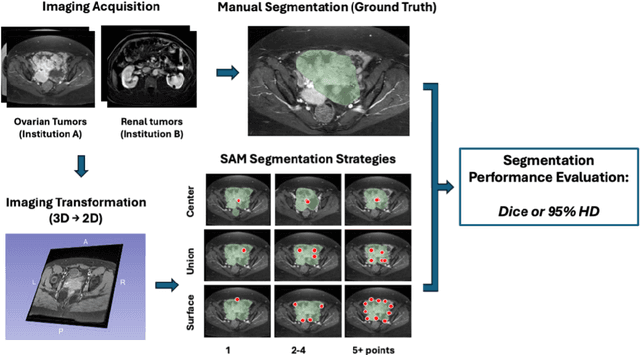
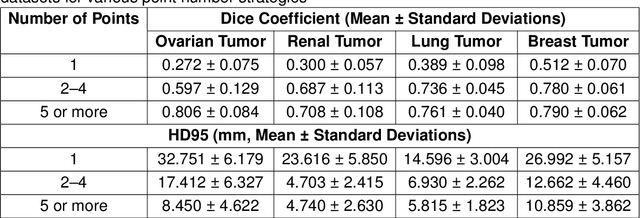
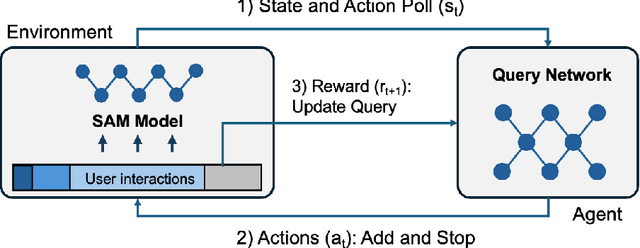
Purpose: To evaluate various Segmental Anything Model (SAM) prompt strategies across four lesions datasets and to subsequently develop a reinforcement learning (RL) agent to optimize SAM prompt placement. Materials and Methods: This retrospective study included patients with four independent ovarian, lung, renal, and breast tumor datasets. Manual segmentation and SAM-assisted segmentation were performed for all lesions. A RL model was developed to predict and select SAM points to maximize segmentation performance. Statistical analysis of segmentation was conducted using pairwise t-tests. Results: Results show that increasing the number of prompt points significantly improves segmentation accuracy, with Dice coefficients rising from 0.272 for a single point to 0.806 for five or more points in ovarian tumors. The prompt location also influenced performance, with surface and union-based prompts outperforming center-based prompts, achieving mean Dice coefficients of 0.604 and 0.724 for ovarian and breast tumors, respectively. The RL agent achieved a peak Dice coefficient of 0.595 for ovarian tumors, outperforming random and alternative RL strategies. Additionally, it significantly reduced segmentation time, achieving a nearly 10-fold improvement compared to manual methods using SAM. Conclusion: While increased SAM prompts and non-centered prompts generally improved segmentation accuracy, each pathology and modality has specific optimal thresholds and placement strategies. Our RL agent achieved superior performance compared to other agents while achieving a significant reduction in segmentation time.
Optimizing prompt strategies for the Segment Anything Model are explored, focusing on prompt location, number, and reinforcement learning-based agent for prompt placement across four lesion datasets
Dec 23, 2024Purpose: To evaluate various Segmental Anything Model (SAM) prompt strategies across four lesions datasets and to subsequently develop a reinforcement learning (RL) agent to optimize SAM prompt placement. Materials and Methods: This retrospective study included patients with four independent ovarian, lung, renal, and breast tumor datasets. Manual segmentation and SAM-assisted segmentation were performed for all lesions. A RL model was developed to predict and select SAM points to maximize segmentation performance. Statistical analysis of segmentation was conducted using pairwise t-tests. Results: Results show that increasing the number of prompt points significantly improves segmentation accuracy, with Dice coefficients rising from 0.272 for a single point to 0.806 for five or more points in ovarian tumors. The prompt location also influenced performance, with surface and union-based prompts outperforming center-based prompts, achieving mean Dice coefficients of 0.604 and 0.724 for ovarian and breast tumors, respectively. The RL agent achieved a peak Dice coefficient of 0.595 for ovarian tumors, outperforming random and alternative RL strategies. Additionally, it significantly reduced segmentation time, achieving a nearly 10-fold improvement compared to manual methods using SAM. Conclusion: While increased SAM prompts and non-centered prompts generally improved segmentation accuracy, each pathology and modality has specific optimal thresholds and placement strategies. Our RL agent achieved superior performance compared to other agents while achieving a significant reduction in segmentation time.