 Add to Chrome
 Add to Firefox
 Add to Edge
DiagChain: A Diagnostic Benchmark for Evaluating LLM Agents on Evidence-Grounded Attack Chain Reconstruction
Aug 04, 2026
Large Language Model (LLM) agents offer a promising approach to attack chain reconstruction by retrieving and interpreting heterogeneous telemetry to infer ordered attacker actions. However, existing benchmarks mainly evaluate final outputs or aggregate accuracy, providing limited insight into how errors arise and propagate across intermediate reasoning stages. We present DiagChain, a diagnostic benchmark for evidence-grounded attack chain reconstruction that enables stage-wise evaluation of LLM agents. DiagChain includes MAIN-69, a suite of 69 scenarios spanning multiple operating systems, evidence noise levels, and chain lengths. It further introduces Evidence-Centric Retrieval-Augmented Generation (ECRAG), which couples evidence retrieval with an evolving structured representation of the reconstructed chain. Five complementary metrics are introduced to assess distinct stages of the reconstruction process and support systematic failure diagnosis. Based on evaluations using 6 LLMs, DiagChain reveals that even the strongest configuration succeeds on only 39.6% of the 849 reference steps in MAIN-69. Our analysis further shows that smaller models struggle with the more basic task of incorporating retrieved evidence into their outputs, whereas larger models can proceed to later steps, where correctly ordering that evidence becomes the main bottleneck. These results validate the importance of diagnostic evaluation beyond end-to-end accuracy and provide actionable insights for improving evidence-grounded cybersecurity agents.

SE(3)-Equivariant Ternary Complex Prediction Towards Target Protein Degradation
Feb 26, 2025
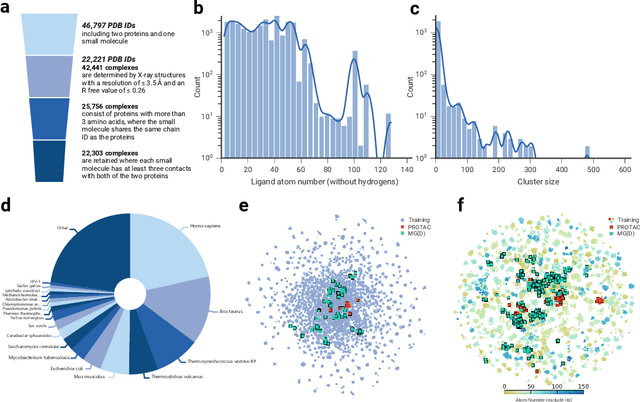


Targeted protein degradation (TPD) induced by small molecules has emerged as a rapidly evolving modality in drug discovery, targeting proteins traditionally considered "undruggable". Proteolysis-targeting chimeras (PROTACs) and molecular glue degraders (MGDs) are the primary small molecules that induce TPD. Both types of molecules form a ternary complex linking an E3 ligase with a target protein, a crucial step for drug discovery. While significant advances have been made in binary structure prediction for proteins and small molecules, ternary structure prediction remains challenging due to obscure interaction mechanisms and insufficient training data. Traditional methods relying on manually assigned rules perform poorly and are computationally demanding due to extensive random sampling. In this work, we introduce DeepTernary, a novel deep learning-based approach that directly predicts ternary structures in an end-to-end manner using an encoder-decoder architecture. DeepTernary leverages an SE(3)-equivariant graph neural network (GNN) with both intra-graph and ternary inter-graph attention mechanisms to capture intricate ternary interactions from our collected high-quality training dataset, TernaryDB. The proposed query-based Pocket Points Decoder extracts the 3D structure of the final binding ternary complex from learned ternary embeddings, demonstrating state-of-the-art accuracy and speed in existing PROTAC benchmarks without prior knowledge from known PROTACs. It also achieves notable accuracy on the more challenging MGD benchmark under the blind docking protocol. Remarkably, our experiments reveal that the buried surface area calculated from predicted structures correlates with experimentally obtained degradation potency-related metrics. Consequently, DeepTernary shows potential in effectively assisting and accelerating the development of TPDs for previously undruggable targets.