 Add to Chrome
 Add to Firefox
 Add to Edge
Movable Antennas for Robust Wireless Sensing via Joint Cramér-Rao Bound and Sidelobe Minimization
Jun 22, 2026
This paper presents a novel design approach for movable antenna (MA)-enabled wireless sensing systems by jointly minimizing the Cramér-Rao bound (CRB) and the maximum sidelobe level (MSL) of the ambiguity function via antenna position optimization. In particular, the mean squared error (MSE) of angle-of-arrival (AoA) estimation is decomposed into a local estimation error within the mainlobe of the ambiguity function (i.e., CRB) and an additional ambiguity error caused by its sidelobes. Since the MSE is dominated by the CRB in the high-signal-to-noise ratio (SNR) regime but by the sidelobes of the ambiguity function in the low-SNR regime, our analysis reveals a fundamental trade-off between CRB minimization and MSL minimization in the moderate-SNR regime. Specifically, minimizing the CRB prefers a narrower mainlobe, where antennas are concentrated near the two edges of the one-dimensional (1-D) movement region; whereas minimizing the MSL favors a wider mainlobe, where antennas are distributed more densely near the center of the movement region. Inspired by this and to ensure robust sensing performance across different SNR regimes, we formulate an optimization problem to minimize the CRB subject to a prescribed MSL constraint via antenna position optimization. An efficient successive convex approximation (SCA) algorithm is developed to optimize the antenna position vector (APV), and a 1-D linear search method is proposed to determine the optimal MSL threshold that minimizes the actual MSE for any given SNR. Numerical results demonstrate that the proposed scheme effectively balances the trade-off between MSL and CRB minimization, thus achieving a significantly lower AoA estimation MSE across the entire SNR range compared to conventional uniform and non-uniform fixed-position antenna (FPA) arrays.

Cognitive-Driven Optimization of Sparse Array Transceiver for MIMO Radar Beamforming
Mar 04, 2021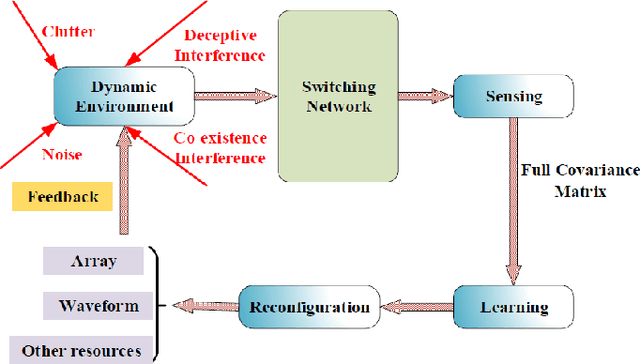

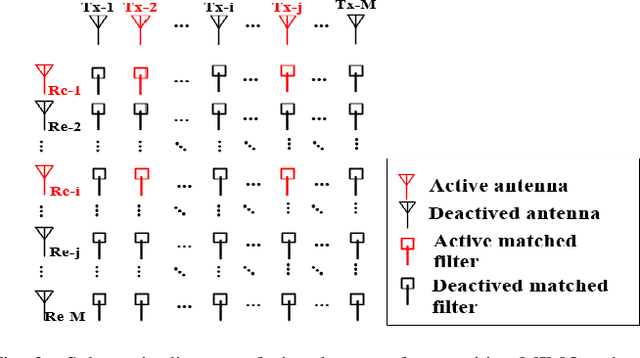
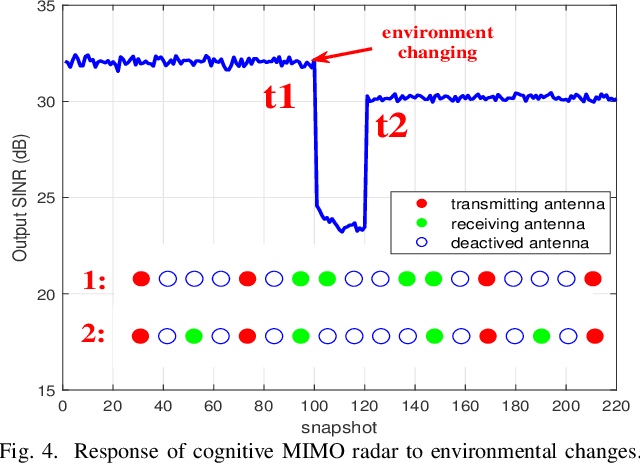
Cognitive multiple-input multiple-output (MIMO) radar is capable of adjusting system parameters adaptively by sensing and learning in complex dynamic environment. Beamforming performance of MIMO radar is guided by both beamforming weight coefficients and the transceiver configuration. We propose a cognitive-driven MIMO array design where both the beamforming weights and the transceiver configuration are adaptively and concurrently optimized under different environmental conditions. The perception-action cycle involves data collection of full virtual array, covariance reconstruction and joint design of the transmit and receive arrays by antenna selection.The optimal transceiver array design is realized by promoting two-dimensional group sparsity via iteratively minimizing reweighted mixed L21-norm, with constraints imposed on transceiver antenna spacing for proper transmit/receive isolation. Simulations are provided to demonstrate the "perception-action" capability of the proposed cognitive sparse MIMO array in achieving enhanced beamforming and anti-jamming in dynamic target and interference environment.
Sparse Array Transceiver Design for Enhanced Adaptive Beamforming in MIMO Radar
Feb 20, 2021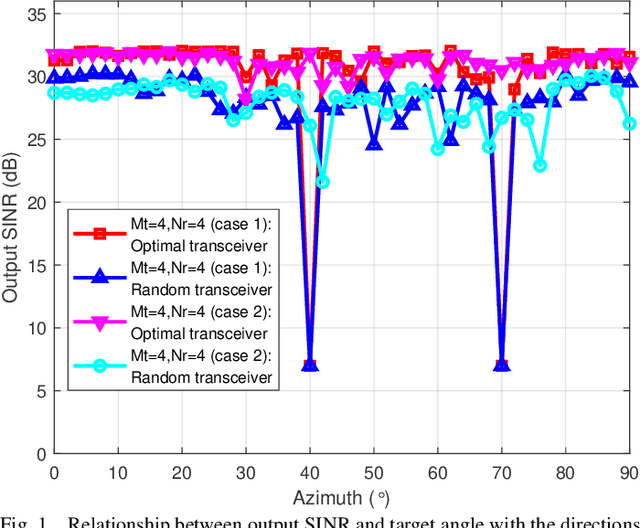
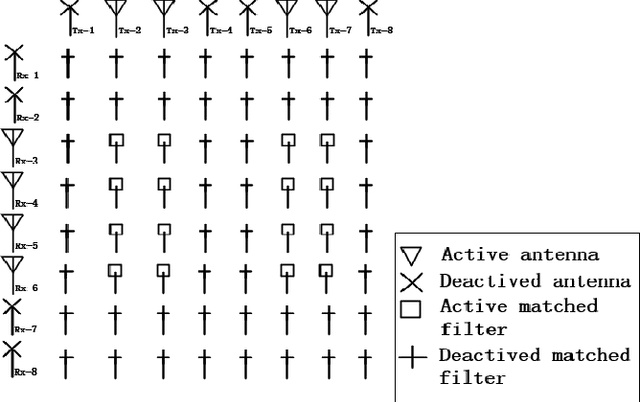
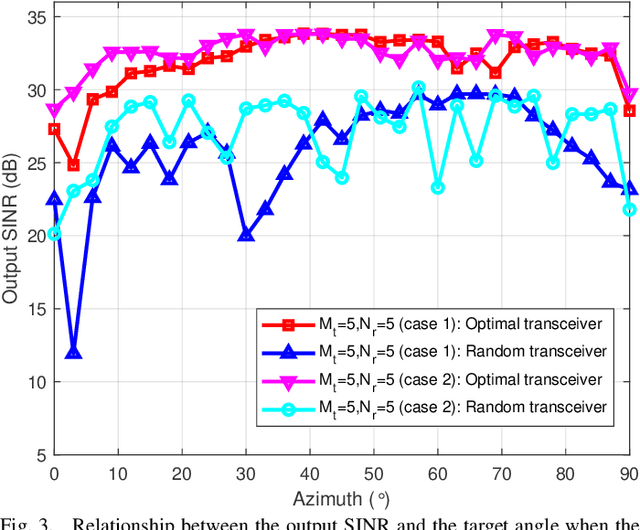
Sparse array design aided by emerging fast sensor switching technologies can lower the overall system overhead by reducing the number of expensive transceiver chains. In this paper, we examine the active sparse array design enabling the maximum signal to interference plus noise ratio (MaxSINR) beamforming at the MIMO radar receiver. The proposed approach entails an entwined design, i.e., jointly selecting the optimum transmit and receive sensor locations for accomplishing MaxSINR receive beamforming. Specifically, we consider a co-located multiple-input multiple-output (MIMO) radar platform with orthogonal transmitted waveforms, and examine antenna selections at the transmit and receive arrays. The optimum active sparse array transceiver design problem is formulated as successive convex approximation (SCA) alongside the two-dimensional group sparsity promoting regularization. Several examples are provided to demonstrate the effectiveness of the proposed approach in utilizing the given transmit/receive array aperture and degrees of freedom for achieving MaxSINR beamforming.