 Add to Chrome
 Add to Firefox
 Add to Edge
ML-Guided Primal Heuristics for Mixed Binary Quadratic Programs
Apr 24, 2026
Mixed Binary Quadratic Programs (MBQPs) are an important and complex set of problems in combinatorial optimization. As solving large-scale combinatorial optimization problems is challenging, primal heuristics have been developed to quickly identify high-quality solutions within a short amount of time. Recently, a growing body of research has also used machine learning to accelerate solution methods for challenging combinatorial optimization problems. Despite the increasing popularity of these ML-guided methods, a large body of work has focused on Mixed-Integer Linear Programs (MILPs). MBQPs are challenging to solve due to the combinatorial complexity coupled with nonlinearities. This work proposes ML-guided primal heuristics for Mixed Binary Quadratic Programs (MBQPs) by adapting and extending existing work on ML-guided MILP solution prediction to MBQPs. We introduce a new neural network architecture for MBQP solution prediction and a new training data collection procedure. Moreover, we extend existing loss functions in solution prediction and propose to combine contrastive and weighted cross-entropy losses. We evaluate the methods on standard and real-world MBQP benchmarks and show that the developed ML-guided methods significantly outperform existing primal heuristics and state-of-the-art solvers. Furthermore, models trained with our proposed extension with combined losses outperform other ML-based methods adapted from MILPs and improve generalization in cross-regional inference on a real-world wind farm layout optimization problem.

Distributional MIPLIB: a Multi-Domain Library for Advancing ML-Guided MILP Methods
Jun 11, 2024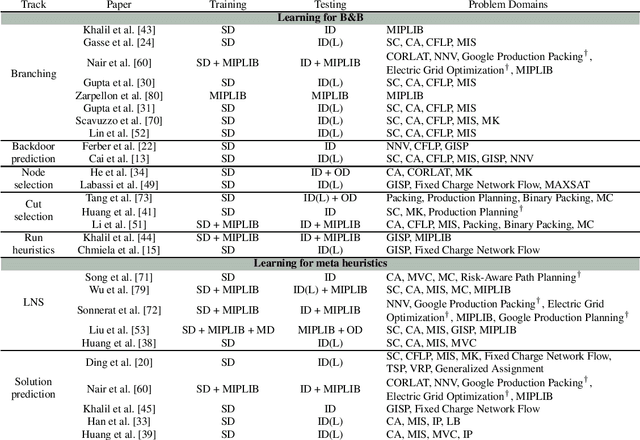
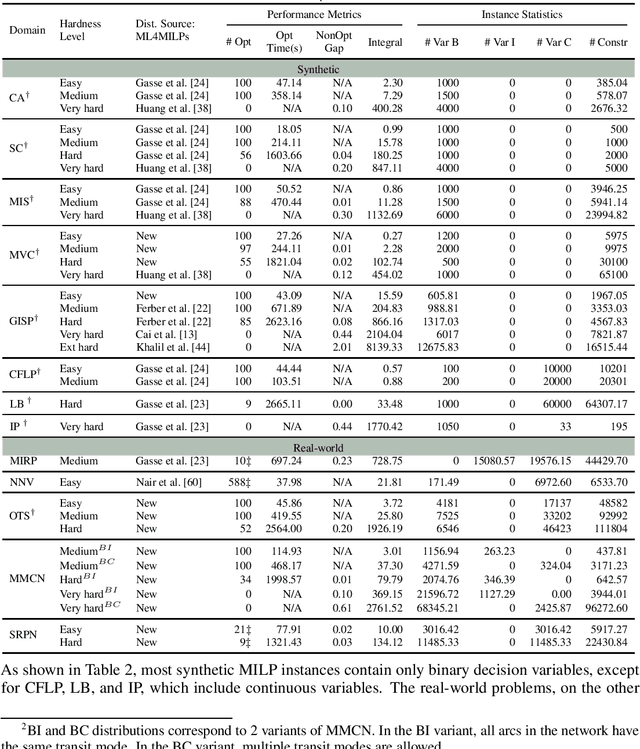
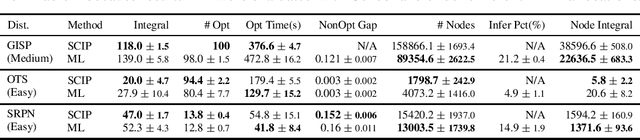
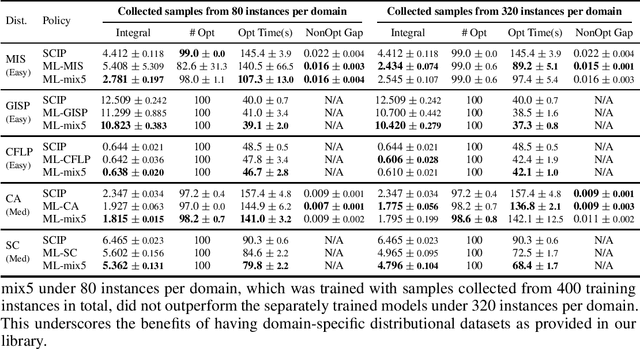
Mixed Integer Linear Programming (MILP) is a fundamental tool for modeling combinatorial optimization problems. Recently, a growing body of research has used machine learning to accelerate MILP solving. Despite the increasing popularity of this approach, there is a lack of a common repository that provides distributions of similar MILP instances across different domains, at different hardness levels, with standardized test sets. In this paper, we introduce Distributional MIPLIB, a multi-domain library of problem distributions for advancing ML-guided MILP methods. We curate MILP distributions from existing work in this area as well as real-world problems that have not been used, and classify them into different hardness levels. It will facilitate research in this area by enabling comprehensive evaluation on diverse and realistic domains. We empirically illustrate the benefits of using Distributional MIPLIB as a research vehicle in two ways. We evaluate the performance of ML-guided variable branching on previously unused distributions to identify potential areas for improvement. Moreover, we propose to learn branching policies from a mix of distributions, demonstrating that mixed distributions achieve better performance compared to homogeneous distributions when there is limited data and generalize well to larger instances.
Walkability Optimization: Formulations, Algorithms, and a Case Study of Toronto
Dec 10, 2022The concept of walkable urban development has gained increased attention due to its public health, economic, and environmental sustainability benefits. Unfortunately, land zoning and historic under-investment have resulted in spatial inequality in walkability and social inequality among residents. We tackle the problem of Walkability Optimization through the lens of combinatorial optimization. The task is to select locations in which additional amenities (e.g., grocery stores, schools, restaurants) can be allocated to improve resident access via walking while taking into account existing amenities and providing multiple options (e.g., for restaurants). To this end, we derive Mixed-Integer Linear Programming (MILP) and Constraint Programming (CP) models. Moreover, we show that the problem's objective function is submodular in special cases, which motivates an efficient greedy heuristic. We conduct a case study on 31 underserved neighborhoods in the City of Toronto, Canada. MILP finds the best solutions in most scenarios but does not scale well with network size. The greedy algorithm scales well and finds near-optimal solutions. Our empirical evaluation shows that neighbourhoods with low walkability have a great potential for transformation into pedestrian-friendly neighbourhoods by strategically placing new amenities. Allocating 3 additional grocery stores, schools, and restaurants can improve the "WalkScore" by more than 50 points (on a scale of 100) for 4 neighbourhoods and reduce the walking distances to amenities for 75% of all residential locations to 10 minutes for all amenity types. Our code and paper appendix are available at https://github.com/khalil-research/walkability.